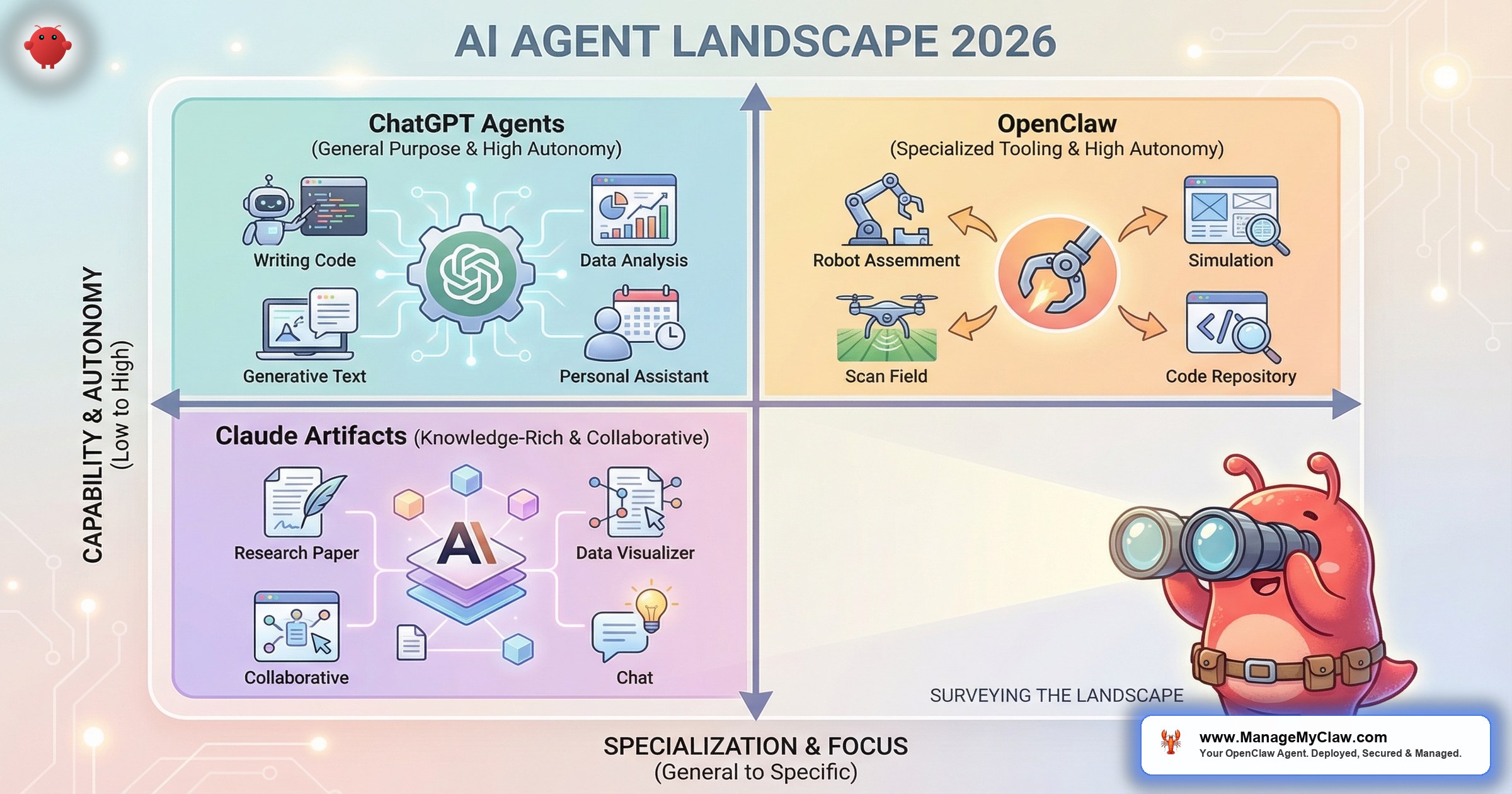
Gartner projects 40% of enterprise applications will include agentic AI capabilities by end of 2026. The agentic AI market is projected at $9 billion for 2026 alone. And the landscape is fragmenting fast: OpenClaw dominates open-source, Manus launched as a cloud-native agent platform, OpenAI released ChatGPT Agents as a plugin layer, and Anthropic’s Claude Artifacts provide agent-like capabilities within the Claude interface.
The question isn’t “which one is best.” It’s which one fits your use case, your infrastructure preferences, and your risk tolerance. Each platform makes fundamentally different tradeoffs between control, convenience, cost, and privacy.
Choosing an AI agent platform based on hype is how you end up in the 80% of companies that see zero productivity gains from AI.
The Comparison Table
| Feature | OpenClaw | Manus | ChatGPT Agents | Claude Artifacts |
|---|---|---|---|---|
| Deployment | Self-hosted (VPS, Mac Mini, Pi) | Cloud-hosted (their infra) | Cloud-hosted (OpenAI) | Cloud-hosted (Anthropic) |
| Data privacy | Full control (your server) | Vendor-controlled | OpenAI sees all data | Anthropic sees all data |
| Model choice | Any (Anthropic, OpenAI, local) | Multi-model (their routing) | GPT models only | Claude models only |
| Pricing | $12–$24/mo hosting + API costs | $39/mo + usage fees | $20/mo (ChatGPT Plus) | $20/mo (Claude Pro) |
| Custom tools | 13,729+ skills + custom | Plugin marketplace | Actions + API calls | Limited to Claude features |
| Automation | Full (cron, webhooks, 24/7) | Full (cloud-managed) | Limited (conversation-based) | Limited (conversation-based) |
| Setup difficulty | High (15+ hrs DIY) | Low (SaaS) | Very low (built-in) | Very low (built-in) |
| GitHub stars | 250,000+ | N/A (closed source) | N/A (closed source) | N/A (closed source) |
OpenClaw: Maximum Control, Maximum Responsibility
OpenClaw is the open-source option. 250,000+ GitHub stars, 196 contributors, 13,729+ skills on ClawHub. You deploy it on your own infrastructure — VPS, Mac Mini, or Raspberry Pi. You choose the AI model (Anthropic, OpenAI, or local). You control the data.
Strengths: Full customization. Any model. Custom skills. Cron-based automation that runs 24/7 without an open browser tab. Thriving open-source community. No vendor lock-in.
Weaknesses: 15+ hours of setup time for a proper deployment. 9 disclosed CVEs. The ClawHavoc attack exposed the skill marketplace’s vulnerability. Ongoing maintenance burden — 7 updates in 2 weeks, each potentially breaking your config.
Best for: Founders who want AI automation running 24/7 on their own infrastructure, with full control over data, models, and configuration. The DIY path costs $3,000-$7,500 in time. Services like ManageMyClaw reduce that to under 60 minutes at a fraction of the cost.
Manus: The Cloud-Native Agent
Manus launched as a fully cloud-hosted agent platform. You don’t deploy anything — sign up, connect your tools, and start building automations. It routes tasks across multiple models for cost optimization (similar to ClawRouter but managed for you).
Strengths: Zero infrastructure management. Multi-model routing built in. Clean web interface for building automations.
Weaknesses: Closed source. Your data runs through their servers. Limited customization compared to OpenClaw. Vendor lock-in — switching away means rebuilding everything. Newer platform with less community validation.
Best for: Teams that want cloud-managed automation without infrastructure responsibility and are comfortable with their data on a third-party platform.
ChatGPT Agents: Convenience with Constraints
OpenAI’s ChatGPT Agents add tool-use and automation capabilities to the ChatGPT interface. Build a custom GPT, connect it to external APIs through Actions, and it can browse the web, run code, and interact with connected services.
Strengths: Easiest to get started. No deployment, no infrastructure, no configuration files. Built into a product 200+ million people already use. GPT-4’s reasoning capabilities are strong.
Weaknesses: Conversation-based — the agent doesn’t run 24/7 on a cron schedule. No background automation. GPT models only. Limited tool permission control. All data flows through OpenAI. Rate limits on the $20/month plan restrict heavy usage.
Best for: Individual users who want a smart assistant for interactive tasks — research, writing, analysis — but don’t need 24/7 background automation.
Claude Artifacts: Agent-Adjacent, Not Agent
Anthropic’s Claude with Artifacts creates interactive outputs (code, documents, visualizations) within the conversation. It’s not a traditional “agent” — it doesn’t run background tasks, connect to external services, or operate autonomously. But for certain workflows, the distinction barely matters.
Strengths: Claude’s reasoning quality. Clean, interactive output format. Strong on analysis, writing, and code generation.
Weaknesses: Not an agent in the autonomous sense — no background tasks, no cron, no 24/7 operation. Limited tool integration. Claude models only. All data flows through Anthropic.
Best for: Knowledge workers who need a powerful interactive assistant for analysis, writing, and code but don’t need autonomous background automation.
The Decision Framework
Do you need 24/7 background automation? If yes, OpenClaw or Manus. ChatGPT Agents and Claude Artifacts require an open session.
Do you need data privacy? If your data can’t leave your infrastructure, OpenClaw is the only option. Every other platform routes your data through their servers.
Do you want zero infrastructure? If you never want to touch a terminal, ChatGPT Agents or Claude Artifacts. Manus is also zero-infra but requires more setup.
Do you need custom tool integrations? OpenClaw’s 13,729+ skills and custom skill support give it the deepest integration ecosystem. Manus is second. ChatGPT Actions are more limited. Claude Artifacts has minimal external tool support.
On r/AI_Agents, the comparison debate runs constantly. One thread with 234 upvotes summed it up: “OpenClaw if you want to own it. ChatGPT if you want to use it. Manus if you want someone else to run it. Claude if you want the best model but don’t need agent features.”
Why this matters: The “best” agent platform depends entirely on your constraints. A founder who needs email triage running at 8 AM while they sleep has a fundamentally different requirement than a consultant who wants help analyzing a spreadsheet during a call. The technology matters less than the architecture matching your workflow.
The Bottom Line
OpenClaw is the power tool. Maximum flexibility, maximum control, maximum setup investment. For autonomous business automation — email triage, morning briefings, client onboarding, KPI reporting running 24/7 — it’s the most capable platform available, with the deepest tool ecosystem and the only one where your data stays on your infrastructure.
The setup complexity is real. That’s what services like ManageMyClaw exist to solve — the deployment, security hardening, and ongoing maintenance so you get OpenClaw’s capabilities without the 15+ hours of infrastructure work.
Frequently Asked Questions
Can I use ChatGPT Agents and OpenClaw together?
Yes, and some users do. ChatGPT Agents for interactive tasks (research, analysis, brainstorming) and OpenClaw for background automation (email triage, cron jobs, scheduled reports). They serve different workflows and don’t overlap much. The cost is additive — $20/month for ChatGPT Plus plus your OpenClaw infrastructure costs.
Is Manus a competitor to OpenClaw or a different category?
Both. Manus competes on automation capability but differs on architecture — cloud-hosted vs. self-hosted. For users who prioritize convenience over control, Manus is more accessible. For users who prioritize data privacy and customization, OpenClaw wins. The cloud vs. self-hosted tradeoff is the same one that separates managed WordPress from WP Engine.
Will OpenAI or Anthropic release their own self-hosted agent platform?
Both companies sell API access, which means you can already build agents using their models on your own infrastructure — which is exactly what OpenClaw does. A fully self-hosted agent platform from OpenAI or Anthropic would cannibalize their cloud subscription revenue. It’s possible but unlikely in the near term. OpenClaw’s moat is the open-source ecosystem, not the underlying model.
Which platform is most secure?
Security depends on configuration, not platform. A well-configured OpenClaw deployment with Docker sandboxing, Tailscale VPN, and tool permission allowlists is more secure than a cloud platform where you can’t control the infrastructure. A poorly configured OpenClaw deployment with the gateway bound to 0.0.0.0 is less secure than anything. The platform provides the tools. The configuration determines the security posture.
What about NemoClaw for enterprise use cases?
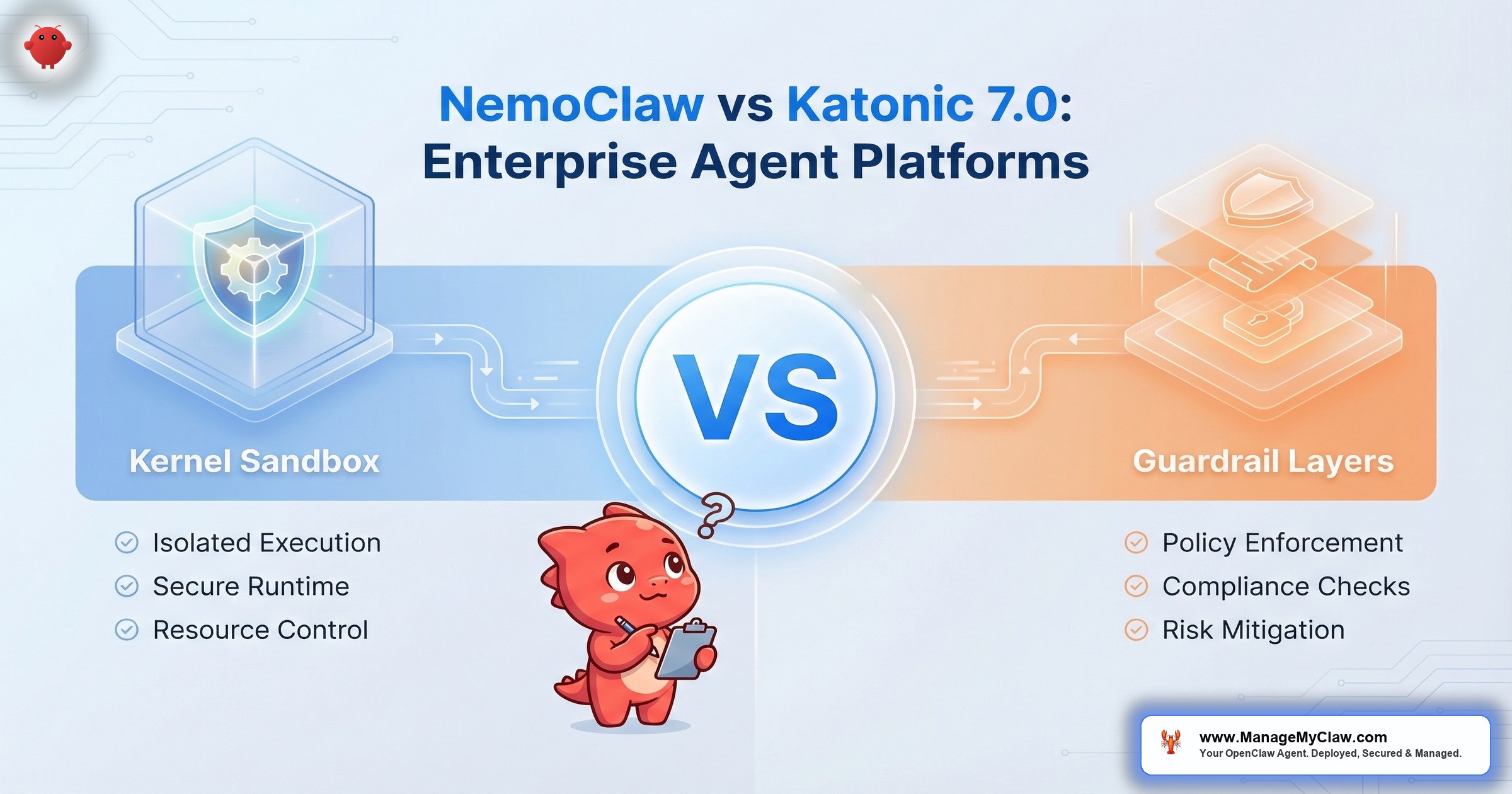
NemoClaw is NVIDIA’s enterprise AI agent platform with kernel-level sandboxing, a YAML policy engine, and a privacy router for data sovereignty. It occupies a different segment — enterprise governance and compliance, not individual productivity. For organizations with SOC2 requirements, HIPAA concerns, or multi-agent governance needs, NemoClaw adds a security and compliance layer that none of the platforms above provide. ManageMyClaw offers NemoClaw implementation services for enterprise clients.
OpenClaw, Deployed and Managed
ManageMyClaw handles the deployment, security hardening, and ongoing maintenance of OpenClaw — so you get the most capable agent platform without the infrastructure work. Starting at $499.
View Plans — No Call Required