The agentic AI market is projected to reach $9 billion in 2026. OpenClaw has 250,000+ GitHub stars, 196 contributors, and a release cadence that ships 7 updates in 2 weeks. It is the most widely deployed open-source AI agent framework in the world.
And most people using it are trying to automate their own workflows. Very few are thinking about what the person next to them needs.
The money in OpenClaw is not in running it for yourself. It is in running it for other people who do not have the 15+ hours, the DevOps knowledge, or the patience to do it right.
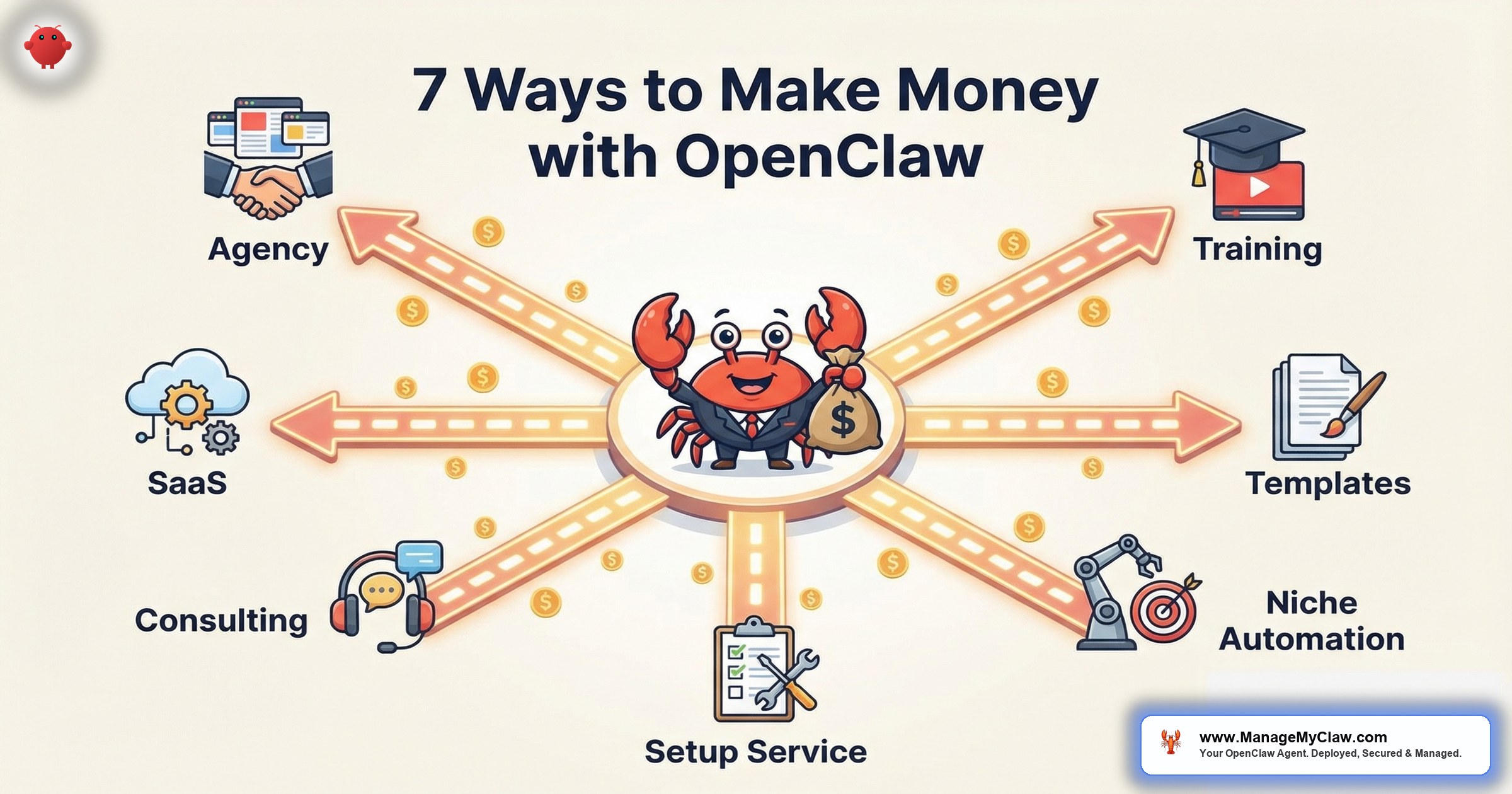
Here are 7 business models that work today — not theoretical, not “when the ecosystem matures.” Each has a defined customer, a price range, and an explanation of why the demand exists right now.
One: The Agency Model
What you sell: Done-for-you OpenClaw deployment, workflow configuration, and ongoing management for businesses.
Who buys it: Non-technical founders, small businesses, and agencies who need AI automation but do not have a technical co-founder or DevOps engineer on staff. This is the largest and most underserved segment in the OpenClaw ecosystem.
Revenue model: One-time setup fees ($500–$5,000 depending on complexity) plus recurring monthly management ($200–$500/month). A 20-client book at $300/month in managed care generates $6,000/month in recurring revenue on top of setup fees.
Why the demand exists: DIY setup takes 15+ hours. At founder rates of $200–$500/hour, that is $3,000–$7,500 in time. And 80% of DIY deployers skip security hardening entirely — Docker sandboxing, the DOCKER-USER iptables chain, Composio OAuth, tool permission allowlists. SetupClaw charges $3,000–$6,000 for the same service. SuperClaw charges $1,200–$2,400 for setup and $250–$1,250/month for managed care. The market has validated that founders will pay for this. The price range is wide enough for new entrants.
On r/Entrepreneur, threads about “productized services” consistently generate high engagement. The pattern is clear: take a complex technical task, package it into a fixed-scope service, and sell it to people whose time is worth more than the service costs.
How to start: Deploy OpenClaw for 3 people for free. Document the process. Build a portfolio. Price your first paid client at $499 for setup and $199/month for managed care. Increase prices as your client list grows.
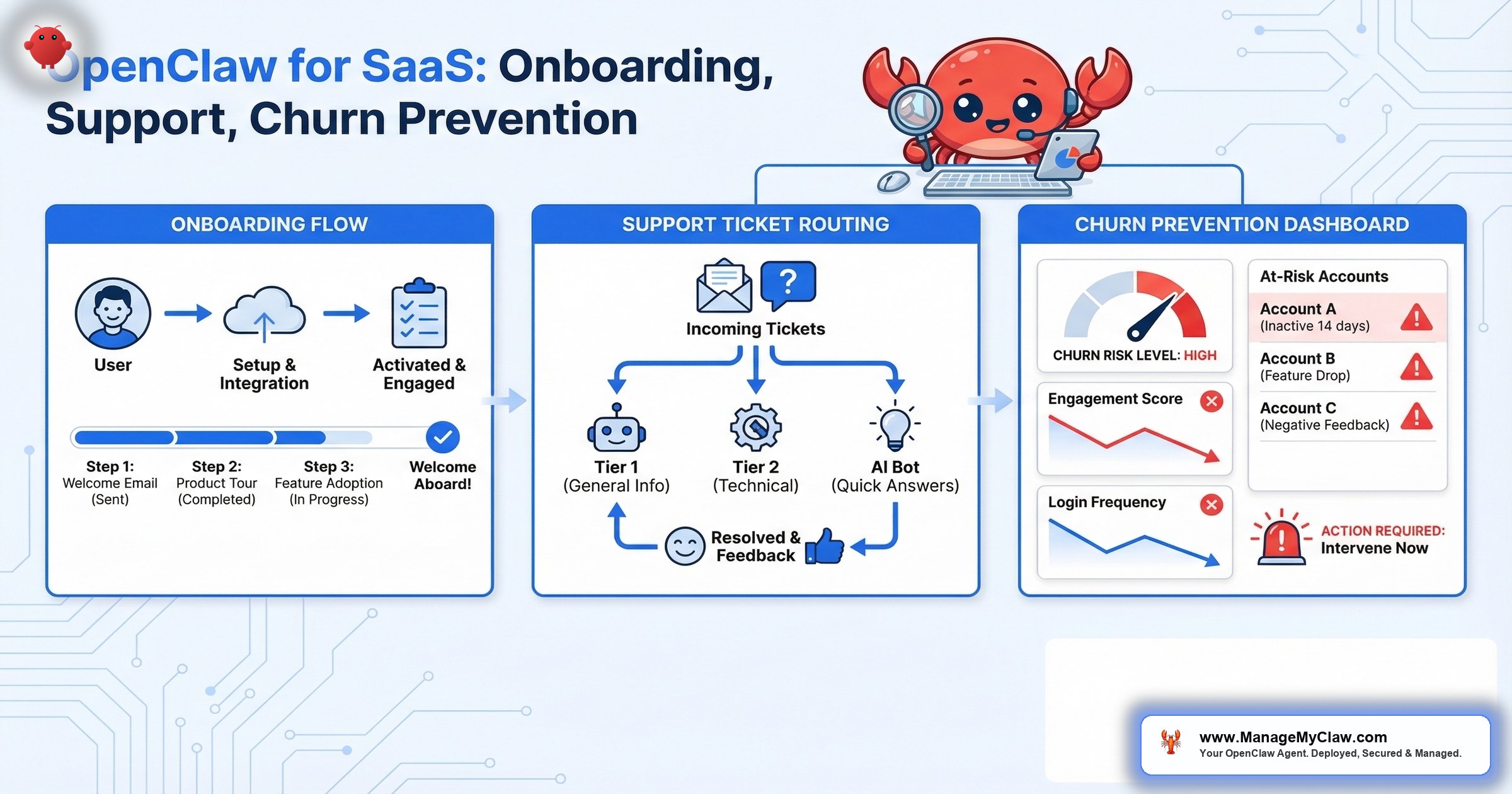
Two: SaaS Wrapper
What you build: A hosted platform that runs OpenClaw for customers through a web dashboard. They sign up, configure their workflows, and get a running agent — without touching a terminal.
Who buys it: The same non-technical founders as the agency model, but those who prefer self-serve over a service relationship. Also small teams that want to manage their own configuration through a GUI instead of SSH.
Revenue model: Monthly subscription ($49–$199/month per user). Infrastructure costs per customer are approximately $15–$30/month (VPS + overhead). At 200 customers paying $99/month, gross revenue is $19,800/month with approximately $4,000–$6,000 in infrastructure costs.
Why the demand exists: OpenClaw is command-line software. Configuring workflows requires editing YAML files, managing Docker containers, and understanding OAuth flows. A GUI wrapper that abstracts this complexity creates a product that OpenClaw’s core team has not built and likely will not — their focus is on the framework, not the end-user experience.
Technical requirements: This is the most technically demanding model on the list. You need multi-tenant infrastructure, user authentication, a workflow builder UI, deployment automation, and the operational capacity to run and monitor dozens (eventually hundreds) of OpenClaw instances simultaneously. If you are a developer looking for a product to build, this has the highest ceiling and the highest barrier.
Three: OpenClaw Consulting
What you sell: Expert advice on OpenClaw architecture, workflow design, security hardening, and model routing — without doing the deployment yourself.
Who buys it: Technical teams that have the engineers to deploy OpenClaw but lack the specialized knowledge to do it well. Startups with a developer who can follow documentation but needs guidance on architecture decisions, security configuration, and prompt engineering.
Revenue model: Hourly consulting ($100–$250/hour) or fixed-scope engagements ($1,000–$5,000 for a security audit, workflow design session, or architecture review). The independent NemoClaw consultant market has already validated $150/hour as a going rate.
Why the demand exists: OpenClaw has 9 disclosed CVEs, including a CVSS 8.8 one-click RCE. The ClawHavoc attack planted 2,400+ malicious skills on ClawHub. CNCERT issued a formal security warning. Companies deploying OpenClaw for business use need someone who understands the threat landscape and can configure the security stack correctly. That is a specialized skill set, and it is scarce.
How to start: Write 5–10 technical blog posts about OpenClaw security, architecture, or workflow design. Share them on r/AI_Agents and r/selfhosted. Answer questions in detail. Your blog becomes your portfolio, and the people who read it become your pipeline.
Four: Managed Setup Service
What you sell: A fixed-price, fixed-scope OpenClaw deployment with a defined deliverable list. Not ongoing management — just the setup.
Who buys it: Technical founders who can manage their own infrastructure after setup but do not want to spend 15+ hours on initial deployment. They want it done right the first time, documented, and handed over.
Revenue model: Fixed price per engagement ($300–$2,000 depending on scope). Lower revenue per client than the agency model, but also lower ongoing commitment. You can process more clients in parallel because there is no managed care component.
Why the demand exists: Fiverr and Upwork already have OpenClaw setup gigs priced at $40–$175. Most of them skip security hardening entirely. There is room for a premium tier that includes Docker sandboxing, firewall configuration (including the DOCKER-USER chain), Composio OAuth, and documentation — priced above the commodity freelancers but below the $3,000+ agencies.
How to differentiate: Include a security hardening checklist as a deliverable. Give the customer a written document showing what was configured, what was tested, and what they need to monitor going forward. The $40 Fiverr gig does not include this. Your $800 service does.
Five: Training and Education
What you sell: Courses, workshops, and training materials that teach people how to deploy, configure, and use OpenClaw.
Who buys it: Developers and technical founders who want to learn the system themselves. Teams that need to train multiple members. Companies evaluating OpenClaw who want to build internal capability before committing to a deployment.
Revenue model: Self-paced courses ($97–$497), live cohort workshops ($500–$2,000 per seat), team training engagements ($2,000–$10,000 for custom training). SuperClaw already charges $6,000–$20,000 for their ClawCamp training program — proving enterprise willingness to pay for structured OpenClaw education.
Why the demand exists: OpenClaw’s documentation is solid for developers but inaccessible for business users. Kevin Jeppesen’s troubleshooting video has 13,557 views. Creator Magic’s “I Fixed OpenClaw and Set It Loose” has 30,132 views. These videos prove demand for structured learning content — people are searching for help, watching long-form video troubleshooting guides, and still struggling.
How to start: Create a free YouTube series covering the basics. Use it to build an audience. Then launch a paid course that goes deeper — security hardening, multi-workflow configuration, prompt engineering, and troubleshooting. The free content is your top of funnel.
Six: Template and Prompt Marketplace
What you sell: Pre-built workflow templates, prompt libraries, and configuration packages for specific use cases.
Who buys it: People who have OpenClaw running but want pre-built workflows for specific tasks — real estate lead follow-up, e-commerce customer service, agency client reporting, SaaS onboarding sequences.
Revenue model: Individual templates ($19–$99 each), bundles ($149–$499 for industry-specific packages), or a subscription library ($29–$49/month for access to the full catalog). This is a high-margin, low-support model — once the template is built and documented, distribution costs are near zero.
Why the demand exists: ClawHub has 13,729+ skills, but skills are different from complete workflow templates. A skill is a tool. A template is a complete configuration — system prompt, tool permissions, memory settings, delivery channel config, and testing checklist — for a specific business outcome. The gap between “I installed the email skill” and “my email triage is working reliably” is where templates add value.
Quality standard: Every template should include the workflow configuration, the system prompt, a tool permission allowlist, testing instructions, and a troubleshooting guide. Low-effort templates that are just a system prompt pasted into a text file will not sustain a business. The value is in the complete, tested, documented package.
Seven: Niche Automation Agency
What you sell: OpenClaw deployment and workflows for a single industry vertical. Not “OpenClaw for everyone” — “OpenClaw for real estate agents” or “OpenClaw for e-commerce stores” or “OpenClaw for law firms.”
Who buys it: Businesses in your chosen vertical who see a service specifically designed for their industry and their workflows, instead of a generic “we deploy OpenClaw” pitch.
Revenue model: Higher per-client value than generalist agencies ($1,000–$5,000 setup, $300–$800/month managed care) because you are selling industry expertise, not just technical deployment. A real estate OpenClaw agency that handles lead follow-up, showing scheduling, and transaction document management charges more than a generalist because the workflows are pre-built and proven for that specific use case.
Why the demand exists: Business buyers trust specialists over generalists. A law firm looking for AI automation wants to hire someone who understands legal workflows, client confidentiality requirements, and bar association ethics rules — not a generic AI deployment service. The narrower your niche, the more you can charge, and the easier it is to market.
How to choose your niche: Pick an industry you already know. If you worked in real estate, build OpenClaw workflows for real estate. If you ran an e-commerce store, build workflows for e-commerce. Domain expertise is the moat — anyone can learn to deploy OpenClaw, but not everyone understands the specific pain points of a niche industry.
Why this matters: All 7 of these models exist because OpenClaw has created a gap between what the software can do and what most people can actually deploy on their own. The framework is powerful. The setup is hard. The security is critical. And the market for bridging that gap is growing as fast as OpenClaw’s star count.
The Bottom Line
OpenClaw is open-source software with enterprise-grade capabilities and a consumer-grade setup experience. That mismatch creates a market. Every business model above fills a different segment of that market — from $19 templates to $10,000 enterprise training engagements.
The common thread across all 7: you are not selling AI. You are selling the result of AI that actually works. The founder does not care about Docker sandboxing. They care that their email gets triaged, their clients get onboarded, and their morning briefing arrives at 8 AM. Package the outcome, not the technology.
Frequently Asked Questions
Do I need to be a developer to start an OpenClaw business?
For the agency model, managed setup service, and niche automation agency — you need working knowledge of Docker, Linux command line, and OAuth configuration. You do not need to be a software engineer. For the SaaS wrapper, yes — you need development skills or a technical co-founder. For training and templates, you need deep OpenClaw knowledge but not necessarily coding skills. The consulting model requires the most expertise but the least infrastructure.
Which model has the fastest path to revenue?
The managed setup service. You can deploy your first paid client within a week of deciding to start. No website needed beyond a simple landing page. No recurring obligations. Deploy, document, deliver, get paid. The agency model has the best long-term economics because of recurring managed care revenue, but it takes longer to build a client base that generates meaningful monthly income.
How do I price my services when competitors charge $3,000 or more?
Start below established competitors to build a portfolio, then raise prices as your reputation grows. An initial price of $499–$999 for deployment with $199–$299/month for managed care positions you below SetupClaw ($3,000–$6,000) and SuperClaw ($1,200–$2,400) while still valuing your work appropriately. Do not compete on price with Fiverr gigs at $40–$175 — compete on security, documentation, and reliability.
Is the market big enough for multiple OpenClaw service providers?
OpenClaw has 250,000+ GitHub stars. Intuit’s 2026 research shows 89% of small businesses are using AI tools. The managed WordPress hosting market — which is the closest analogy — supports WP Engine, Kinsta, Flywheel, Cloudways, and hundreds of smaller providers. The managed OpenClaw market is in its earliest days. There is room for dozens of providers across different niches, price points, and geographic markets.
What about liability if a client’s agent causes damage?
This is a real concern that most new providers ignore. Include clear service agreements that define the scope of your work, the client’s responsibilities (API costs, data backup, password management), and limitations of liability. Carry professional liability insurance — policies for tech consulting typically run $500–$2,000/year. And never skip security hardening. The inbox-wipe incident — 10,271 upvotes, career-threatening for the user — happened because of a configuration gap. Proper hardening is your best risk mitigation.
Want to see how a managed OpenClaw service works from the inside?
ManageMyClaw handles deployment, security hardening, and ongoing managed care for OpenClaw — starting at $499, live in under 60 minutes. See exactly what a productized OpenClaw service delivers.
See Plans and PricingRelated reading: Managed OpenClaw Deployment • OpenClaw for Business: The Complete Guide • OpenClaw Prompt Engineering: Twenty Prompts That Actually Work
Not affiliated with or endorsed by the OpenClaw open-source project.