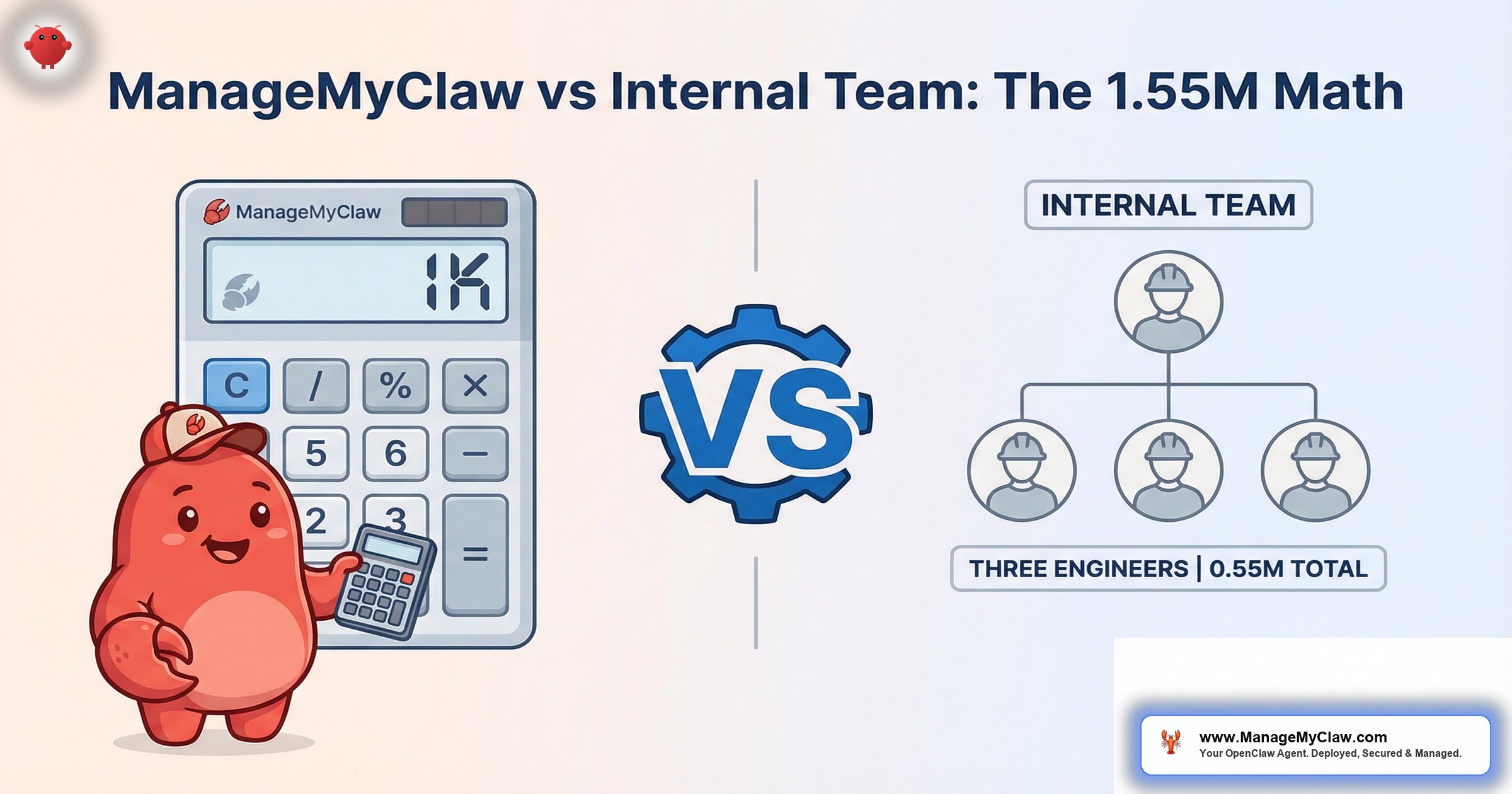
3 engineers at $175,000 average salary. Benefits, recruiting costs, management overhead. 3 years. The total: $1.55 million minimum. That is the real cost of building an internal team to deploy, harden, and maintain a NemoClaw stack. ManageMyClaw Enterprise covers the same scope for approximately $225,000 over the same period. That is a 7x difference.
And the $1.55M number is optimistic. It assumes you can hire all 3 engineers within 90 days, that none of them leave, and that none of them need to ramp up on NemoClaw’s architecture from scratch. In practice, every one of those assumptions breaks.
The nemoclaw internal team build vs buy decision is not a technology question. It is a capital allocation question. This post breaks down the real math — salaries, benefits, recruiting, ramp time, attrition risk, and the hidden costs that never make it into the initial spreadsheet.
The Full Cost Breakdown: Internal Team vs. ManageMyClaw Enterprise
| Cost Category | Internal Team (3 Engineers) | ManageMyClaw Enterprise |
|---|---|---|
| Year 1 salaries (3 × $175K) | $525,000 | — |
| Year 1 benefits (~30% of salary) | $157,500 | — |
| Year 1 recruiting (3 hires × $30K) | $90,000 | — |
| Year 1 tooling and infrastructure | $100,000 | — |
| Year 1 implementation | — | $45,000 |
| Year 1 managed care | — | $60,000 |
| Year 1 total | ~$872,500 | ~$105,000 |
| Year 2 (salaries + benefits + tooling) | ~$500,000 | $60,000 |
| Year 3 (salaries + benefits + tooling) | ~$500,000 | $60,000 |
| 3-year total | ~$1,550,000+ | ~$225,000 |
Internal team estimate assumes US-based engineers. Benefits include health insurance, 401(k), payroll taxes, and PTO. Recruiting cost estimate from SHRM average cost-per-hire for technical roles. ManageMyClaw Enterprise uses Tier 2 implementation ($45K) plus Tier 3 managed care at $5,000/month. Infrastructure costs (compute, API, hosting) are separate in both scenarios.
The 3-year gap is $1,325,000. That is not a negotiation position. That is the structural difference between maintaining a team and hiring a specialist.
Why this matters: The $1.55M is the floor, not the ceiling. Add attrition, ramp time, and management overhead, and internal team costs climb further. The $225,000 figure is a fixed, predictable cost with published SLAs attached.
The Hidden Costs the Spreadsheet Misses
1. Recruiting timeline: 3–6 months before anyone starts
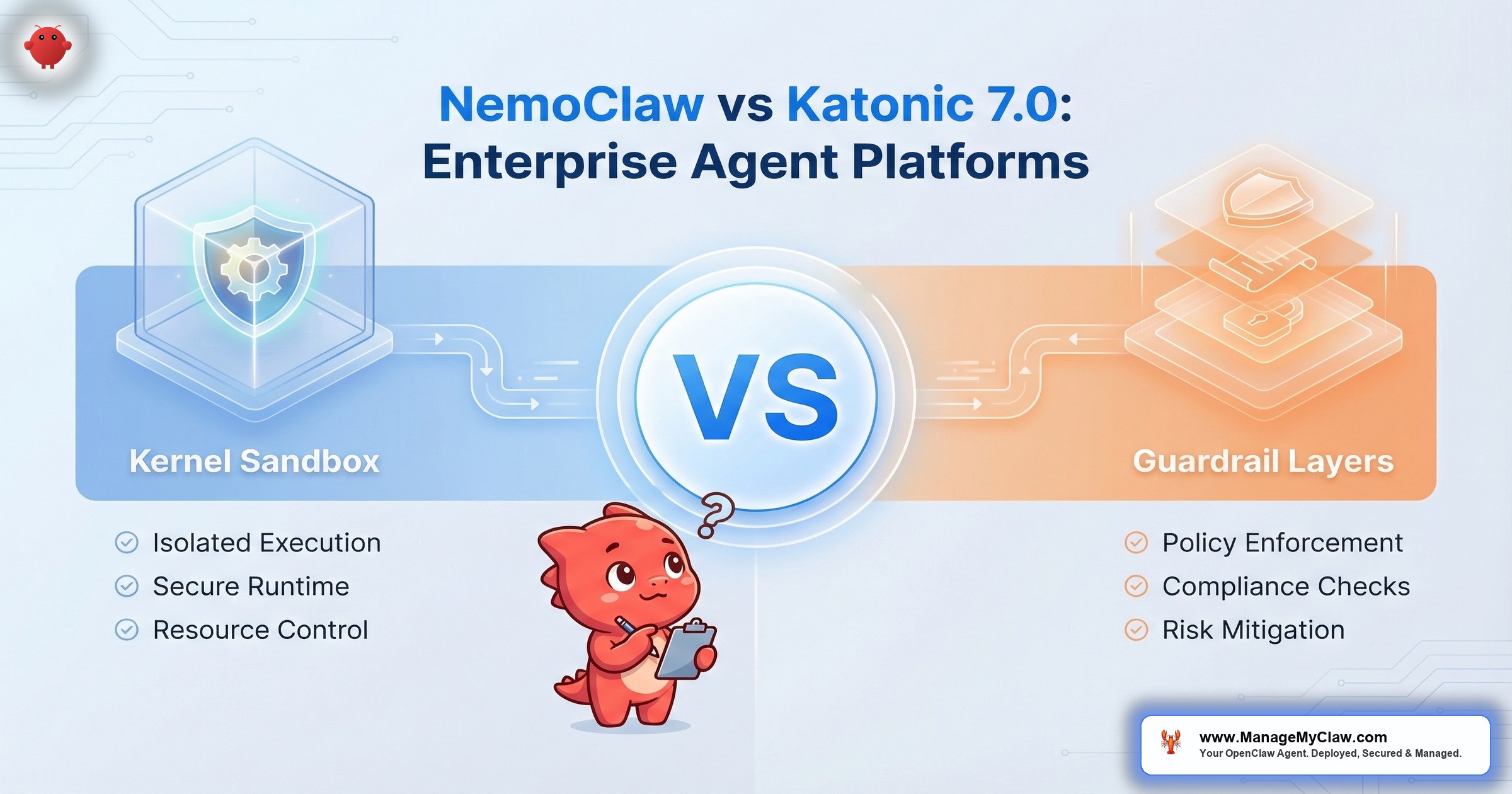
NemoClaw requires engineers who understand kernel-level sandboxing (Landlock filesystem isolation, seccomp filters, network namespaces), YAML policy engine configuration across 4 evaluation levels, privacy router deployment with local/cloud model splitting, and NVIDIA’s AI agent ecosystem. That skill combination is narrow. The average time-to-hire for specialized DevOps/security roles in 2026 is 45–90 days per position. Hiring 3 sequentially means 4–9 months before your team is staffed.
ManageMyClaw Enterprise starts an Assessment in 1 week and begins implementation within 2. The recruiting timeline alone creates a 3–8 month gap in time-to-value.
2. Ramp time: another 2–4 months after hiring
Even experienced engineers need ramp time on NemoClaw’s specific architecture. NemoClaw is alpha software as of March 2026. The documentation is evolving. The OpenShell sandbox configuration, YAML policy syntax, and privacy router routing tables require hands-on learning that no prior Docker or Kubernetes experience fully covers. A reasonable ramp estimate is 2–4 months before an internal team reaches production-deployment readiness.
So the real timeline: 3–6 months to hire + 2–4 months to ramp = 5–10 months before your first production NemoClaw deployment. The board asked about AI strategy last quarter.
3. Attrition risk: losing 1 engineer resets the clock
The average tenure for a DevOps engineer in the US is 2.1 years. On a 3-year plan with 3 engineers, the statistical probability of at least 1 departure is significant. When a NemoClaw specialist leaves, their institutional knowledge leaves with them. The replacement cycle — recruiting, hiring, ramping — adds another 5–7 months and $60,000+ in recruiting and onboarding costs.
With a managed service, institutional knowledge lives in documented processes and runbooks maintained by a team. No single departure creates a knowledge gap.
4. Management overhead: someone has to manage the team
3 engineers need a manager. If that manager is the VP of Engineering or CTO, you are spending a $250,000–$400,000/year person’s time on operational NemoClaw management. If you hire a dedicated engineering manager, add another $180,000–$220,000/year to the cost. Neither option is reflected in the base $1.55M estimate. The managed service model eliminates this layer entirely — you manage a vendor relationship, not a team.
Why this matters: The salary line item is the visible cost. Recruiting, ramp time, attrition, and management overhead are the invisible costs that inflate the real number by 30–50% above the initial estimate. A 2025 Deloitte study on build-vs-buy decisions found that organizations consistently underestimate internal team costs by 40–60% when measured against actual 3-year outcomes.
When Building Internally Makes Sense
The build-vs-buy decision is not always one-sided. There are legitimate scenarios where an internal team is the right investment.
1. AI agents are your core product
If you are building a product where AI agent orchestration is the customer-facing value proposition, internal expertise is a competitive advantage. You need engineers who can modify the NemoClaw stack, not just configure it. The internal team cost is justified because the capability is revenue-generating, not operational overhead.
2. You already have the team
If your organization already employs DevOps engineers with kernel-level security expertise and NVIDIA ecosystem experience, the marginal cost of adding NemoClaw to their portfolio is far less than $1.55M. The build-vs-buy math changes when the “build” team already exists and has available capacity.
3. Regulatory requirements mandate in-house control
Some regulated industries require that certain security-critical infrastructure be managed exclusively by employees, not contractors or vendors. If your compliance framework explicitly prohibits third-party management of AI agent infrastructure, the internal team is not a choice — it is a requirement.
Why this matters: Build makes sense when AI agents are your product, when the team already exists, or when regulations mandate it. For every other case — where NemoClaw is operational infrastructure, not a competitive differentiator — the specialist model delivers the same outcome at 15% of the cost with published SLAs and no recruiting risk.
What ManageMyClaw Enterprise Delivers (Specifically)
For $225,000 over 3 years, ManageMyClaw Enterprise provides the full NemoClaw lifecycle: implementation and ongoing managed care.
Implementation ($15,000–$45,000): Full NemoClaw stack deployment including kernel-level sandbox configuration (Landlock, seccomp, network namespaces), YAML policy engine with custom enterprise policies, privacy router for local/cloud model splitting, CrowdStrike Falcon integration, SIEM/SOC integration, up to 10 agents, and compliance documentation package covering SOC2 evidence, HIPAA mapping, and OWASP ASI01–ASI10. Delivered in 2–6 weeks with 30-day hypercare.
Enterprise Managed Care ($2,500–$10,000/month): 24/7 monitoring, OpenShell policy updates, privacy router optimization, CVE patching (critical within 24 hours), monthly security reports, dedicated account manager, 99.9% uptime SLA, quarterly business reviews, 8 hours/month engineering support, and 1-hour incident acknowledgment.
That is a team, an SLA, and a compliance framework — without the recruiting, benefits, attrition risk, or management overhead. NVIDIA shipped NemoClaw with 17 launch partners including Adobe, Salesforce, SAP, and CrowdStrike. The security architecture behind these deployments is documented and proven. The question is who configures it for your organization — and at what cost.
The Bottom Line
Building an internal NemoClaw team costs $1.55M+ over 3 years. ManageMyClaw Enterprise costs $225,000 for the same period. That is a 7x difference in cost, a 5–10 month difference in time-to-deployment, and the elimination of recruiting risk, attrition risk, and management overhead.
The $1,325,000 you save does not disappear — it becomes available for product development, market expansion, or additional AI initiatives. In a market where 48% of CISOs rank agentic AI as their number one attack vector, speed and cost efficiency are not luxuries. They determine whether your AI agents deploy with governance this quarter or next year.
Start with the $5,000 Pilot Program — 30 days, 1 agent, full security stack, written evaluation. That is less than 2 weeks of a single engineer’s fully loaded cost. See how ManageMyClaw Enterprise compares to Big 4 consulting for additional context on the specialist vs. generalist decision.
Frequently Asked Questions
Can we start with ManageMyClaw Enterprise and transition to an internal team later?
Yes. NemoClaw is open-source and deploys on your infrastructure. ManageMyClaw provides full documentation and configuration exports. Many organizations start with managed deployment to get production-ready quickly, then build internal expertise over 12–18 months while the managed care team maintains operations. The transition plan is built into the engagement — no vendor lock-in, no proprietary dependencies.
What if we only need 1 engineer instead of 3?
A single engineer reduces the salary cost to approximately $525,000 over 3 years (salary + benefits + tooling). But 1 engineer creates a single point of failure — vacation, illness, or departure leaves your NemoClaw stack unmanaged. Production infrastructure requires at least 2 engineers for coverage, and 3 for sustainable on-call rotation. The independent consultant market benchmarks at $150/hour, which translates to $150,000 for 1,000 hours — with no SLA and no managed care.
How does ManageMyClaw ensure knowledge continuity?
ManageMyClaw is a division of Space-O Technologies with 200+ employees and 15+ years of operation. Knowledge lives in documented runbooks, configuration repositories, and team processes — not in a single engineer’s head. If a team member transitions, the institutional knowledge stays intact. Enterprise Managed Care includes a dedicated account manager for relationship continuity and quarterly business reviews to maintain strategic alignment.
What compliance documentation comes with ManageMyClaw Enterprise?
Tier 2 implementation includes SOC2 evidence packages, HIPAA mapping, audit trail setup, and OWASP Agentic Top 10 (ASI01–ASI10) coverage. EU AI Act alignment documentation is part of the compliance package. Enterprise Managed Care maintains this evidence as the NemoClaw stack evolves — so your compliance posture stays current through updates, patches, and policy changes without requiring your team to track each change.
Is the $175,000 salary figure accurate for NemoClaw engineers?
The $175,000 figure reflects the average US salary for a mid-senior DevOps/infrastructure engineer with security expertise. In major tech markets (San Francisco, New York, Seattle), the average is $190,000–$230,000. The total cost per engineer including benefits, payroll taxes, equipment, and workspace runs 1.3–1.5x the base salary. At $175,000 base, fully loaded cost is approximately $230,000–$260,000 per engineer per year.
Run the build-vs-buy math for your organization.
ManageMyClaw Enterprise deploys a fully hardened NemoClaw stack in 2–6 weeks for $15,000–$45,000 — with ongoing managed care, 99.9% SLA, and compliance documentation included. Pilot program: $5,000 for 30 days.
See Enterprise Pricing Learn About Managed Deployment