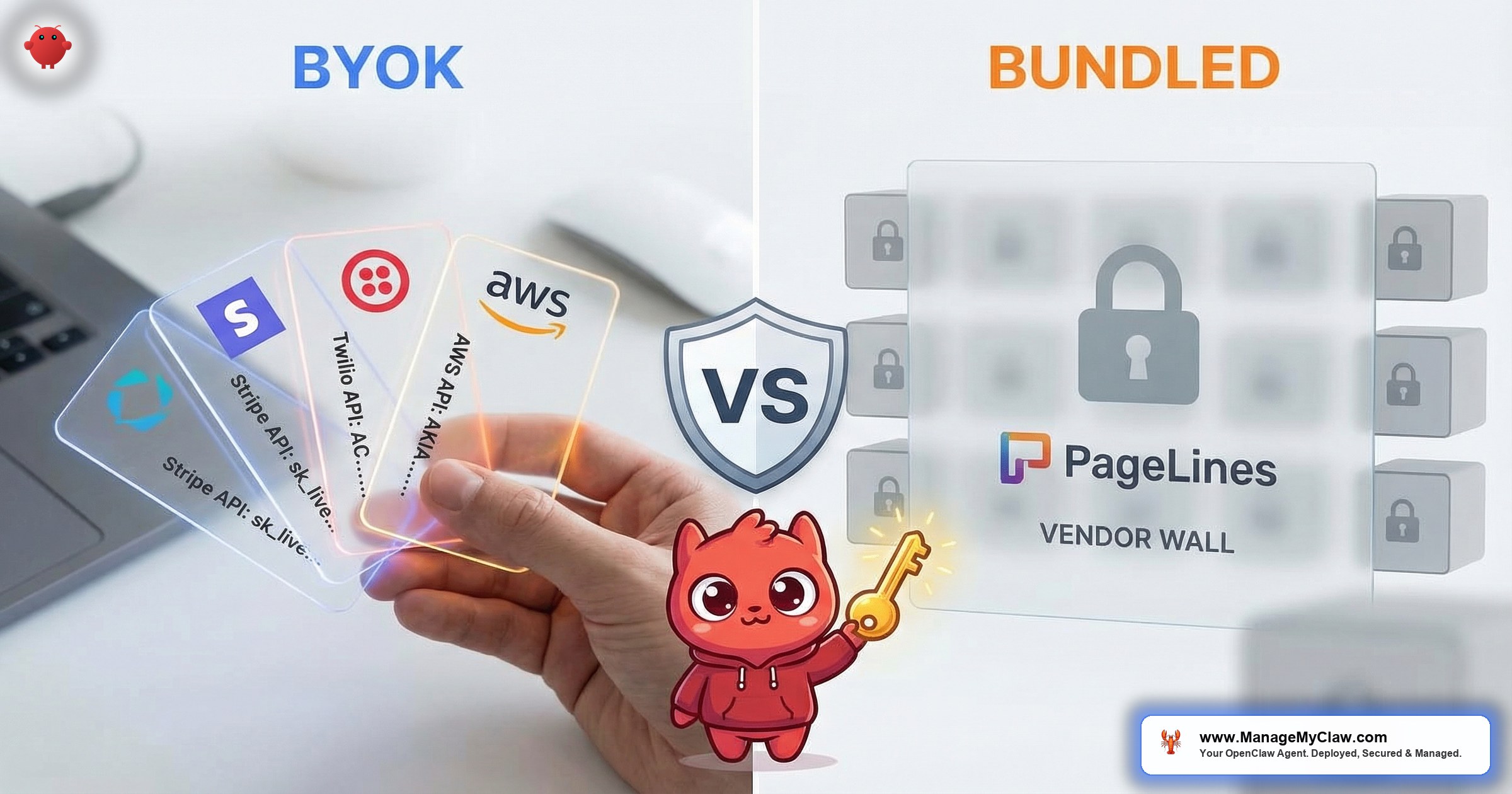
PageLines bundles Claude, Apollo, DataForSEO, and Apify API keys into their platform. You use their keys. ManageMyClaw deploys OpenClaw on your VPS with your own API keys. That is not a minor technical detail — it is the fundamental difference between a SaaS platform and a managed deployment service. Two different models, two different ownership structures, two different answers to the question: “Who controls my AI agent’s infrastructure?”
Neither model is wrong. But choosing the wrong one for your situation creates problems that are expensive to unwind later. Here is how they differ and who each one is built for.
The managed OpenClaw space has split into two camps: SaaS platforms that host OpenClaw for you with bundled services, and deployment services that set up OpenClaw on your infrastructure. PageLines represents the SaaS camp. ManageMyClaw represents the deployment camp. Understanding the distinction matters because it determines who owns your data, who controls your API costs, and what happens if you want to leave.
TL;DR — Who Should Choose Which
Choose PageLines if: you want a managed SaaS platform where API keys are bundled in, you prefer not to manage your own API provider relationships, you want access to pre-integrated tools like Apollo and DataForSEO without separate subscriptions, or you are comfortable with a monthly subscription model and using someone else’s API keys.
Choose ManageMyClaw if: you want OpenClaw deployed on your own VPS with your own API keys (BYOK), you want full control over your infrastructure and data, you prefer a one-time deployment fee over a recurring SaaS subscription, or you need the ability to switch providers without re-platforming.
Head-to-Head Comparison Table
| Feature | ManageMyClaw | PageLines |
|---|---|---|
| Model | Managed deployment service (your infrastructure) | SaaS platform (their infrastructure) |
| API key ownership | BYOK — you bring your own API keys | Bundled — you use PageLines’ keys |
| Pricing model | $499 one-time setup + optional $299/month managed care | Monthly SaaS subscription |
| Infrastructure ownership | Your VPS — you own and control it | PageLines’ infrastructure |
| Data residency | Your VPS — you choose the location | PageLines’ servers |
| Bundled API services | None — you manage your own API subscriptions | Claude, Apollo, DataForSEO, Apify included |
| Vendor lock-in | None — standard OpenClaw on your VPS | Tied to PageLines platform and bundled keys |
| Security hardening | Included at every tier (9-layer stack) | Platform-managed |
| Docker sandboxing | Yes (non-root, cap-drop=ALL, no Docker socket) | Platform-level isolation |
| Self-serve purchase | Yes — no call required | Yes |
| Deployment time | Under 60 minutes | Instant (SaaS signup) |
| Portability if you leave | Full — your VPS, your config, your data | Requires migration off PageLines platform |
PageLines data verified from pagelines.com, March 2026. ManageMyClaw customers pay hosting ($12–$24/month) and AI model API costs ($50–$200/month) separately.
The BYOK vs. Bundled API Difference
This is the core architectural difference and it cascades into everything else.
Bundled keys (PageLines model)
PageLines bundles API keys for Claude, Apollo, DataForSEO, and Apify into their platform. You do not need separate accounts with each provider. The upside: simplicity. One subscription, one bill, no API key management. The downside: you are using their keys, which means your usage flows through their accounts. If you leave PageLines, you leave the API access that came with it. Your workflows, prompts, and configurations are tied to a platform — not to infrastructure you own.
You also do not control API costs directly. When you bring your own keys, you see exactly what each API call costs and you can optimize model routing (using cheaper models for simple tasks). When keys are bundled, the cost is baked into the subscription — efficient for some usage patterns, opaque for others.
BYOK (ManageMyClaw model)
ManageMyClaw deploys OpenClaw on your VPS. You bring your own API keys — Anthropic, OpenAI, or whichever provider you choose. You own the API relationships directly. You see every API call, every cost, and you control model routing. If you leave ManageMyClaw, your agent keeps running on your VPS with your keys. Nothing changes except who manages it.
The tradeoff: you need to set up API accounts yourself. That takes 10 to 15 minutes per provider. ManageMyClaw handles the configuration and integration through Composio OAuth — but the accounts are yours.
The analogy: renting a furnished apartment vs. buying a house and choosing your own furniture. One is immediately livable. The other is yours to modify, keep, or sell.
Why this matters: If you are evaluating AI agent deployment options, the BYOK vs. bundled question is more important than the price difference. It determines who controls your data, your API costs, and your exit strategy. On r/SaaS, a thread about OpenClaw managed hosts captured the market’s growing awareness: the top comment noted that “convenience moat evaporates fast” — and when it does, you want to be on infrastructure you own, not infrastructure you rent.
Where PageLines Wins
Zero API management overhead
PageLines handles all API provider relationships. You do not need accounts with Anthropic, Apollo, DataForSEO, or Apify. For buyers who want a single subscription with no API key management, this is a genuine simplification. One bill. One provider. No hunting for API documentation or managing multiple accounts.
Pre-integrated toolchain
The bundled Claude + Apollo + DataForSEO + Apify stack means PageLines users get access to research, data enrichment, SEO intelligence, and web scraping tools out of the box. If your workflows depend on these specific tools and you do not want to manage the integrations yourself, PageLines packages them together.
Instant access
As a SaaS platform, PageLines can provide immediate access after signup. No VPS provisioning, no deployment process. If speed to first workflow is the primary requirement and you do not need infrastructure ownership, the SaaS model is faster.
Why this matters: For buyers who prioritize convenience over control, PageLines reduces the number of moving parts. If you are testing OpenClaw workflows before committing to infrastructure ownership, the SaaS model is a lower-friction starting point.
Where ManageMyClaw Wins
You own everything
Your VPS. Your API keys. Your data. Your configuration. If you stop paying ManageMyClaw, your agent keeps running. That is a fundamental difference from the SaaS model, where stopping payment means losing access to the platform and the bundled APIs.
On r/openclaw, community conversations consistently surface portability as a top concern. When a user asked about hosted OpenClaw options, one commenter on r/vibecoding warned about a budget provider: “very scammy. No way to cancel your plan.” Infrastructure ownership eliminates that risk entirely. Your agent runs on a VPS you control. No vendor can hold your deployment hostage.
API cost transparency and control
With BYOK, you see every API call on your provider’s dashboard. You can route cheaper models for simple tasks and reserve expensive models for complex reasoning. ManageMyClaw Managed Care includes quarterly API cost optimization reviews — typical savings of 20% to 40% on API spend. When API costs run $50 to $200/month, that optimization saves $120 to $960 per year. With bundled keys, API costs are opaque — built into the subscription price.
Security hardening you can verify
ManageMyClaw publishes its full 9-layer security hardening stack: Docker sandboxing (non-root, cap-drop=ALL, no Docker socket), DOCKER-USER iptables firewall chain, Tailscale VPN, Composio OAuth, tool allowlists, ClawHub skill vetting, kill switch, audit logging, and system-level safety constraints. Because the agent runs on your VPS, you can audit every layer. With a SaaS platform, security is a promise — not something you can independently verify on your own infrastructure.
OpenClaw has 9 disclosed CVEs. The ClawHavoc attack planted 2,400+ malicious skills on ClawHub. CNCERT issued a formal warning. In this threat environment, “trust our security” is not the same as “here are the 9 layers, running on your VPS, that you can audit yourself.”
One-time fee vs. recurring subscription
ManageMyClaw Starter is $499 one-time. You pay once for deployment. Managed Care at $299/month is optional — you can self-manage after deployment if you prefer. PageLines charges a monthly SaaS subscription — stop paying, lose access. The total cost calculus depends on how long you use the service, but the ownership dynamic is different: ManageMyClaw gives you an asset (a deployed, configured agent on your VPS). A SaaS subscription gives you access (to a platform you do not own).
Why this matters: The BYOK model means you control the full stack: infrastructure, API keys, data, and configuration. If your relationship with ManageMyClaw ends, you keep everything. That portability is not just a technical feature — it is business continuity insurance. See how ManageMyClaw pricing works.
The Exit Strategy Test
The most revealing question when evaluating any service: what happens if you leave?
| Question | ManageMyClaw | PageLines |
|---|---|---|
| Does my agent keep running? | Yes — it is on your VPS | No — platform access ends |
| Do I keep my API keys? | Yes — they are yours | No — bundled keys are platform-owned |
| Do I keep my configuration? | Yes — config is on your VPS | Depends on export capabilities |
| Can I switch to another provider? | Yes — standard OpenClaw, no lock-in | Requires re-deployment on new infrastructure |
| Is there a cancellation penalty? | No — 30-day notice, no fees | Standard SaaS cancellation |
This is not a critique of PageLines specifically — the SaaS model always works this way. But the exit dynamics are different enough to matter when you are choosing where to build your AI agent infrastructure.
Who Should Choose PageLines
- You want zero API management. No Anthropic account, no API keys to configure. One subscription covers everything.
- You need the bundled toolchain. Apollo, DataForSEO, and Apify are part of your workflow and you prefer them pre-integrated rather than setting them up yourself.
- You prefer SaaS convenience over infrastructure ownership. You are comfortable using someone else’s platform and do not need to own the underlying VPS or configuration.
- You are testing OpenClaw before committing to a full deployment and want the fastest possible time to first workflow.
Who Should Choose ManageMyClaw
- You want BYOK — your own API keys, your own infrastructure. Full control over what your agent accesses, what it costs, and where your data lives.
- You want a one-time deployment fee instead of a recurring SaaS subscription. $499 one-time for setup. Managed Care from $299/month if you want ongoing maintenance — but optional.
- You need portability. If you leave ManageMyClaw, your agent keeps running on your VPS. Your data, your config, your API keys — nothing changes. Learn more about the deployment process.
- You want verifiable security hardening. 9 layers, running on your VPS, that you can audit independently. Docker sandboxing, firewall rules, Composio OAuth, tool allowlists — at every tier.
- You want API cost control. See every API call, optimize model routing, and save 20% to 40% on API spend with quarterly optimization reviews.
The Bottom Line
PageLines built a different product for a different buyer. Their SaaS platform removes API management overhead and bundles tools that would otherwise require separate subscriptions. That simplification has real value for teams that prioritize convenience and do not need infrastructure ownership.
ManageMyClaw built the opposite: a deployment service that puts everything on your VPS, with your API keys, under your control. The $499 one-time fee buys you an asset, not access. The security hardening is verifiable. The exit is clean.
The question is not which service is better. It is which model fits how you want to own and operate your AI infrastructure. Bundled APIs trade control for convenience. BYOK trades convenience for control. Choose the tradeoff that matches your priorities. See the full cost breakdown of running OpenClaw.
Frequently Asked Questions
What does BYOK mean in the context of OpenClaw deployment?
BYOK stands for Bring Your Own Keys. It means you create your own API accounts with providers like Anthropic or OpenAI, and ManageMyClaw configures your OpenClaw instance to use your keys through Composio OAuth. You own the API relationships, see the costs directly, and keep the keys if you switch providers. The alternative is bundled keys where the platform provides API access through their own accounts.
Can I use ManageMyClaw with PageLines’ toolchain (Apollo, DataForSEO, Apify)?
Yes, but through your own accounts. ManageMyClaw can configure OpenClaw to work with Apollo, DataForSEO, Apify, or any other API service — you just need your own API keys for each service. The integration work is part of the deployment. The difference is that you manage the API subscriptions directly rather than having them bundled into a single platform subscription.
What happens to my data if PageLines shuts down?
With any SaaS platform, your data and configuration live on their infrastructure. If the platform shuts down or changes terms, you need to migrate. With ManageMyClaw’s deployment model, your agent runs on your VPS — it is not dependent on ManageMyClaw’s infrastructure to keep running. This portability is inherent to the BYOK deployment model.
Is PageLines cheaper or more expensive than ManageMyClaw?
The comparison is not straightforward because the pricing models differ. ManageMyClaw charges $499 one-time for deployment plus optional $299/month managed care. PageLines charges a monthly SaaS subscription that includes bundled API access. The total cost depends on usage volume, how many bundled tools you use, and how long you subscribe. For a fair comparison, calculate the total cost of PageLines’ subscription plus the value of the bundled APIs against ManageMyClaw’s deployment fee plus your direct API costs.
Can I start with PageLines and switch to ManageMyClaw later?
Yes, but it requires a full deployment — not a migration. Since PageLines runs on their infrastructure with their API keys, moving to ManageMyClaw means deploying OpenClaw on your VPS, setting up your own API accounts, and reconfiguring your workflows. ManageMyClaw’s deployment process handles all of this starting at $499. The switch is possible but not seamless — which is one reason the infrastructure ownership question matters early.
Your agent. Your VPS. Your keys.
ManageMyClaw deploys OpenClaw on your infrastructure with BYOK — you own everything. Docker sandboxing, firewall hardening, Composio OAuth, and tool allowlists included at every tier. Starting at $499. No phone call required.
Get Started — BYOK Deployment