“How to Set Up NemoClaw on a DigitalOcean Droplet with 1-Click — the cloud deployment path for teams that need sandboxed agents today and do not have DGX hardware in the budget.”
— DigitalOcean official tutorial, NemoClaw cloud deployment, 2026
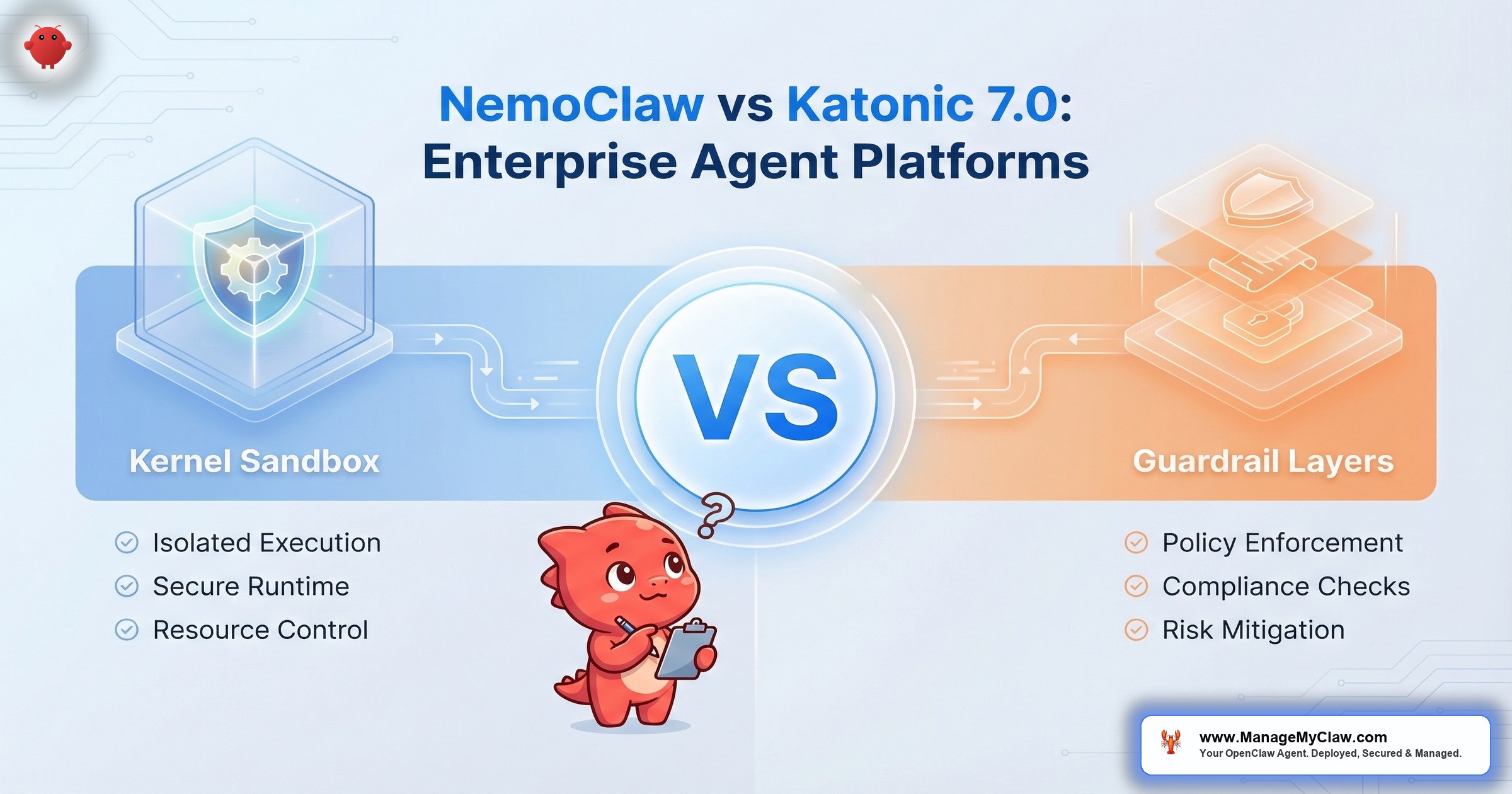
NemoClaw is NVIDIA’s enterprise security wrapper for agentic AI — the runtime environment that adds kernel-level sandboxing, YAML policy enforcement, and a privacy router to the open-source OpenClaw agent framework. While NemoClaw’s full feature set — including local inference with the privacy router in air-gapped mode — requires an NVIDIA GPU, the sandbox and policy engine work on any Linux server with kernel 5.13 or higher. This means NemoClaw can run on a DigitalOcean Droplet, routing inference to cloud LLM endpoints while still providing the sandbox isolation and policy enforcement that bare OpenClaw lacks.
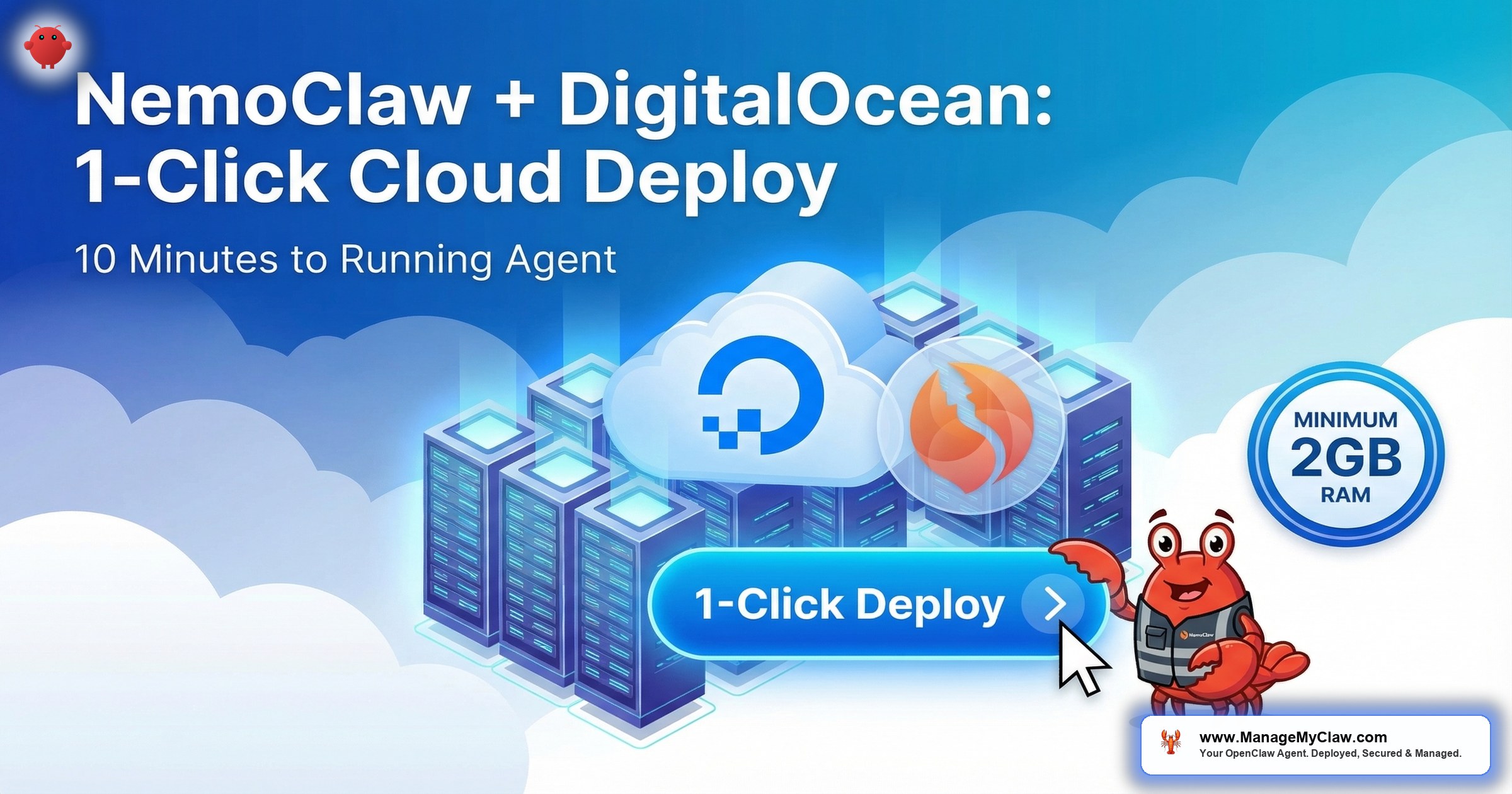
DigitalOcean published an official 1-click deployment tutorial — “How to Set Up NemoClaw on a DigitalOcean Droplet with 1-Click” — and NemoClaw Alpha is now available directly in the DigitalOcean Marketplace as a pre-built 1-Click application. The Marketplace listing provides a fully configured, out-of-the-box environment that takes a team from zero to a running NemoClaw instance in under 10 minutes. This article walks through that deployment, adds the security configuration the tutorial omits, maps the full landscape of NemoClaw cloud and on-premises deployment options, and addresses the critical privacy tradeoff that every team must understand before choosing cloud over local inference.
For a comparison of VPS providers that support NemoClaw and OpenClaw, see our Best VPS Providers for OpenClaw guide. For the full implementation walkthrough with local inference, see our NemoClaw Implementation Guide. For pricing on managed cloud deployment, see our Pricing page.
The Privacy Tradeoff: Cloud NemoClaw Cannot Do Local Inference
This must be stated clearly before any cloud deployment discussion: NemoClaw on a DigitalOcean Droplet without a GPU cannot run local inference. The privacy router’s most powerful feature — routing all inference to a local vLLM server so that no data leaves the machine — requires an NVIDIA GPU. A standard DigitalOcean Droplet is a CPU-only server. The NemoClaw sandbox and policy engine work perfectly, but inference must be routed to a cloud LLM endpoint: NVIDIA’s build.nvidia.com API catalog, OpenAI, Anthropic, or another provider.
This means your prompts, tool outputs, and agent reasoning leave the Droplet and traverse the network to the cloud LLM provider. NemoClaw’s privacy router can strip PII before sending requests to the cloud endpoint, but the sanitized content still leaves your infrastructure. For teams handling regulated data under HIPAA, ITAR, or EU data residency requirements, cloud inference may not be compliant. For teams evaluating NemoClaw, prototyping agent workflows, or running non-sensitive workloads, cloud deployment is the fastest and most affordable path to a sandboxed agent.
- Sandbox isolation — works on cloud. OpenShell uses Landlock and seccomp, which are kernel features available on any Linux 5.13+ server.
- YAML policy engine — works on cloud. Policies are evaluated locally on the Droplet regardless of where inference runs.
- Privacy router (PII stripping) — works on cloud. PII is removed before requests leave the Droplet.
- Privacy router (local-only mode) — does NOT work without a GPU. Local inference requires an NVIDIA GPU with sufficient VRAM.
DigitalOcean 1-Click Deployment Walkthrough
DigitalOcean’s 1-click NemoClaw deployment creates a Droplet with NemoClaw pre-installed, the OpenShell sandbox configured, and a web dashboard for policy management. An onboarding script launches automatically on first login, walking you through initial configuration: it asks for a sandbox name (which defaults to my-assistant if you skip) and your NVIDIA API key for cloud inference. The minimum requirement is a 2GB RAM Droplet for basic operation, though the recommended $24/month Droplet (4GB RAM, 2 vCPUs, 80GB SSD) provides better headroom for a single-agent deployment with cloud inference.
DigitalOcean also offers a separate 1-Click app for OpenClaw (the open-source agent framework without NemoClaw’s security wrapper). DEV Community has an official DigitalOcean post — “How to Run OpenClaw with DigitalOcean” — covering the OpenClaw-only deployment. If you are evaluating whether you need NemoClaw’s sandbox and policy engine, start with the OpenClaw 1-Click to understand the base agent framework, then upgrade to the NemoClaw 1-Click when you need enterprise security controls.
What You Need
- DigitalOcean account with billing configured
- SSH key added to your DigitalOcean account
- Cloud LLM API key — NVIDIA API catalog (build.nvidia.com), OpenAI, or Anthropic
- Domain name (optional, for HTTPS access to the management dashboard)
Step 1: Create the Droplet
# Create a NemoClaw Droplet using the 1-click image
$ doctl compute droplet create nemoclaw-prod \
    --image nemoclaw-1click \
    --size s-2vcpu-4gb \
    --region nyc3 \
    --ssh-keys $(doctl compute ssh-key list --format ID --no-header) \
    --tag-names nemoclaw,production \
    --wait

# Get the Droplet IP
$ doctl compute droplet get nemoclaw-prod --format PublicIPv4
203.0.113.42

# SSH into the Droplet
$ ssh root@203.0.113.42
Step 2: Configure the Cloud LLM Provider
providers:
  default: nvidia-api
  nvidia-api:
    endpoint: "https://integrate.api.nvidia.com/v1"
    model: "nvidia/nemotron-3-super-49b"
    api_key_env: "NVIDIA_API_KEY"
    max_tokens: 8192
    timeout_seconds: 60

privacy_router:
  mode: cloud-with-pii-stripping
  strip_patterns:
    - "email"
    - "phone"
    - "ssn"
    - "credit_card"
    - "address"
  allowed_endpoints:
    - "integrate.api.nvidia.com:443"
log_stripped_fields: true# Store the API key securely
$ echo "NVIDIA_API_KEY=nvapi-xxxxxxxxxxxxxxxxxxxx" >> /etc/nemoclaw/env
$ chmod 600 /etc/nemoclaw/env
# Start NemoClaw
$ nemoclaw start --config /etc/nemoclaw/nemoclaw-config.yaml
# Verify the deployment
$ nemoclaw status
Agent PID: 8721
Sandbox: ACTIVE (deny-by-default)
Provider: nvidia-api (integrate.api.nvidia.com)
Privacy Router: cloud-with-pii-stripping
Status: RUNNINGStep 3: Security Hardening the Droplet
The DigitalOcean tutorial gets NemoClaw running but does not harden the host. NemoClaw’s sandbox protects the agent from the host, but the host itself must also be secured. These steps are not optional for production.
# Disable root SSH login
$ sed -i 's/PermitRootLogin yes/PermitRootLogin no/' /etc/ssh/sshd_config
$ systemctl restart sshd

# Configure UFW firewall
$ ufw default deny incoming
$ ufw default allow outgoing
$ ufw allow 22/tcp comment "SSH"
$ ufw allow 443/tcp comment "NemoClaw dashboard (if using HTTPS)"
$ ufw enable

# Enable automatic security updates
$ apt install unattended-upgrades -y
$ dpkg-reconfigure -plow unattended-upgrades

# Set up fail2ban for SSH brute force protection
$ apt install fail2ban -y
$ systemctl enable fail2ban
$ systemctl start fail2banCloud and On-Premises Alternatives to DigitalOcean
DigitalOcean’s 1-click deployment is the fastest path, but it is not the only one. NemoClaw runs on any Linux server with kernel 5.13+. The following table maps the complete deployment landscape — cloud providers for CPU-only sandbox deployment, GPU cloud providers for cloud-based local inference, and on-premises server vendors for fully air-gapped deployments.
| Provider | Type | GPU Available | Local Inference | Starting Cost |
|---|---|---|---|---|
| DigitalOcean | Cloud (CPU) | No (GPU Droplets limited) | No | $24/mo |
| build.nvidia.com | Cloud API | N/A (hosted inference) | No (NVIDIA hosts) | Pay-per-token |
| CoreWeave | GPU Cloud | A100, H100, H200 | Yes | ~$2.50/hr (A100) |
| Together AI | GPU Cloud | Managed inference | Partial (dedicated instances) | Pay-per-token |
| Fireworks | GPU Cloud | Managed inference | Partial (dedicated instances) | Pay-per-token |
| Cisco UCS | On-Premises | NVIDIA GPUs (BTO) | Yes | $15,000+ |
| Dell PowerEdge | On-Premises | NVIDIA GPUs (BTO) | Yes | $12,000+ |
| HPE ProLiant | On-Premises | NVIDIA GPUs (BTO) | Yes | $14,000+ |
| Lenovo ThinkSystem | On-Premises | NVIDIA GPUs (BTO) | Yes | $13,000+ |
| Supermicro | On-Premises | NVIDIA GPUs (BTO) | Yes | $10,000+ |
CoreWeave, Together AI, and Fireworks offer GPU instances where you can run vLLM with Nemotron models. This gives you the local inference experience (your model instance, not shared) but on cloud hardware. The data still traverses the network to the GPU cloud provider’s data center. This is a middle ground: more privacy than shared API endpoints, less privacy than on-premises hardware. For teams that need local inference but cannot invest in DGX or RTX hardware, GPU cloud with dedicated instances is the pragmatic compromise.
Scaling NemoClaw on DigitalOcean: From Prototype to Production
The $24/month Droplet is a starting point for single-agent prototyping. Production workloads with multiple concurrent agent sessions, persistent tool state, and high-availability requirements need larger infrastructure.
| Use Case | Droplet Size | Monthly Cost | Agent Capacity |
|---|---|---|---|
| Prototype / single agent | s-2vcpu-4gb | $24 | 1 agent, light workload |
| Small team / 2–3 agents | s-4vcpu-8gb | $48 | 2–3 concurrent agents |
| Production / 5–10 agents | m-8vcpu-16gb (CPU-Optimized) | $96 | 5–10 concurrent agents |
| Enterprise / high concurrency | m6-16vcpu-32gb | $192 | 15–20 concurrent agents |
NemoClaw’s sandbox creates a separate Landlock/seccomp context for each agent session. Each context consumes approximately 50–100MB of RAM. The primary bottleneck on cloud Droplets is not CPU or memory but API latency to the cloud LLM. Each agent session makes sequential inference calls to the cloud provider, and the round-trip time (typically 500ms–3s depending on the provider and model) dominates execution time. More concurrent agents do not increase per-agent speed — they increase throughput by running in parallel.
When to Move from Cloud to On-Premises
Cloud NemoClaw is the right choice when you are evaluating NemoClaw’s sandbox and policy engine, prototyping agent workflows, running non-sensitive workloads, or operating with a small team that does not justify hardware investment. It becomes the wrong choice when any of these conditions apply.
- Regulated data. If your agents process PHI (HIPAA), financial records (SOX/PCI-DSS), or export-controlled data (ITAR), cloud inference likely violates your compliance requirements regardless of PII stripping. The privacy router strips known patterns, but it cannot guarantee zero data leakage for all possible sensitive content.
- API cost exceeds hardware amortization. If you are spending more than $500/month on cloud LLM API calls, the three-year amortized cost of a DGX Spark ($3,999 / 36 months = $111/month) or an RTX 5090 workstation ($3,000 / 36 months = $83/month) is lower than your ongoing API spend. At $2,000+/month in API costs, the hardware pays for itself in one quarter.
- Latency sensitivity. Cloud inference adds 500ms–3s of network round-trip per request. Local vLLM inference on an RTX 5090 responds in 50–200ms for typical agent tool calls. If your agents make dozens of sequential inference calls per task, the latency difference compounds to minutes of additional wait time per task.
- Data gravity. If the data your agents process already resides on-premises (databases, file servers, internal APIs), routing inference through the cloud means either moving data to the cloud (expensive, slow, risky) or having the cloud LLM reason without access to the full dataset (reduced quality). On-premises NemoClaw keeps everything co-located.
Migrating from DigitalOcean to On-Premises
NemoClaw’s configuration is portable. The YAML policy files, sandbox settings, and agent configurations developed on a DigitalOcean Droplet transfer directly to an on-premises server. The only configuration change is the provider section — swapping the cloud API endpoint for a local vLLM endpoint.
# Export the current NemoClaw configuration
$ nemoclaw config export --output nemoclaw-migration.tar.gz
Exported: policies/ (12 files)
Exported: nemoclaw-config.yaml
Exported: agent-definitions/ (5 files)
Exported: tool-configurations/ (8 files)

# On the on-premises server: import the configuration
$ nemoclaw config import --input nemoclaw-migration.tar.gz

# Update only the provider section for local inference
$ nemoclaw config set providers.default vllm-local
$ nemoclaw config set providers.vllm-local.endpoint "http://127.0.0.1:8000/v1"
$ nemoclaw config set privacy_router.mode local-only

# Start with local inference
$ nemoclaw start
Provider: vllm-local (127.0.0.1:8000)
Privacy Router: local-only
Status: RUNNING
The migration takes the policies and agent definitions you refined on the cloud Droplet and runs them on local hardware with full privacy. This is the recommended adoption path: prototype on DigitalOcean, validate workflows and policies, then migrate to on-premises when the use case justifies the hardware investment.
Frequently Asked Questions
Can I add a GPU to a DigitalOcean Droplet for local inference?
DigitalOcean does not currently offer GPU Droplets suitable for LLM inference. Their GPU offerings are limited and not designed for sustained vLLM workloads. For cloud-based GPU inference, use CoreWeave, Lambda Labs, or RunPod, which offer H100 and A100 instances designed for AI workloads. You can run the NemoClaw sandbox on DigitalOcean and route inference to a GPU instance on a separate provider, though this adds network complexity and latency.
Is the DigitalOcean 1-click image maintained by NVIDIA or DigitalOcean?
The 1-click image is maintained by DigitalOcean in collaboration with NVIDIA. DigitalOcean handles the image build, Ubuntu base, and marketplace listing. NVIDIA provides the NemoClaw binaries and configuration templates. Updates follow DigitalOcean’s marketplace image update cycle, which typically lags 2–4 weeks behind NVIDIA’s NemoClaw releases. For the latest NemoClaw version, deploy the 1-click image and then run nemoclaw update to pull the newest release.
How does the cloud LLM API key stay secure on the Droplet?
Store the API key in /etc/nemoclaw/env with 600 permissions (owner read/write only). NemoClaw reads this file at startup and loads the key into memory. The key is never written to logs or passed through the sandbox — the privacy router makes API calls from the host process, outside the sandbox boundary. If the sandbox is compromised, the attacker cannot access the API key because it exists only in the host process’s memory space, not in the sandboxed agent’s environment. Never store API keys in the YAML configuration file itself.