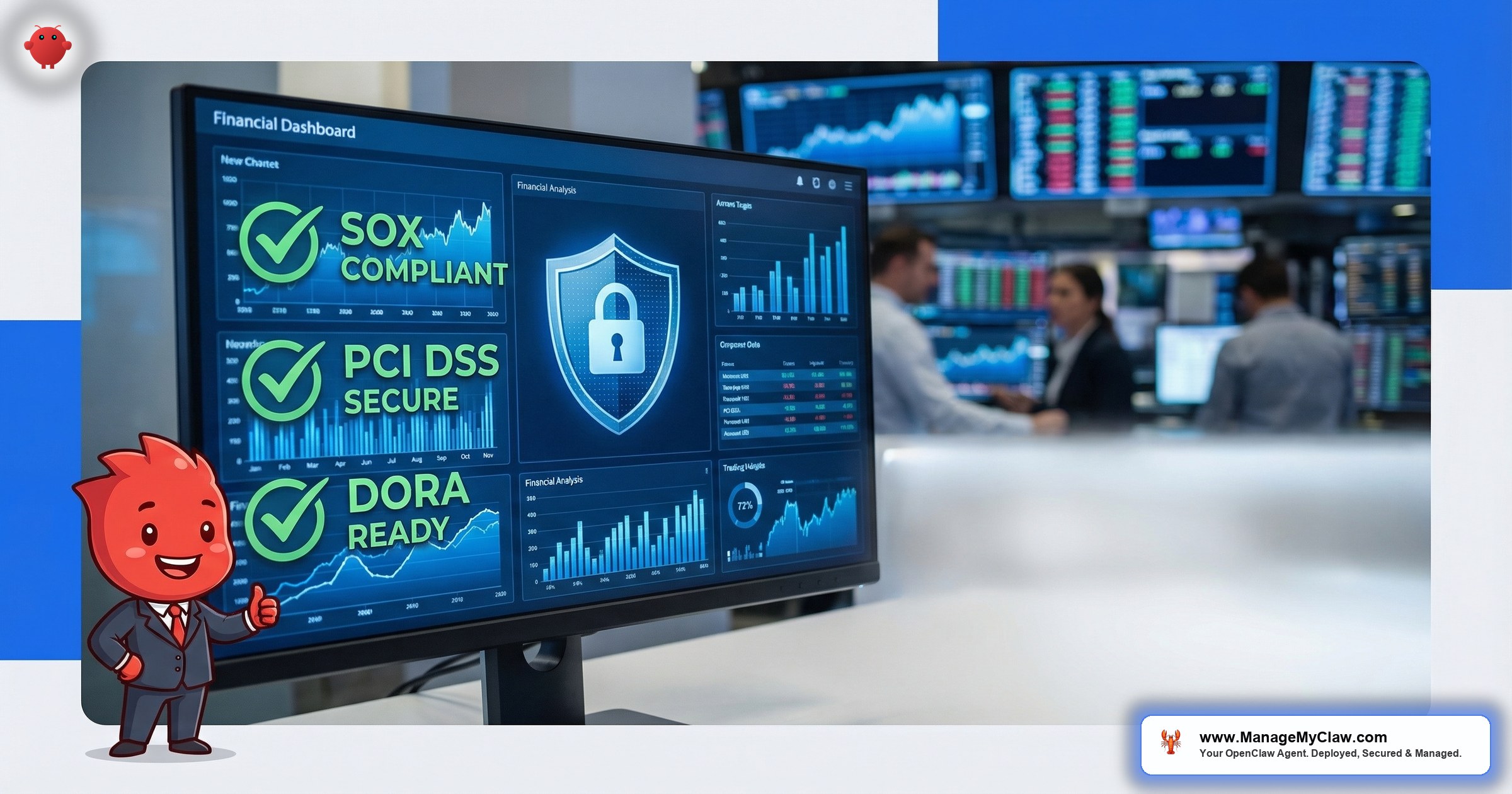
DORA — the Digital Operational Resilience Act — reached full enforcement in January 2025. SOX audit trail requirements have been non-negotiable since 2002. PCI DSS 4.0 applies to any system that touches payment card data. If your financial services organization is deploying AI agents, every one of these frameworks has requirements that a standard OpenClaw deployment does not meet. NemoClaw’s architecture was built for exactly this problem.
The challenge in financial services is not whether AI agents are useful — they are. The challenge is whether your compliance team, your auditor, and your regulator can say yes. NemoClaw turns the answer from “no” to “yes, with these controls.”
This guide maps NemoClaw’s architecture to the specific requirements of nemoclaw financial services sox pci compliance — kernel-level isolation for SOX segregation of duties, privacy routing for PCI DSS data isolation, and the operational resilience framework DORA demands. Each section references the specific regulation, the specific NemoClaw capability, and how the 2 connect.
SOX Compliance: Audit Trails and Segregation of Duties
SOX Section 404 requires that internal controls over financial reporting are documented, tested, and auditable. When an AI agent accesses financial data, generates reports, or processes transactions, every action must be traceable to a specific agent, a specific policy, and a specific approval chain. “The AI did it” is not an acceptable audit response.
NemoClaw’s SOX-relevant capabilities
Audit trail at the kernel level: NemoClaw’s OpenShell sandbox logs every system call, file access, and network request the agent makes. This is not application-level logging that the agent could theoretically manipulate. It is OS-level logging enforced by Landlock and seccomp filters. The agent cannot modify, delete, or suppress its own audit trail because the logging operates outside the agent’s sandbox boundary.
Segregation of duties via YAML policy engine: The 4-level policy evaluation (binary, destination, method, path) enables role-based agent permissions that mirror SOX segregation requirements. An agent that reads financial reports cannot approve transactions. An agent that processes payments cannot modify reporting templates. These boundaries are defined in YAML configuration, version-controlled, and auditable — the same way you manage infrastructure-as-code for your existing systems.
Immutable action records: Every agent action is recorded with a timestamp, the policy that authorized it, the data it accessed, and the outcome. These records are stored outside the agent’s filesystem boundary. An auditor can reconstruct the complete decision chain for any agent action — which is exactly what SOX Section 302 and 404 require for financial reporting controls.
Why this matters: SOX auditors ask “who accessed this data, when, under what authority, and what did they do with it?” NemoClaw’s architecture answers all 4 questions at the kernel level, not the application level. That distinction matters because kernel-level controls cannot be bypassed by the application they are controlling.
PCI DSS 4.0: Payment Data Isolation
PCI DSS Requirement 3 mandates that stored cardholder data is protected. Requirement 7 restricts access to cardholder data by business need-to-know. Requirement 10 requires logging and monitoring of all access to network resources and cardholder data. An AI agent that processes payment information or accesses systems containing cardholder data falls under all 3 requirements.
NemoClaw’s PCI DSS-relevant capabilities
Privacy router for cardholder data isolation: NemoClaw’s privacy router classifies data by sensitivity and routes accordingly. Payment card data, account numbers, and cardholder information route to local Nemotron models that process on your infrastructure — never leaving your network boundary. General reasoning tasks (generating reports, drafting communications, scheduling) route to cloud models. The routing table is explicit: you define which data classifications stay local and which can use cloud processing.
Network namespace isolation: Each agent runs in its own network namespace. An agent processing payment data cannot communicate with an agent handling marketing automation, even if both run on the same host. This is PCI DSS Requirement 1 (network segmentation) implemented at the container level through Linux kernel primitives, not through application-level network rules that could be misconfigured.
Filesystem isolation via Landlock: The OpenShell sandbox uses Landlock to restrict which files and directories each agent can access. An agent scoped to payment processing sees only the payment-related data directories. Customer PII, trading data, and internal communications are invisible to that agent — not just restricted but literally outside the agent’s filesystem view.
Why this matters: PCI DSS assessors look for defense-in-depth. NemoClaw provides it at 3 layers: data routing (privacy router), network segmentation (namespaces), and filesystem isolation (Landlock). Each layer operates independently, so a failure in one does not compromise the others.
DORA: Digital Operational Resilience
DORA applies to financial entities in the EU, including banks, insurance companies, investment firms, and payment institutions. It requires ICT risk management, incident reporting, digital operational resilience testing, and third-party risk management. AI agents that operate within financial infrastructure fall under DORA’s scope as ICT systems.
DORA Article 6: ICT risk management
DORA requires financial entities to identify, classify, and manage ICT risks. NemoClaw’s YAML policy engine enables explicit risk classification at the agent level: which systems each agent can access, which data it can process, which actions it can take. Policy changes are version-controlled, reviewed, and auditable. This maps directly to DORA’s requirement for documented ICT risk management procedures.
DORA Article 17: Incident reporting
Major ICT incidents must be reported to the relevant supervisory authority. NemoClaw’s kernel-level audit logging captures the data required for incident reporting: what happened, when, which systems were affected, and what data was accessed. Integration with your existing SIEM platform means AI agent incidents flow through the same incident response pipeline as your other ICT systems. CrowdStrike Falcon AIDR integration adds runtime threat detection — if an agent behaves anomalously, the alert fires through your existing CrowdStrike console.
DORA Article 28: Third-party ICT service provider risk
DORA requires financial entities to manage the risks associated with third-party ICT service providers. NemoClaw is open-source and deploys on your infrastructure — which fundamentally changes the third-party risk profile. You are not sending data to a third-party SaaS platform. You are running software on your servers. The privacy router ensures that any data sent to cloud model providers is explicitly classified and approved, with sensitive data routed to local models by default.
Why this matters: DORA enforcement is live. Financial entities that deploy AI agents without the resilience, monitoring, and incident reporting capabilities DORA requires face regulatory action. NemoClaw’s architecture maps to DORA’s requirements at the infrastructure level — not as a compliance overlay but as a design principle.
Financial Services Use Cases
The compliance architecture exists to enable workflows, not to prevent them. Here are 4 financial services use cases where NemoClaw’s governance framework permits AI agent deployment that a standard OpenClaw installation cannot safely support.
1. Trade settlement reconciliation. The agent monitors settlement data from your OMS, matches against clearing house confirmations, flags discrepancies, and generates exception reports. All settlement data stays on local Nemotron models via the privacy router. The agent has read-only access to settlement records and write access only to the exception reporting system. SOX audit trail captures every data access and every flag.
2. KYC document processing. The agent ingests customer identification documents, extracts relevant data, checks against sanctions lists, and prepares the verification package for human review. PII stays local via the privacy router. The agent cannot approve a KYC check — it can only prepare the package. Segregation of duties enforced via the YAML policy engine.
3. Regulatory reporting automation. The agent pulls data from multiple internal systems, formats reports according to regulatory templates (MiFID II transaction reporting, EMIR trade reporting, SFTR securities financing), and prepares submissions for human review and approval. The agent formats and prepares — it does not submit. The action boundary is explicit in the YAML policy.
4. Client communication compliance. The agent monitors client-facing communications for compliance with regulations (MiFID II suitability requirements, FCA consumer duty), flags potential issues, and logs every communication for the required retention period. Real-time monitoring at scale that a compliance team cannot perform manually across thousands of daily interactions.
Why this matters: Financial services firms do not lack AI use cases. They lack the governance framework that lets their compliance team approve the deployment. NemoClaw provides the framework. The security architecture behind these controls is documented and auditable.
The Bottom Line
Financial services regulation exists because the consequences of failure are systemic. SOX exists because Enron’s executives hid financial fraud behind opaque reporting. PCI DSS exists because payment data breaches cost billions. DORA exists because a single ICT failure can cascade across interconnected financial systems.
AI agents in financial services inherit these regulatory obligations. NemoClaw’s kernel-level sandbox, YAML policy engine, and privacy router provide the architectural controls that regulators and auditors require. The technology is capable. The governance framework makes it permissible.
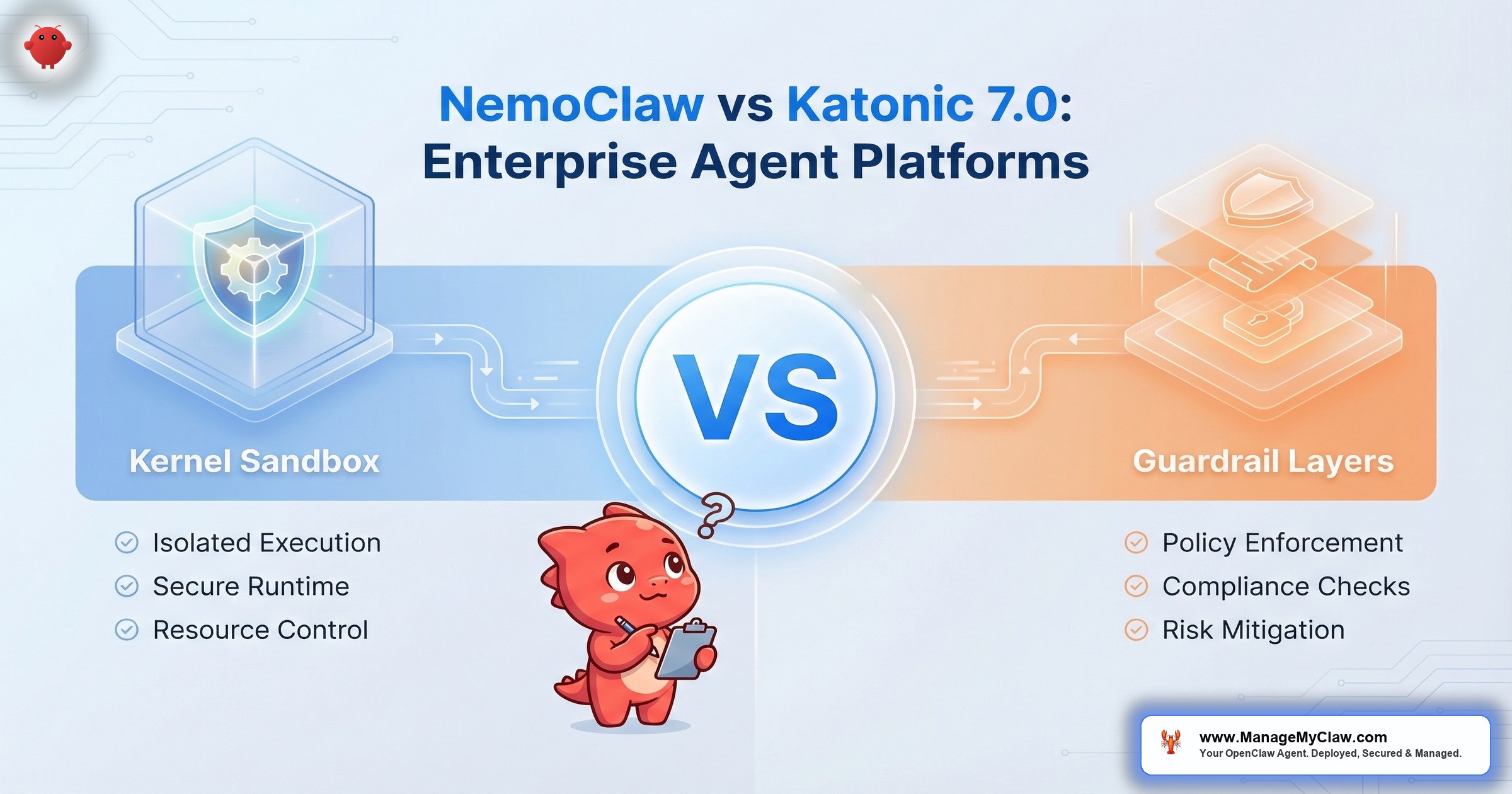
For financial services organizations evaluating NemoClaw, the build-vs-buy analysis covers the cost of internal implementation versus specialist deployment. The NemoClaw vs. Katonic comparison covers the architectural differences between kernel-level and application-layer agent governance.
Frequently Asked Questions
Does NemoClaw meet SOX Section 404 requirements for internal controls?
NemoClaw provides the technical controls that support SOX compliance: kernel-level audit trails, role-based agent permissions via YAML policies, and immutable action records. The compliance determination depends on how these controls are implemented, documented, and tested within your specific environment. ManageMyClaw Enterprise includes a SOC2 evidence package and audit trail setup as part of the Tier 2 implementation to ensure the controls map to your compliance requirements.
Can NemoClaw handle PCI DSS Level 1 requirements?
NemoClaw’s privacy router keeps payment card data on local infrastructure, and the OpenShell sandbox provides network segmentation and filesystem isolation. These are architectural building blocks for PCI DSS compliance. Level 1 certification requires a QSA assessment of your complete cardholder data environment — NemoClaw’s controls contribute to that assessment but do not replace it. The key advantage is that NemoClaw keeps cardholder data within your CDE boundary by default rather than sending it to cloud model providers.
How does NemoClaw support DORA’s ICT incident reporting requirements?
NemoClaw’s kernel-level audit logging captures the data required for DORA incident reports: timestamp, systems affected, data accessed, actions taken, and outcome. Integration with your SIEM platform routes these logs through your existing incident response workflow. CrowdStrike Falcon AIDR integration provides real-time anomaly detection. When an incident occurs, the forensic data is already captured and formatted for regulatory reporting.
Is NemoClaw mature enough for production financial services use?
NemoClaw is alpha software as of March 2026. The core security primitives (OpenShell sandbox, policy engine, privacy router) work today. NVIDIA shipped it with 17 launch partners including CrowdStrike and SAP. For financial services, we recommend starting with a pilot deployment ($5,000 for 30 days) on a non-critical workflow — regulatory reporting preparation or document processing — to validate the architecture against your compliance requirements before broader rollout. Early adopters who build governance frameworks now will be production-ready when NemoClaw reaches GA.
What hardware does NemoClaw require for financial services deployments?
NemoClaw’s minimum system requirements are Linux, 4 vCPU, and 8 GB RAM. For financial services deployments running local Nemotron models via the privacy router, GPU-accelerated hardware is recommended for inference performance. NVIDIA’s DGX or Dell Pro Max GB10 (DGX Spark, $4,756.84) provide the local compute needed for privacy-routed workloads. The specific hardware requirements scale with the volume of data processing and the number of concurrent agents.
Deploy NemoClaw with the compliance controls your auditor requires.
ManageMyClaw Enterprise implements NemoClaw with SOX audit trails, PCI DSS data isolation, and DORA-ready monitoring — including compliance documentation, SIEM integration, and CrowdStrike Falcon configuration. Start with the $5,000 Pilot Program.
See Enterprise Pricing Learn About Managed Deployment