48% of CISOs rank agentic AI as their number one attack vector in 2026. In federal agencies, that number is closer to a mandate: zero tolerance.
Government organizations face a paradox that the private sector does not. Federal leadership wants AI-driven automation — the Executive Order on Artificial Intelligence, OMB memoranda M-24-10 and M-24-18, and agency-specific directives all push adoption. But the infrastructure requirements for government AI deployments make commercial SaaS solutions non-starters. Air-gapped networks, FedRAMP authorization, FISMA compliance, controlled unclassified information handling, and supply chain risk management under NIST SP 800-161 — these are not optional add-ons. They are table stakes.
The private sector asks “can we deploy AI agents?” Government asks “can we deploy AI agents on a network that never touches the public internet, with audit trails that satisfy an Inspector General, using hardware that clears supply chain review?”
NemoClaw — NVIDIA’s enterprise-grade fork of the OpenClaw framework, launched with 17 partners including CrowdStrike, Adobe, and Salesforce at GTC 2026 — is the first AI agent stack built for exactly this class of deployment. Its architecture separates the security plane from the agent plane at the kernel level: OpenShell sandbox with Landlock filesystem isolation, out-of-process YAML policy engine, and a privacy router that can keep all inference local. No data leaves the enclave. No model calls hit the public internet.
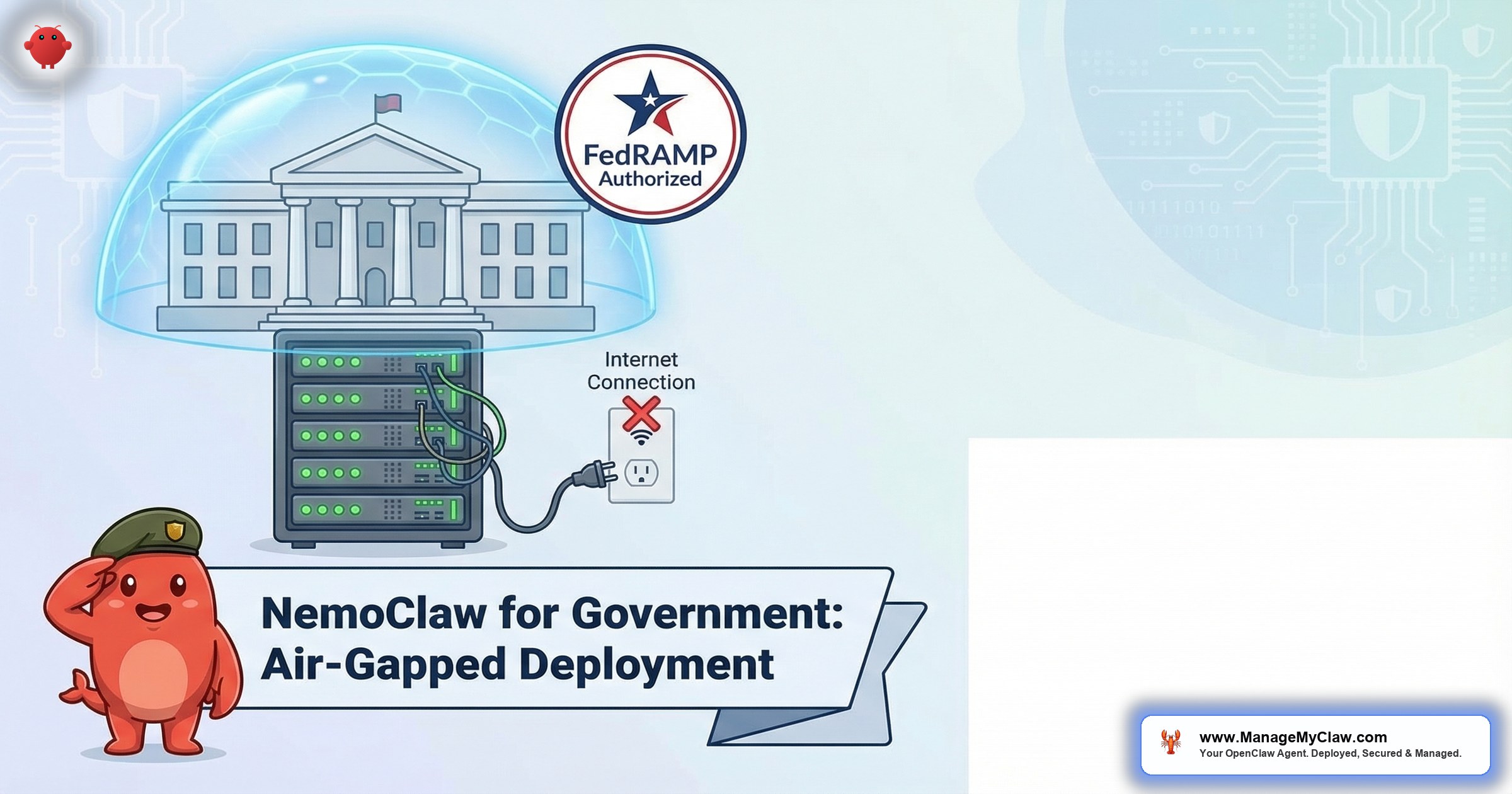
And critically for government buyers: NVIDIA’s DGX Station supports air-gapped configurations natively. The hardware, the models, the agent framework, and the governance layer can all operate inside a disconnected network with no architectural compromises.
Why Government Needs a Different Architecture
Commercial AI agent deployments — including standard OpenClaw — rely on cloud-based model APIs. Every prompt, every response, every piece of context traverses the public internet. For a startup automating email triage, that model works. For a Department of Defense analyst processing intelligence briefings, or a VA case worker handling veteran health records, or an IRS agent triaging taxpayer correspondence, it does not.
The requirements break down into 4 categories that commercial deployments rarely address simultaneously.
Network isolation. Air-gapped networks have no physical or logical connection to the public internet. Every component of the AI stack — model weights, agent framework, governance tools, monitoring infrastructure — must operate entirely within the secure enclave. Cloud API calls are not an option. Hybrid architectures that “fall back” to cloud inference are not compliant. The entire inference pipeline runs locally.
Data sovereignty. Controlled Unclassified Information, Personally Identifiable Information, Protected Health Information, and classified data cannot leave authorized boundaries. NIST SP 800-171 defines 110 security requirements for CUI handling. The AI agent that processes this data must be subject to the same controls as every other system in the authorization boundary — including access controls, audit logging, incident response, and media protection.
Supply chain integrity. Executive Order 14028 and NIST SP 800-161 require agencies to evaluate the provenance of every software component. Open-source AI agent frameworks with 13,729+ community-contributed plugins and a documented malware incident (ClawHavoc planted 2,400+ malicious skills on ClawHub) present a supply chain risk that government procurement offices flag immediately.
Continuous authorization. FedRAMP and FISMA do not end at initial deployment. Continuous monitoring, vulnerability scanning, Plan of Action and Milestones management, and annual reauthorization are ongoing requirements. An AI agent stack that ships 7 updates in 2 weeks — as OpenClaw does — creates a continuous authorization challenge that most agencies are not staffed to handle manually.
Why this matters: These are not hypothetical compliance boxes. The Government Accountability Office reported that 23 of 24 major federal agencies had cybersecurity as a material weakness or significant deficiency in their financial audits. Adding an AI agent with access to agency systems without the controls above creates audit findings, not productivity gains.
NemoClaw’s Architecture for Air-Gapped Deployment
NemoClaw was not designed for air-gapped use as an afterthought. The architecture supports disconnected operation at every layer.
OpenShell Sandbox: Kernel-Level Isolation
OpenShell replaces Docker-level sandboxing with kernel-level enforcement. Landlock Linux Security Module restricts filesystem access to explicitly allowed paths. Seccomp filters block dangerous system calls. Network namespaces isolate the agent from other processes on the same host. The sandbox operates on a deny-by-default model: the agent has access to nothing unless explicitly granted.
For government deployments, this means the agent cannot access files outside its designated workspace, cannot make unauthorized network connections (even on an internal network), and cannot escalate privileges — even if the agent’s instructions are manipulated through prompt injection.
Privacy Router: All Inference Stays Local
The privacy router is what makes air-gapped NemoClaw viable. In a commercial deployment, the router splits requests between local Nemotron models (for sensitive data) and cloud models (for general reasoning). In a government air-gapped deployment, the router directs all inference to local Nemotron models running on NVIDIA hardware inside the secure boundary. No routing table entry points outside the enclave.
Nemotron models — NVIDIA’s family of open-weight large language models — run entirely on-premise. Model weights are transferred to the air-gapped environment through approved media transfer procedures (the same process agencies use for any software deployment to disconnected networks). Once loaded, the models require no external connectivity.
YAML Policy Engine: Auditable Governance
NemoClaw’s policy engine evaluates every agent action through 4 levels of policy checking: binary (allowed/denied), destination (where data can be sent), method (what operations are permitted), and path (which resources are accessible). Policies are defined in human-readable YAML files that can be reviewed by compliance officers, version-controlled in agency repositories, and mapped directly to NIST 800-53 controls.
The policy engine runs as a separate process — out-of-process from the agent itself. A compromised agent cannot modify its own governance rules. This architectural separation is the equivalent of separation of duties in access control: the entity being governed cannot govern itself.
DGX Station: Purpose-Built Air-Gapped Hardware
NVIDIA’s DGX Station supports air-gapped configurations as a documented deployment mode. The workstation-class hardware provides the GPU compute needed for local Nemotron inference without requiring rack-mounted data center infrastructure. For agencies deploying NemoClaw in SCIFs (Sensitive Compartmented Information Facilities), secure operations centers, or field environments, DGX Station provides the compute density in a form factor that fits existing physical security perimeters.
The hardware supply chain is NVIDIA-controlled from fabrication through delivery, addressing NIST SP 800-161 supply chain risk concerns that open-source software running on commodity cloud infrastructure cannot satisfy.
Why this matters: Air-gapped deployment is not “disconnect the Ethernet cable and hope.” It requires every layer of the stack — hardware, model inference, agent framework, policy engine, and monitoring — to operate independently of external connectivity. NemoClaw’s architecture supports this natively. OpenClaw’s does not.
JetPatch: Enterprise Control Plane for Government Verticals
JetPatch announced its Enterprise Control Plane for NemoClaw, adding fleet management capabilities specifically relevant to government deployments with multiple agents across multiple classification domains.
Centralized policy management. Define YAML policies once and propagate them across all NemoClaw agents in the deployment. When a policy changes — new data handling restrictions, updated access controls, revised escalation procedures — JetPatch pushes the update to every agent without manual reconfiguration of individual instances.
Patch orchestration. When NVIDIA releases a NemoClaw update, JetPatch handles staged rollouts: test in a non-production environment, validate against policy compliance, then deploy to production agents in controlled batches. For agencies managing dozens of NemoClaw agents across multiple networks, this replaces the manual update-and-pray cycle.
Compliance reporting. JetPatch generates reports mapping NemoClaw’s security controls to NIST 800-53, FedRAMP, and FISMA requirements. These reports feed directly into agency POA&M processes and continuous monitoring dashboards.
Why this matters: Government agencies do not deploy single agents. They deploy fleets — across bureaus, field offices, and classification domains. Managing each agent individually does not scale. JetPatch provides the fleet governance layer that turns NemoClaw from a promising technology into an operationally viable government platform.
The FedRAMP Readiness Path
NemoClaw is not FedRAMP authorized today. NVIDIA has not publicly announced a FedRAMP timeline. That is an honest assessment of where things stand in March 2026.
But the architectural foundations for FedRAMP readiness are in place, and agencies pursuing Authority to Operate through their own assessment process have a credible path.
NIST 800-53 control mapping. NemoClaw’s architecture addresses controls across multiple families: Access Control (AC) through the policy engine, Audit and Accountability (AU) through comprehensive logging, Configuration Management (CM) through YAML-defined policies, System and Communications Protection (SC) through OpenShell sandboxing and network namespaces, and System and Information Integrity (SI) through continuous monitoring and update management.
Boundary definition. NemoClaw’s separation of the agent process, policy engine, privacy router, and monitoring components maps cleanly to the system boundary documentation required for ATO packages. Each component has defined interfaces, data flows, and security controls.
Continuous monitoring support. The logging and audit capabilities in NemoClaw — every agent action logged with timestamp, policy evaluation result, and data classification — feed the continuous monitoring requirements that FedRAMP and FISMA mandate post-authorization.
OWASP Agentic Top 10 alignment. NemoClaw’s security architecture maps directly to the OWASP ASI01-ASI10 framework, covering Agentic Injection (ASI01) through sandbox isolation, Unsafe Tool/Function Calling (ASI02) through the policy engine, and Excessive Permissions (ASI03) through deny-by-default access controls. This mapping provides assessment teams with a recognized framework for evaluating the agent’s security posture.
Government agencies that start the ATO process now — while NemoClaw is in alpha — position themselves to deploy at scale when the platform reaches general availability. Agencies that wait for GA to begin their authorization process will be 12–18 months behind.
Government Use Cases That Map to NemoClaw
AI agent automation in government follows the same logic as commercial deployment: identify repeatable tasks with structured inputs and defined outputs. The difference is the security and compliance wrapper around each workflow.
Intelligence briefing compilation. An agent pulls data from classified and unclassified sources within the agency network, formats intelligence summaries by priority and topic, and delivers them to analysts at shift start. All processing happens on air-gapped infrastructure. All source material stays within the classification boundary.
Constituent correspondence triage. Congressional offices and agency public affairs divisions handle thousands of emails, letters, and portal submissions per week. An agent categorizes by topic and urgency, drafts standard responses for routine inquiries, and escalates complex cases with full context to the appropriate specialist. The privacy router ensures no constituent PII leaves agency infrastructure.
Compliance document review. Agencies reviewing contractor submissions, grant applications, or regulatory filings can deploy agents that check documents against requirements checklists, flag missing sections or non-compliant language, and generate preliminary review summaries. The policy engine restricts the agent to read-only access on all document repositories.
IT service desk automation. Federal IT help desks handle 80% routine requests — password resets, access requests, equipment provisioning. An agent triages tickets, resolves routine items through established procedures, and escalates complex issues with full diagnostic context. Audit logging captures every action for FISMA compliance.
Why this matters: Government agencies spend $100+ billion annually on IT operations. McKinsey estimates that AI automation could reduce federal administrative costs by 20–30%. But only if the deployment architecture meets the security and compliance requirements that government mandates. NemoClaw on air-gapped DGX Station infrastructure is the first stack that can deliver both the productivity gains and the compliance posture simultaneously.
What a Government NemoClaw Deployment Looks Like
A government implementation follows a different timeline and process than commercial deployment. The phases below reflect the reality of federal procurement, ATO, and change management.
Phase 1: Assessment (2–4 weeks). Architecture review of existing infrastructure. Gap analysis against NIST 800-53 and OWASP Agentic Top 10. Hardware specification for air-gapped compute requirements. Written report with remediation plan and ATO evidence mapping.
Phase 2: Pilot (4–8 weeks). Single-agent deployment on designated hardware within the agency’s test environment. One workflow configured and validated. Security controls tested by agency assessment team. Policy engine configured to agency-specific requirements. Written evaluation at completion with go/no-go recommendation.
Phase 3: Production Deployment (4–12 weeks). Full NemoClaw stack on production air-gapped infrastructure. Multiple agents configured for approved workflows. JetPatch control plane deployed for fleet management. Integration with agency SIEM and SOC infrastructure. Compliance documentation package delivered for ATO submission.
Phase 4: Managed Operations (ongoing). Continuous monitoring. Update management through JetPatch staged rollouts. Quarterly security reviews. Policy engine updates as agency requirements evolve. Compliance evidence maintenance for continuous authorization.
The Bottom Line
Government agencies need AI agents. The productivity mandate is real. But deploying a commercial AI agent framework — one with 9 disclosed CVEs, 42,665 exposed instances, and a documented malware incident on its plugin marketplace — on government infrastructure is not a path any agency CISO will approve.
NemoClaw’s kernel-level sandbox, out-of-process policy engine, privacy router with fully local inference, and DGX Station air-gapped hardware support provide the architecture that government security requirements demand. JetPatch adds the fleet governance layer for multi-agent deployments across classification domains. The FedRAMP readiness path is credible even though formal authorization has not been announced.
The agencies that begin their assessment and pilot process now will be production-ready when NemoClaw reaches general availability. The agencies that wait will still be writing their ATO packages.
Frequently Asked Questions
Can NemoClaw operate on a fully air-gapped network with no internet connectivity?
Yes. NemoClaw’s privacy router directs all inference to local Nemotron models running on NVIDIA hardware within the secure boundary. Model weights, agent framework, policy engine, and monitoring tools all operate without external connectivity. Initial software and model deployment uses approved media transfer procedures — the same process agencies use for any software installation on disconnected networks. NVIDIA’s DGX Station supports air-gapped configurations as a documented deployment mode.
Is NemoClaw FedRAMP authorized?
Not yet. NVIDIA has not publicly announced a FedRAMP authorization timeline as of March 2026. However, NemoClaw’s architecture maps to NIST 800-53 controls across multiple families (Access Control, Audit and Accountability, Configuration Management, System and Communications Protection). Agencies pursuing ATO through their own assessment process have a credible path using the platform’s built-in security controls, YAML-defined policies, and comprehensive audit logging.
How does NemoClaw handle classified data?
NemoClaw’s privacy router ensures all data processing stays within the authorization boundary. OpenShell’s kernel-level sandbox restricts the agent to explicitly allowed file paths and network destinations. The YAML policy engine enforces data handling rules at every agent action. Combined with air-gapped DGX Station hardware in an approved facility, the architecture supports deployment within classified environments — subject to the agency’s specific security assessment and authorization process.
What hardware does a government NemoClaw deployment require?
Minimum production requirements are Linux with 4 vCPU and 8 GB RAM for the agent framework itself. For air-gapped deployments running local Nemotron models, NVIDIA DGX Station provides the GPU compute density needed for on-premise inference. The specific DGX configuration depends on the number of concurrent agents, model size, and inference throughput requirements. Smaller pilot deployments can run on Dell Pro Max GB10 (DGX Spark) at $4,756.84 for initial proof-of-concept work.
How does JetPatch help manage NemoClaw in government environments?
JetPatch provides centralized policy management, staged patch rollouts, and compliance reporting specifically designed for multi-agent NemoClaw deployments. In government environments with dozens of agents across multiple networks and classification domains, JetPatch replaces manual per-agent configuration with fleet-level governance. Its compliance reporting maps NemoClaw’s security controls to NIST 800-53 and FedRAMP requirements, feeding directly into agency continuous monitoring and POA&M processes.
Government NemoClaw Assessment
ManageMyClaw provides NemoClaw assessment, implementation, and managed care for government organizations. Architecture review, OWASP ASI01-ASI10 gap analysis, and ATO evidence mapping — starting at $2,500 for assessment. Schedule a call with our team to discuss your agency’s requirements.
Schedule Architecture ReviewRelated reading: Managed OpenClaw Deployment • NemoClaw for Manufacturing: Edge AI Agents on Jetson AGX Thor • OpenClaw Security: The Complete Hardening Guide
Not affiliated with or endorsed by the OpenClaw open-source project or NVIDIA Corporation.