Unplanned downtime costs industrial manufacturers an estimated $50 billion per year globally. A single hour of downtime in an automotive assembly plant costs $1.3 million on average. And the median manufacturer still relies on scheduled maintenance intervals and operator experience to predict equipment failures.
AI-driven predictive maintenance can reduce unplanned downtime by 30–50% and extend equipment lifespan by 20–40%, according to McKinsey’s 2025 analysis of industrial AI adoption. Deloitte’s manufacturing survey found that predictive maintenance programs reduce maintenance costs by 25% and eliminate 70% of breakdowns.
But here is the problem: cloud-based AI does not work on a factory floor.
Manufacturing environments have latency requirements measured in milliseconds, not seconds. They have connectivity that drops when a forklift clips a cable. They have operational technology networks that security teams will never connect to the public internet. And they have data sovereignty requirements that keep proprietary process data inside the plant perimeter.
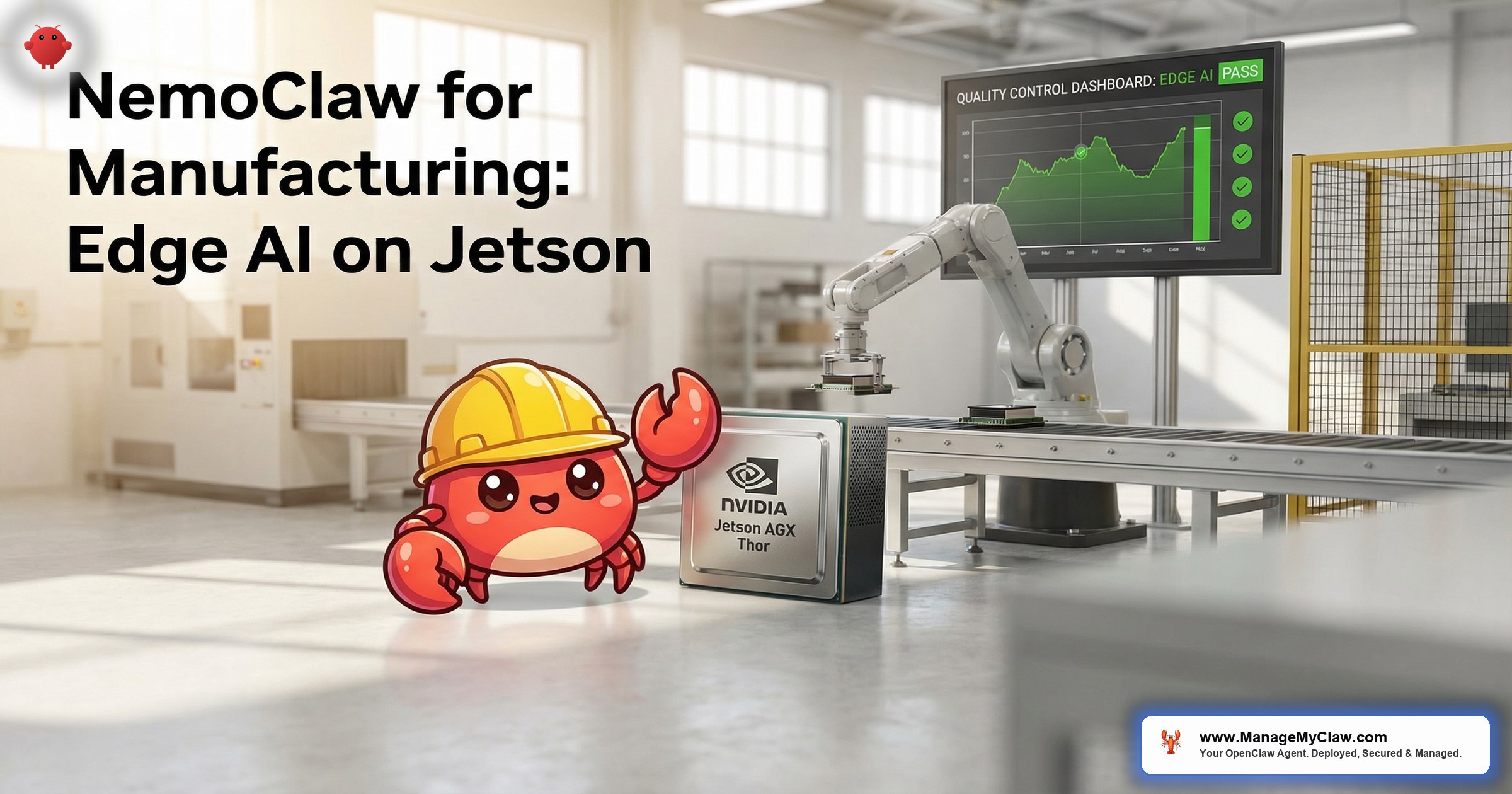
NemoClaw on NVIDIA Jetson AGX Thor is the first AI agent architecture designed to operate at the industrial edge — delivering agent-level intelligence with local inference, kernel-level security, and no cloud dependency.
Why Factory Floor AI Needs Edge Architecture
Cloud AI makes sense when you have reliable connectivity and can tolerate 100–500 milliseconds of round-trip latency. Manufacturing has neither.
Latency kills. A quality control agent inspecting parts on a production line running at 60 units per minute has 1 second per part. Send the image to a cloud API, wait for inference, receive the result — the part has already moved 3 stations down the line. Edge inference on Jetson AGX Thor processes locally in single-digit milliseconds. The agent makes a pass/fail decision before the part reaches the next station.
Connectivity is unreliable. Factory networks deal with electromagnetic interference from welding equipment, vibration-induced cable failures, and OT/IT network segmentation that restricts internet access by design. An AI agent that stops functioning when connectivity drops is not an automation tool — it is a liability. Jetson AGX Thor runs inference locally. Network connectivity affects data aggregation and reporting, not real-time decision-making.
Data stays in the plant. Manufacturers treat process data — cycle times, defect rates, equipment parameters, tooling configurations — as trade secrets. BMW, Toyota, and TSMC do not send their production metrics to cloud APIs for inference. NemoClaw’s privacy router on Jetson AGX Thor processes all data locally. Aggregated analytics can be exported through controlled channels, but raw process data never leaves the factory network.
OT networks are not negotiable. IEC 62443 and the Purdue Model define how industrial control systems are segmented from enterprise IT networks. Adding an AI agent that requires cloud connectivity to an OT network violates the fundamental architecture that keeps production systems safe from IT-originating threats. NemoClaw on Jetson operates entirely within the OT boundary.
Why this matters: Gartner projects that 75% of enterprise-generated data will be created and processed at the edge by 2027. Manufacturing is leading this shift because the physics of production — speed, reliability, data sensitivity — demand it. Cloud AI is a reporting layer. Edge AI is the operational layer.
Jetson AGX Thor: The Hardware Foundation
NVIDIA’s Jetson AGX Thor is a System-on-Module designed for autonomous machines and edge AI workloads. It delivers up to 800 TOPS (Tera Operations Per Second) of AI performance in a module that consumes 100 watts — compared to the 700+ watts of a data center GPU.
Compute density. Thor integrates NVIDIA’s next-generation GPU architecture with an ARM CPU complex, delivering the compute needed to run Nemotron models locally at the edge. A single Thor module can handle multi-modal inference — processing sensor data, camera feeds, and time-series telemetry simultaneously.
Industrial form factor. The module is designed for deployment in industrial environments with extended temperature ranges, shock and vibration tolerance, and fanless cooling options. It mounts in industrial enclosures alongside PLCs and HMIs, not in server racks in climate-controlled data centers.
Multi-sensor integration. Thor supports camera inputs, LiDAR, radar, and industrial sensor protocols. A NemoClaw agent running on Thor can ingest data from vibration sensors, thermal cameras, acoustic monitors, and vision systems simultaneously — the full sensory spectrum needed for comprehensive equipment monitoring.
Software ecosystem. NemoClaw on Jetson uses NVIDIA’s JetPack SDK, Isaac (for robotics and perception), and Metropolis (for vision AI). The agent has access to pre-trained models for defect detection, object tracking, and anomaly classification that can be fine-tuned on plant-specific data without requiring ML engineering expertise.
Manufacturing Workflows: Where NemoClaw Delivers
Predictive Maintenance
Traditional maintenance is either reactive (fix it when it breaks) or scheduled (replace it every N hours regardless of condition). Both are wasteful. Reactive maintenance causes unplanned downtime. Scheduled maintenance replaces components with 40–60% of their useful life remaining.
A NemoClaw agent running on Jetson AGX Thor monitors equipment continuously through vibration sensors, acoustic monitors, thermal cameras, and power consumption data. It builds a baseline for each machine, detects deviations that indicate developing failures, and generates maintenance work orders with predicted failure windows.
How it works in practice: A CNC milling machine’s spindle bearing produces a characteristic vibration signature as it degrades. The NemoClaw agent detects the frequency shift 2–3 weeks before failure, estimates remaining useful life based on historical degradation curves, and creates a maintenance work order timed for the next scheduled production break. The bearing gets replaced during planned downtime instead of causing a line shutdown.
All inference happens locally on Thor. Vibration data, thermal profiles, and acoustic signatures never leave the plant network. The policy engine restricts the agent to read-only access on equipment control systems — it can monitor and report, but it cannot actuate. Humans make the maintenance decision.
Visual Quality Control
Manual visual inspection catches 80% of defects on a good day. Inspector fatigue, shift changes, and subjective judgment create variability that costs manufacturers 15–20% in scrap and rework.
A NemoClaw agent with vision capabilities inspects every unit at production speed. It identifies surface defects, dimensional variances, assembly errors, and cosmetic issues. When a defect is detected, the agent classifies it by type and severity, logs it with the unit’s serial number and production parameters, and triggers the appropriate response — from flagging for human review to activating a reject gate on the conveyor.
Detection consistency: The agent inspects at the same standard on unit 1 and unit 10,000. There is no fatigue curve, no shift handover variability, and no “Friday afternoon” quality dip. Defect classification is consistent and traceable — every decision is logged with the image, the classification, and the confidence score.
Process Optimization
Manufacturing processes have hundreds of parameters — temperature profiles, feed rates, pressure setpoints, material batch variations. A NemoClaw agent monitors these parameters in real time, correlates them with output quality and throughput, and identifies optimization opportunities that human operators miss because the parameter space is too large to track manually.
Example: An injection molding operation runs 8 machines making the same part. Each machine has slightly different thermal characteristics due to age, wear, and position in the facility. The agent monitors mold temperature, injection pressure, cycle time, and part weight across all 8 machines, identifies which parameter combinations produce the lowest defect rates, and recommends adjustments to bring underperforming machines to the level of the best performer.
Safety and Compliance Monitoring
A NemoClaw agent with vision and sensor fusion capabilities monitors PPE compliance (hard hats, safety glasses, high-visibility vests), restricted zone incursions, and equipment lockout/tagout procedures. Detections trigger immediate alerts to shift supervisors with visual evidence. The agent does not replace safety officers — it ensures coverage during gaps between rounds and across camera feeds that no human can monitor simultaneously.
Why this matters: These are not experimental use cases. They are established manufacturing practices that NemoClaw brings from specialized industrial AI systems into a unified agent framework. The difference is that NemoClaw combines sensor monitoring, inference, decision-making, and communication into a single agent that operates on a single piece of edge hardware — rather than requiring separate systems for each function.
Security on the Factory Floor
Industrial cybersecurity is not IT security in a hard hat. The consequences of a compromised industrial system extend beyond data loss to physical safety, environmental impact, and production disruption.
NemoClaw’s security architecture maps to IEC 62443 industrial security requirements:
- OpenShell sandbox: The agent runs in a kernel-level sandbox with deny-by-default access. Even if the agent is compromised through prompt injection, it cannot access control systems, modify PLC programs, or alter equipment setpoints.
- Read-only by default: The YAML policy engine restricts NemoClaw agents to monitoring and reporting. No write access to control systems without explicit, human-approved policy exceptions.
- Network isolation: NemoClaw on Jetson operates within the OT network segment. Network namespaces prevent the agent from communicating across the OT/IT boundary without passing through the security controls defined in the network architecture.
- Audit logging: Every agent action — every sensor read, every analysis, every alert triggered — is logged with timestamp and policy evaluation result. These logs support both cybersecurity audit requirements and quality management system documentation (ISO 9001, IATF 16949).
An AI agent with write access to a PLC program is not an automation tool. It is an attack vector with a conversation interface.
Deployment Architecture for Manufacturing
A typical manufacturing NemoClaw deployment uses a tiered architecture:
Edge tier: Jetson AGX Thor modules deployed at or near each production line. Each module runs 1–3 NemoClaw agents handling real-time monitoring, quality inspection, and anomaly detection. Inference is fully local. Response time is single-digit milliseconds.
Plant tier: A DGX Station or server-class NVIDIA GPU system aggregates data from edge modules, runs plant-wide analytics, correlates patterns across production lines, and hosts the JetPatch control plane for fleet management of all edge agents.
Enterprise tier (optional): For multi-plant manufacturers, an enterprise layer aggregates plant-level analytics for corporate dashboards, cross-plant optimization, and executive reporting. This layer can run on cloud infrastructure because it handles aggregated analytics, not real-time operational data.
JetPatch manages YAML policies across all tiers — a policy change at the enterprise level (new quality standard, updated safety requirement) propagates to every edge agent across every plant through staged rollouts.
The Bottom Line
Manufacturing AI has been promised for a decade. The gap has always been between what cloud-based AI can do and what factory-floor operations actually need. Cloud AI is too slow, too dependent on connectivity, and too risky for OT networks.
NemoClaw on Jetson AGX Thor closes that gap. Local inference at millisecond latency. Kernel-level security that satisfies IEC 62443. Privacy routing that keeps process data in the plant. And a unified agent framework that handles predictive maintenance, quality control, process optimization, and safety monitoring on a single edge platform.
The manufacturers deploying edge AI agents now will have 12–18 months of operational data and process optimization when their competitors start their pilot programs.
Frequently Asked Questions
Can NemoClaw on Jetson AGX Thor operate without any cloud connectivity?
Yes. NemoClaw’s privacy router directs all inference to local Nemotron models running on the Jetson module. Real-time monitoring, quality inspection, and anomaly detection all function without internet connectivity. Network access is needed only for optional data aggregation to plant-level or enterprise-level analytics — and that connectivity uses internal OT/IT networks, not the public internet.
Does NemoClaw have write access to PLCs or equipment control systems?
Not by default. The YAML policy engine enforces read-only access to all control systems. NemoClaw agents monitor, analyze, and report — but they do not actuate. Any write access to control systems requires explicit policy exceptions approved by plant engineering and documented in the audit log. This is a deliberate design choice: an AI agent should inform maintenance decisions, not make them autonomously on safety-critical equipment.
How many NemoClaw agents can a single Jetson AGX Thor module support?
Depending on workflow complexity and sensor input volume, a single Thor module typically runs 1–3 concurrent NemoClaw agents. A predictive maintenance agent monitoring vibration and thermal data from 4–6 machines, a quality inspection agent processing camera feeds at production speed, and a safety monitoring agent tracking PPE compliance can run simultaneously on one module. Multi-modal workloads (vision plus sensor fusion) consume more compute than single-mode monitoring.
How does NemoClaw integrate with existing SCADA and MES systems?
NemoClaw on Jetson supports standard industrial protocols (OPC-UA, MQTT, Modbus TCP) for reading data from SCADA systems and PLCs. Integration with Manufacturing Execution Systems uses REST APIs or database connectors. The agent ingests data from existing systems without requiring changes to the production control architecture. Work orders and maintenance alerts generated by NemoClaw can be pushed to CMMS (Computerized Maintenance Management Systems) through standard integrations.
What is the ROI timeline for predictive maintenance with NemoClaw?
Most manufacturing deployments see measurable results within 8–12 weeks. The first 4–6 weeks are baseline building — the agent learns normal operating signatures for each monitored machine. After baseline establishment, the agent begins identifying anomalies and predicting failures. Deloitte’s research indicates predictive maintenance programs reduce maintenance costs by 25% and eliminate 70% of breakdowns — with the largest returns in high-value equipment where a single unplanned failure costs $50,000 or more per hour.
NemoClaw for Manufacturing Assessment
ManageMyClaw provides NemoClaw assessment, edge deployment, and managed care for manufacturing organizations. Architecture review, OT security gap analysis, and pilot program scoping — starting at $2,500 for assessment. Talk to our team about your production environment.
Schedule Architecture ReviewRelated reading: Managed OpenClaw Deployment • NemoClaw for Government: Air-Gapped Deployment and FedRAMP Readiness • OpenClaw Security: The Complete Hardening Guide
Not affiliated with or endorsed by the OpenClaw open-source project or NVIDIA Corporation.