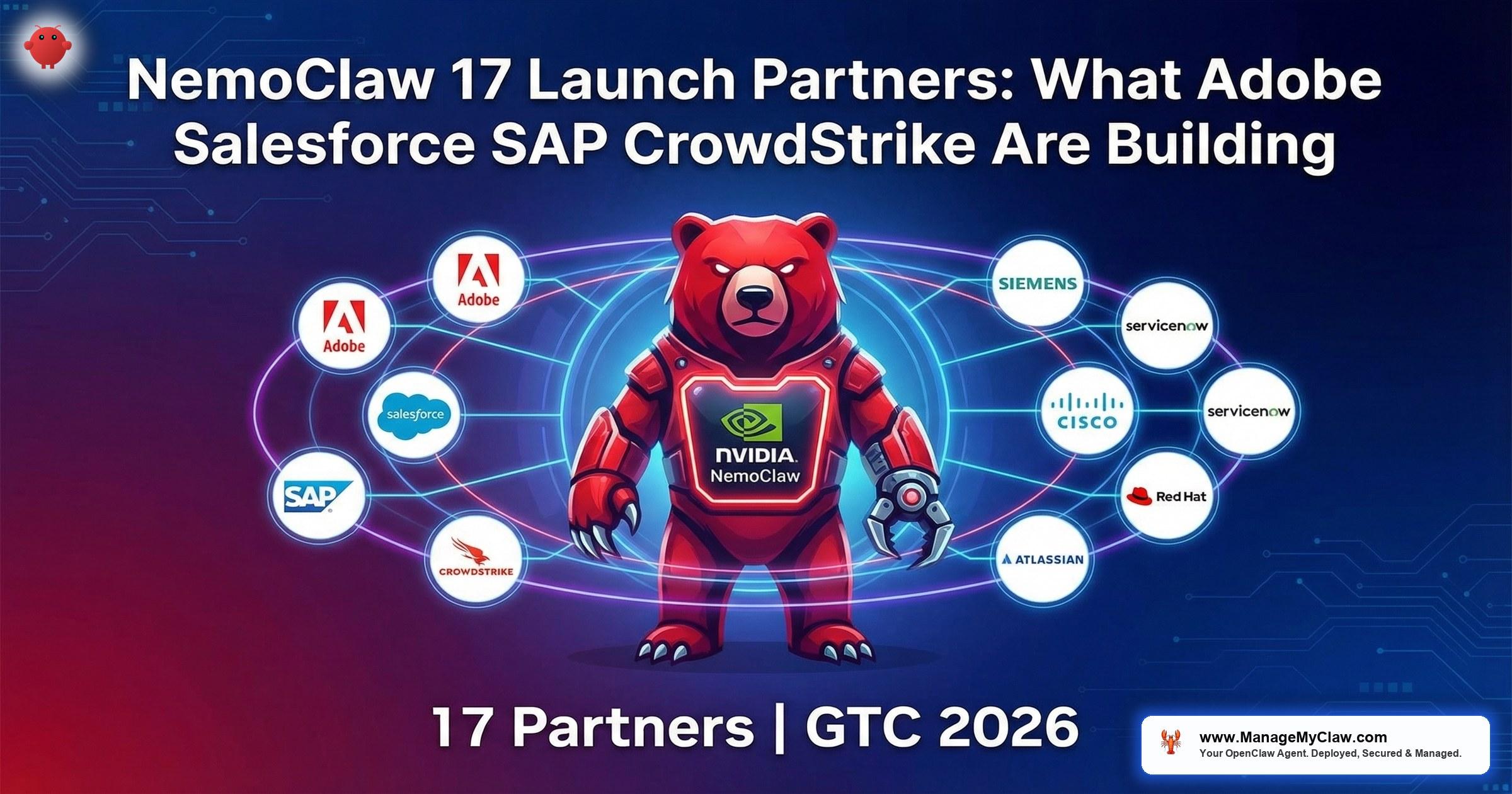
“Nvidia launches enterprise AI agent platform with Adobe, Salesforce, SAP among 17 adopters at GTC 2026.”
— VentureBeat, GTC 2026 Coverage • March 2026
Seventeen companies committed to NVIDIA’s NemoClaw platform at GTC 2026. Not seventeen startups looking for press coverage. Adobe. Salesforce. SAP. CrowdStrike. Atlassian. ServiceNow. Cisco. Red Hat. Siemens. Dassault Systèmes. Companies whose combined enterprise customer base touches nearly every Fortune 500 organization on the planet.
That partner list is the most important signal to come out of GTC — more important than the technical specifications, more important than the benchmarks, more important than the roadmap. Because when the platforms your organization already depends on — your CRM, your project management, your security stack, your content tools — all adopt the same underlying standard for AI agent governance, a gravitational pull forms. The ecosystem makes the adoption decision for you.
Gartner projects that 40% of enterprise applications will include AI agents by end of 2026. This partner list suggests how many of those agents will run on NemoClaw infrastructure. This post breaks down what each launch partner is building, why the ecosystem composition matters for your evaluation, and what it means for organizations planning AI agent deployments in the second half of 2026.
Launch partners committed at GTC 2026
Of enterprise apps will include AI agents by end 2026 (Gartner)
Why 17 Partners Matters More Than 17 Features
Enterprise technology adoption follows a predictable pattern. Platforms succeed or fail based on ecosystem commitment, not feature lists. Kubernetes won container orchestration because Google, Red Hat, Microsoft, and AWS all committed to the same standard. Once the ecosystem converged, choosing an alternative became a risk rather than a preference.
NemoClaw’s launch partner list follows the same pattern, compressed into a single announcement. Consider what the composition signals:
- Software platform vendors (Adobe, Salesforce, SAP, Atlassian, ServiceNow, Box) — The tools your organization already runs are building NemoClaw-native agents. These are not theoretical integrations. These are product roadmap commitments from companies with quarterly earnings calls.
- Security vendors (CrowdStrike, Cisco) — The companies responsible for protecting your infrastructure are embedding NemoClaw into their security architectures. That is a validation signal your CISO will understand.
- System integrators (Accenture, Wipro, Infosys) — The firms that implement enterprise technology at scale are training their teams on NemoClaw. When your consulting partner recommends a platform, the recommendation carries implementation capacity behind it.
- Hardware OEMs (Dell, HPE, Lenovo) — NemoClaw-ready server configurations are coming to market. The infrastructure layer is aligning with the software layer.
- Engineering tools (Cadence, Synopsys, Siemens, Dassault Systèmes) — EDA, PLM, and simulation vendors are building NemoClaw agents for engineering workflows that touch intellectual property worth billions.
When your CRM vendor, your security vendor, your project management platform, and your system integrator all adopt the same agent governance standard, the question shifts from “should we evaluate NemoClaw?” to “how far behind are we if we don’t?”
NemoClaw’s partner list spans the full enterprise technology stack: productivity, security, CRM, DevOps, engineering, and infrastructure. This is not a single-vertical play. It is a horizontal platform adoption pattern — the same pattern that made Kubernetes, OAuth, and the Model Context Protocol (MCP) into de facto standards. The Agent Toolkit — NVIDIA’s open-source developer platform to standardize and scale autonomous AI agents — is the connective tissue across all 17 partners.
Community signals reinforce the enterprise adoption pattern. The nemoclaw.so blog published “What to Expect from NemoClaw at GTC 2026” ahead of the announcement — community-driven anticipation that enterprise platform launches rarely generate. ChatMaxima’s analysis of NemoClaw for customer support AI highlights another vertical: privacy routing for customer data in support agent workflows, where PII protection requirements intersect with real-time response expectations.
The Complete NemoClaw Launch Partner Ecosystem
If you recognize more than three names in this table as current vendors, NemoClaw is already part of your technology roadmap — whether your organization has decided to adopt it or not.
| Partner | Category | What They’re Building | Enterprise Impact |
|---|---|---|---|
| Adobe | Creative / Marketing | Evaluating OpenShell + Nemotron as foundations for personalized, secure agentic loops within Adobe Experience Platform for large-scale creative and marketing workflows | Marketing and creative teams get governed AI agents with kernel-level isolation inside tools they already use |
| Salesforce | CRM / Sales | Integrating NVIDIA Agent Toolkit + Nemotron models into Agentforce for service, sales, and marketing agents; 171% average ROI from enterprise deployments | CRM agents with enterprise-grade security controls powered by Agent Toolkit, not just application-layer guardrails |
| SAP | ERP / Enterprise | Using Agent Toolkit with NeMo to enable AI agents through Joule Studio on SAP BTP; customers and partners can design agents for specific business processes | AI agents for financial data, supply chain, and HR systems designed through Joule Studio with kernel-level isolation |
| CrowdStrike | Security | Secure-by-Design Blueprint with Falcon AIDR integration | Security-first agent architecture validated by a leading endpoint protection vendor |
| Atlassian | DevOps / Collaboration | Evolving Rovo AI agentic strategy for Jira and Confluence | Project management and documentation agents with policy-enforced access boundaries |
| ServiceNow | ITSM / Workflow | NemoClaw-native agents for IT service management | Ticket routing, incident response, and workflow agents under enterprise governance |
| Box | Content / Storage | Agents using Box file system as primary working environment | AI agents access enterprise files through governed pathways, not broad API tokens |
| Cisco | Networking / Security | Network and security agent integrations | Network-layer visibility into agent traffic, integrated with enterprise security stack |
| Red Hat | Infrastructure / Linux | Enterprise Linux and OpenShift integration | NemoClaw deployments on enterprise-supported Linux with container orchestration |
| Cadence | EDA / Semiconductors | AI agents for electronic design automation workflows | Chip design agents operating under strict IP governance and sandbox isolation |
| Synopsys | EDA / Semiconductors | NemoClaw-governed agents for design verification | Agents handling sensitive semiconductor IP with kernel-level data boundaries |
| Siemens | Industrial / PLM | AI agents for industrial digital twin and PLM workflows | Manufacturing and engineering agents governed by enterprise compliance policies |
| Dassault Systèmes | PLM / Simulation | NemoClaw agents for 3D design and simulation environments | Product design agents with data sovereignty controls for global engineering teams |
| Cohesity | Data Management | AI agents for data protection and management workflows | Backup and data governance agents with sandbox-enforced access controls |
| Amdocs | Telecom / BSS | NemoClaw-native agents for telecom business support systems | Telecom customer service and billing agents with regulatory compliance governance |
| IQVIA | Healthcare / Pharma | AI agents for clinical and healthcare data workflows | HIPAA-sensitive agents with privacy router keeping patient data on local models |
| Accenture | System Integrator | Integrating NemoClaw into enterprise transformation programs | Large-scale implementation capacity with trained NemoClaw delivery teams |
| Wipro | System Integrator | Building agent-based service offerings on NemoClaw | Managed AI agent services for enterprises that want outsourced governance |
| Infosys | System Integrator | Developing enterprise AI agent templates for clients | Pre-built agent templates accelerating deployment for common enterprise workflows |
| Dell | Hardware OEM | NemoClaw-ready server configurations | Purpose-built hardware for on-premises NemoClaw deployments |
| HPE | Hardware OEM | NemoClaw-ready infrastructure | Enterprise server platforms optimized for NemoClaw workloads |
| Lenovo | Hardware OEM | NemoClaw-ready configurations | Hardware options for organizations standardizing on NemoClaw |
Count your current vendors in that list. Most enterprise technology leaders we speak with find five or more. The question is not whether NemoClaw enters your environment. It is whether you govern it proactively or discover it retroactively.
What the Major Software Partners Are Building
Adobe: OpenShell + Nemotron for Secure Agentic Loops
Adobe is evaluating OpenShell + Nemotron as foundations for “personalized, secure agentic loops within Adobe Experience Platform” for large-scale creative and marketing workflows (eWeek). This goes beyond generic agent governance. Adobe is exploring NemoClaw’s architecture as the infrastructure for AI agents that operate across the full creative-to-deployment pipeline — from asset generation through campaign optimization to audience targeting — with kernel-level isolation at every stage.
The practical implication: AI agents that generate creative assets, manage campaigns, and optimize marketing workflows will operate inside NemoClaw’s kernel-level sandbox and policy engine, not just behind Adobe’s application-layer permissions. The Agent Toolkit — NVIDIA’s open-source developer platform to standardize and scale autonomous AI agents across enterprises — provides the framework these agents are built on.
For enterprise marketing teams, this addresses a specific governance gap. Creative AI agents need access to brand assets, customer data, campaign performance metrics, and publishing platforms. Without infrastructure-level governance, those agents inherit whatever permissions the marketing team’s service accounts provide. Adobe’s NemoClaw integration enforces per-task boundaries: an agent generating social media assets cannot access the customer data warehouse, and an agent analyzing campaign performance cannot modify published content.
Salesforce Agentforce: Agent Toolkit + Nemotron Integration
Salesforce is integrating NVIDIA Agent Toolkit + Nemotron models into Agentforce for service, sales, and marketing agents (VentureBeat). This is not a surface-level partnership. Salesforce is embedding NVIDIA’s agent infrastructure directly into Agentforce — which has already demonstrated 171% average ROI from enterprise deployments. Agentforce agents handle lead qualification, pipeline management, customer service routing, and revenue forecasting — workflows that touch CRM data, financial projections, and customer PII.
Average ROI from Salesforce Agentforce enterprise deployments
The Agent Toolkit integration addresses the compliance challenge that slows Agentforce adoption in regulated industries. A CRM agent that qualifies leads needs read access to contact records — not write access to billing systems or export capabilities for customer lists. NemoClaw’s YAML policy engine provides that granularity: per-agent, per-workflow access policies defined in version-controlled configuration, auditable by compliance teams, enforced at the kernel level. With Nemotron models available for local inference, organizations can keep sensitive customer data on-premises while still leveraging Agentforce’s automation capabilities.
SAP Joule Studio: Agent Design on SAP BTP
SAP is using Agent Toolkit with NeMo to enable AI agents through Joule Studio on SAP BTP (VentureBeat). The integration is more specific than a generic ERP partnership — SAP is giving customers and partners the ability to design agents for specific business processes through Joule Studio, with NemoClaw’s governance stack providing the security layer beneath. This means procurement agents, financial close agents, supply chain optimization agents, and HR workflow agents can all be designed within the SAP ecosystem while inheriting kernel-level sandbox isolation, privacy routing, and YAML-based policy controls.
For organizations running SAP as their ERP backbone, this is significant. AI agents that touch financial reporting data, employee records, or supplier contracts operate under SOX, GDPR, and industry-specific compliance obligations. The Joule Studio + NemoClaw architecture gives compliance teams a single governance framework across all SAP-deployed agents — versionable policies, auditable routing decisions, and infrastructure-level access controls that cannot be bypassed through application-layer configuration.
Atlassian Rovo AI: Governed Agents for Jira and Confluence
Atlassian is evolving its Rovo AI agentic strategy with NemoClaw integration for Jira and Confluence. Rovo agents assist with ticket triage, sprint planning, documentation generation, and cross-project knowledge retrieval. NemoClaw’s policy engine maps directly to Atlassian’s project and space permission model, adding infrastructure-level enforcement to what is currently application-level access control — preventing AI agents from circumventing project boundaries through broader API access.
Box: The Agent’s Working File System
Box’s integration positions its content platform as the primary working environment for NemoClaw agents. Rather than agents accessing files through generic API calls with broad OAuth scopes, Box agents operate within NemoClaw’s sandbox — accessing enterprise content through governed pathways where every file read, write, and share action passes through the policy engine. The privacy router adds a second layer: sensitive documents can be processed by local Nemotron models without the content ever reaching a cloud API.
CrowdStrike: Security as a First-Class Partner
CrowdStrike’s Secure-by-Design Blueprint is the deepest technical integration in the NemoClaw partner ecosystem. As we covered in our full CrowdStrike Falcon + NemoClaw architecture breakdown, the blueprint integrates Falcon AIDR directly into OpenShell to monitor every prompt, response, and agent action in real time.
Why this matters beyond the technical integration: it validates NemoClaw’s security architecture for enterprise procurement. CrowdStrike — which protects endpoints for more than half of the Fortune 500 — chose to embed its platform into NemoClaw rather than build a competing approach. That is a signal procurement committees understand.
“The Secure-by-Design AI Blueprint embeds CrowdStrike Falcon directly into the NVIDIA AI stack — securing every prompt, response, and agent action to protect AI workloads from development to deployment.”
— CrowdStrike Press Release, GTC 2026
The blueprint addresses three OWASP Agentic Top 10 categories directly: ASI02 (Tool Misuse) through behavioral monitoring, ASI03 (Identity & Privilege Abuse) through Falcon Next-Gen Identity Security, and ASI10 (Rogue Agents) through managed detection and response. JetPatch adds an Enterprise Control Plane for operational governance — turning individual agents into managed corporate assets with lifecycle controls, fleet visibility, and centralized policy management.
- NVIDIA built the kernel-level sandbox (OpenShell) and privacy router
- CrowdStrike validated the architecture and embedded Falcon AIDR into it
- JetPatch added enterprise governance and lifecycle management
- OWASP published the Agentic Top 10 framework the architecture maps against
Accenture, Wipro, and Infosys: The Implementation Signal
The presence of Accenture, Wipro, and Infosys in the launch partner list tells enterprise decision-makers something the software partnerships alone do not: there is implementation capacity at scale. A platform can have the best architecture in the market and still fail without qualified deployment teams. NemoClaw launched with three of the largest technology consulting firms already building delivery capabilities:
- Accenture is integrating NemoClaw into enterprise transformation programs. When Accenture includes NemoClaw in transformation roadmaps, it reaches CTO offices that might not independently evaluate agent governance platforms.
- Wipro is building managed AI agent services on NemoClaw — handling deployment, governance, and ongoing management for enterprises that prefer to outsource infrastructure operations.
- Infosys is developing enterprise AI agent templates — pre-built, governance-compliant agent configurations that lower the deployment barrier from “hire a specialist” to “configure a pre-validated template.”
Accenture, Wipro, and Infosys collectively employ over 900,000 technology professionals. This is how platforms move from early-adopter to mainstream: system integrators train their teams, productize delivery, and embed the platform into ongoing client relationships.
If your organization works with Accenture, Wipro, or Infosys, ask your existing account team about NemoClaw readiness. The conversation is already happening inside those firms. If your organization is too small for big-four consulting but too large for DIY deployment, specialists like ManageMyClaw fill that gap — NemoClaw expertise without the consulting overhead.
Dell, HPE, and Lenovo: NemoClaw-Ready Hardware
Dell, HPE, and Lenovo have committed to NemoClaw-ready server configurations. This is the infrastructure signal that enterprise procurement teams need before they can approve deployment: validated hardware platforms with known performance characteristics, vendor support agreements, and enterprise lifecycle management.
NemoClaw’s minimum system requirements are modest — 4 vCPU, 8 GB RAM, Linux — but production enterprise deployments with local inference require GPU capacity. Dell’s Pro Max GB10 (DGX Spark), priced at $4,756.84, represents the entry point for on-premises NemoClaw deployments with full local inference capability. HPE and Lenovo configurations extend the options for organizations with existing vendor relationships. For organizations that require data sovereignty, the combination of NemoClaw’s privacy router and purpose-built on-premises hardware provides a deployment model that cloud-only alternatives cannot match.
Engineering and Regulated Industry Partners
Five NemoClaw launch partners operate in domains where intellectual property and regulatory compliance are not optional considerations — they are existential requirements. Cadence and Synopsys dominate the electronic design automation market. Siemens and Dassault Systèmes lead product lifecycle management. IQVIA handles clinical and healthcare data.
These companies chose NemoClaw for a specific reason: their customers cannot deploy AI agents without governance controls that satisfy industry-specific compliance requirements. A semiconductor company running agents on chip design data needs kernel-level isolation guarantees. A pharmaceutical company running agents on clinical trial data needs the privacy router to keep patient information off cloud APIs. A manufacturing company needs audit trails that satisfy ISO and export control requirements.
If Cadence and Synopsys — companies whose customers’ intellectual property is worth billions — are building on NemoClaw, the security primitives have passed a level of scrutiny that smaller vendors would struggle to replicate.
Healthcare: IQVIA brings HIPAA-compliant agent workflows with privacy router data residency. Finance: SAP’s ERP integration addresses SOX and SOC 2 audit requirements. Semiconductors: Cadence and Synopsys address IP protection and export control. Manufacturing: Siemens and Dassault Systèmes cover PLM compliance and quality system requirements. Telecom: Amdocs brings regulatory compliance for BSS workflows.
The Gravitational Pull: When Your Vendors Decide for You
When enough of your existing vendors adopt the same underlying standard, the adoption decision becomes less about evaluating the standard and more about managing the transition. The standard arrives whether you chose it or not.
Consider a typical enterprise technology stack: Salesforce for CRM. Atlassian for project management. Box for content. CrowdStrike for endpoint security. ServiceNow for ITSM. Adobe for marketing. SAP for ERP. That is seven NemoClaw launch partners — seven products that will ship NemoClaw-native AI agents in their upcoming releases.
When those agents arrive, they will need governance — sandbox configurations, policy definitions, privacy routing rules, and audit trails. The organization that has already established its NemoClaw governance framework will configure policies for each new agent incrementally. The organization that has not will face a multiplying governance problem with no centralized security or compliance posture.
Projected agentic AI enterprise market in 2026 (tech-insider.org)
This is the gravitational pull effect. Adobe does not need every enterprise customer to independently evaluate NemoClaw. Adobe only needs to ship Agent Toolkit with NemoClaw as the default governance layer. Salesforce only needs to release Agentforce agents that run on NemoClaw infrastructure. The standard spreads through the applications, not through standalone procurement decisions.
In 2016, a CTO could reasonably ask “should we adopt Kubernetes?” By 2019, the question was irrelevant — every cloud vendor, every CI/CD platform, and every monitoring tool had already adopted it. The question became “how well is our Kubernetes governance?” NemoClaw is following the same trajectory, compressed by NVIDIA’s partner strategy into months rather than years.
What This Means for Your Organization’s AI Agent Strategy
The 17-partner announcement changes the enterprise evaluation calculus in three specific ways:
- NemoClaw governance is not optional — it is inevitable. If your organization uses Salesforce, Atlassian, Adobe, Box, SAP, or ServiceNow, NemoClaw agents will enter your environment through your existing vendor relationships. The decision is not whether to adopt NemoClaw. It is whether to govern it proactively or reactively.
- Early governance investment compounds. YAML policies, privacy routing tables, audit trail configurations, and compliance documentation built today apply to every NemoClaw agent that arrives tomorrow. Organizations that establish governance frameworks now will extend them to new agents incrementally. Organizations that start from zero when agents arrive will face the full governance burden at once.
- The alpha status is a timing advantage, not a risk. NemoClaw is in alpha. The core security primitives — OpenShell sandbox, policy engine, privacy router — work today. The API surface may change, but the governance patterns are stable. The 17 launch partners are building on the same foundation. Organizations that deploy governance now will be production-ready when NemoClaw reaches GA. Organizations that wait will be 6–12 months behind.
- Vendor audit — Identify which NemoClaw launch partners are in your current technology stack
- Agent inventory — Catalog which vendors have announced AI agent capabilities on their roadmaps
- Governance gap assessment — Evaluate your current agent governance posture against OWASP ASI01-ASI10
- Architecture review — Assess your infrastructure readiness for NemoClaw deployment (Linux, compute, network)
- Compliance mapping — Document regulatory requirements (SOC 2, HIPAA, EU AI Act) that apply to AI agent deployments
- Stakeholder alignment — Brief your CISO, compliance officer, and VP of Engineering on the partner ecosystem signal
Frequently Asked Questions
Do I need NemoClaw if I’m already using Salesforce Agentforce or Atlassian Rovo AI?
Those platforms will integrate NemoClaw agents into their products. The question is whether you govern those agents centrally or let each vendor’s agents operate under separate security models. NemoClaw governance unifies controls across all of them. See What Is NemoClaw? for the architecture overview.
Is it too early to invest in NemoClaw governance given the alpha status?
The 17 launch partners do not consider it too early. The governance patterns — YAML policies, privacy routing, audit configuration — are stable and carry forward to GA. The risk of waiting: when NemoClaw agents arrive through your vendor relationships, you have zero governance infrastructure. The risk of starting now: API surface changes require policy updates, which are configuration changes, not architecture rebuilds.
What if my organization does not use any of the 17 launch partners?
The launch partner list represents the first wave. NemoClaw is open source (Apache 2.0) and hardware-agnostic. Additional vendors will adopt it as the platform reaches GA. Even without current launch partners in your stack, NemoClaw’s standalone security controls (OpenShell sandbox, policy engine, privacy router) apply to any OpenClaw-based agent deployment.
How does the CrowdStrike integration work if we use a different endpoint vendor?
NemoClaw’s core security stack works independently of CrowdStrike. The Secure-by-Design Blueprint adds Falcon-specific layers (AIDR, identity security, MDR). If your organization uses a different endpoint platform, the NemoClaw layers still apply. ManageMyClaw can integrate NemoClaw with your existing SIEM/SOC infrastructure regardless of endpoint vendor.
What’s the difference between what Accenture/Wipro offer and what ManageMyClaw provides?
Accenture, Wipro, and Infosys are generalist integrators with engagements starting at $150K–$500K+. ManageMyClaw is a NemoClaw specialist. Our Assessment starts at $2,500 with 1-week turnaround. Full implementation runs $15,000–$45,000 with managed care from $2,500/month. Same NVIDIA partner ecosystem, specialist depth, 3–10x lower cost.
Our Assessment tier ($2,500) maps your current vendor ecosystem against the NemoClaw launch partner list, identifies governance gaps, delivers OWASP ASI mapping, and provides a written readiness report. 1-week turnaround. No implementation commitment required.
Schedule Architecture Review