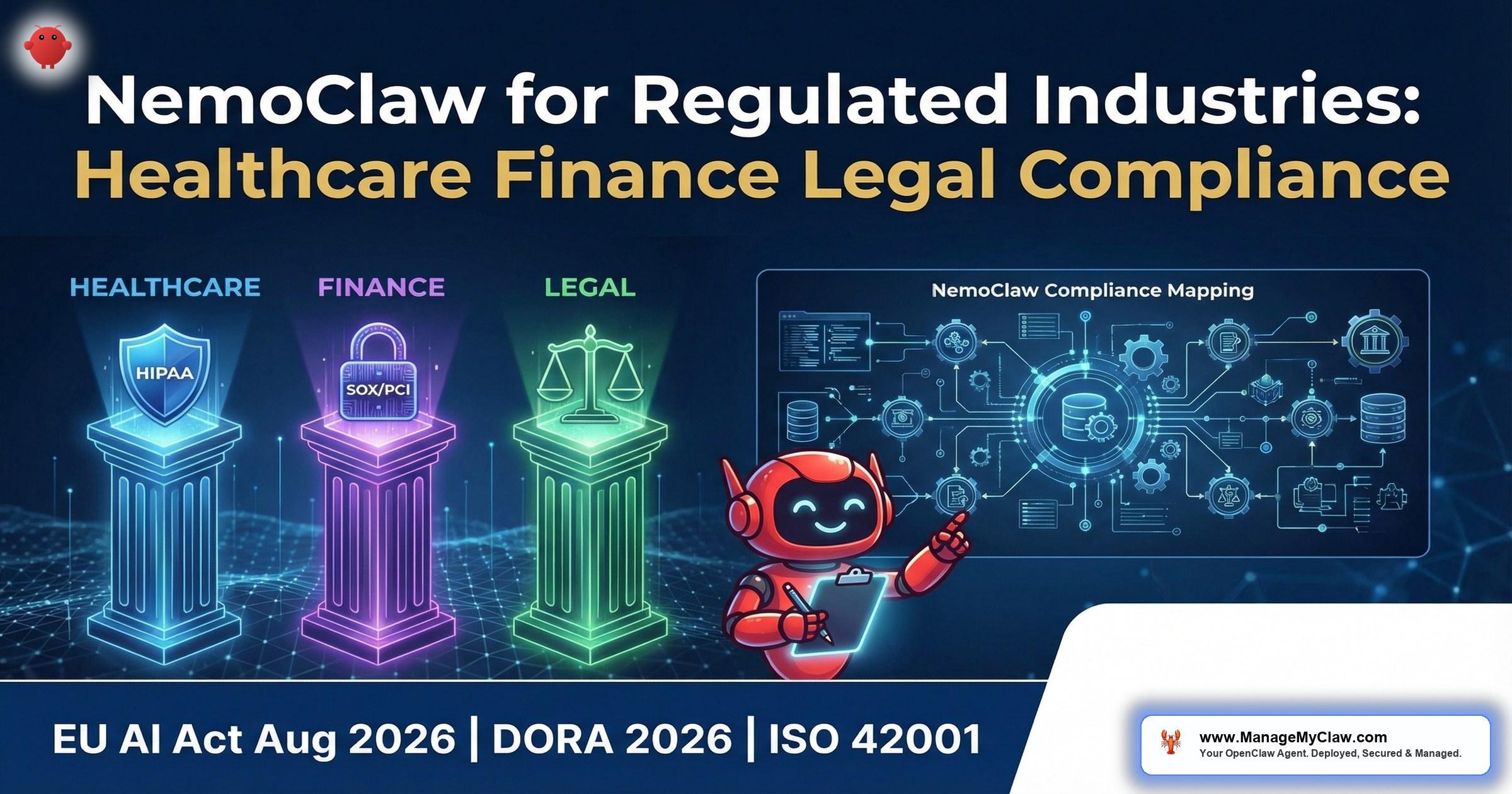
“EU AI Act reaches full enforcement in August 2026. For healthcare, finance, and legal organizations deploying AI agents, ‘we are evaluating our options’ is no longer a compliance strategy.”
Gartner projects 40% of enterprise apps will include AI agents by end of 2026. In regulated industries — healthcare, financial services, and legal — that projection comes with constraints that general-purpose enterprise deployments do not face. HIPAA mandates protection of electronic protected health information. SOX and PCI DSS require verifiable controls over financial data processing. Attorney-client privilege demands that confidential case materials never leave a firm’s control. The EU AI Act reaches full enforcement in August 2026, adding transparency, human oversight, and risk management requirements on top of every existing framework. And in January 2025, the EU’s Digital Operational Resilience Act (DORA) became fully enforced for financial institutions — adding ICT risk management, incident reporting, and third-party oversight requirements that apply directly to AI agent deployments in banking and insurance.
The problem is not whether AI agents can deliver value in regulated environments. They can. The problem is that most AI agent architectures — where every inference call routes through a cloud LLM with no data classification, no routing controls, and no audit trail — are fundamentally incompatible with the compliance requirements these industries operate under.
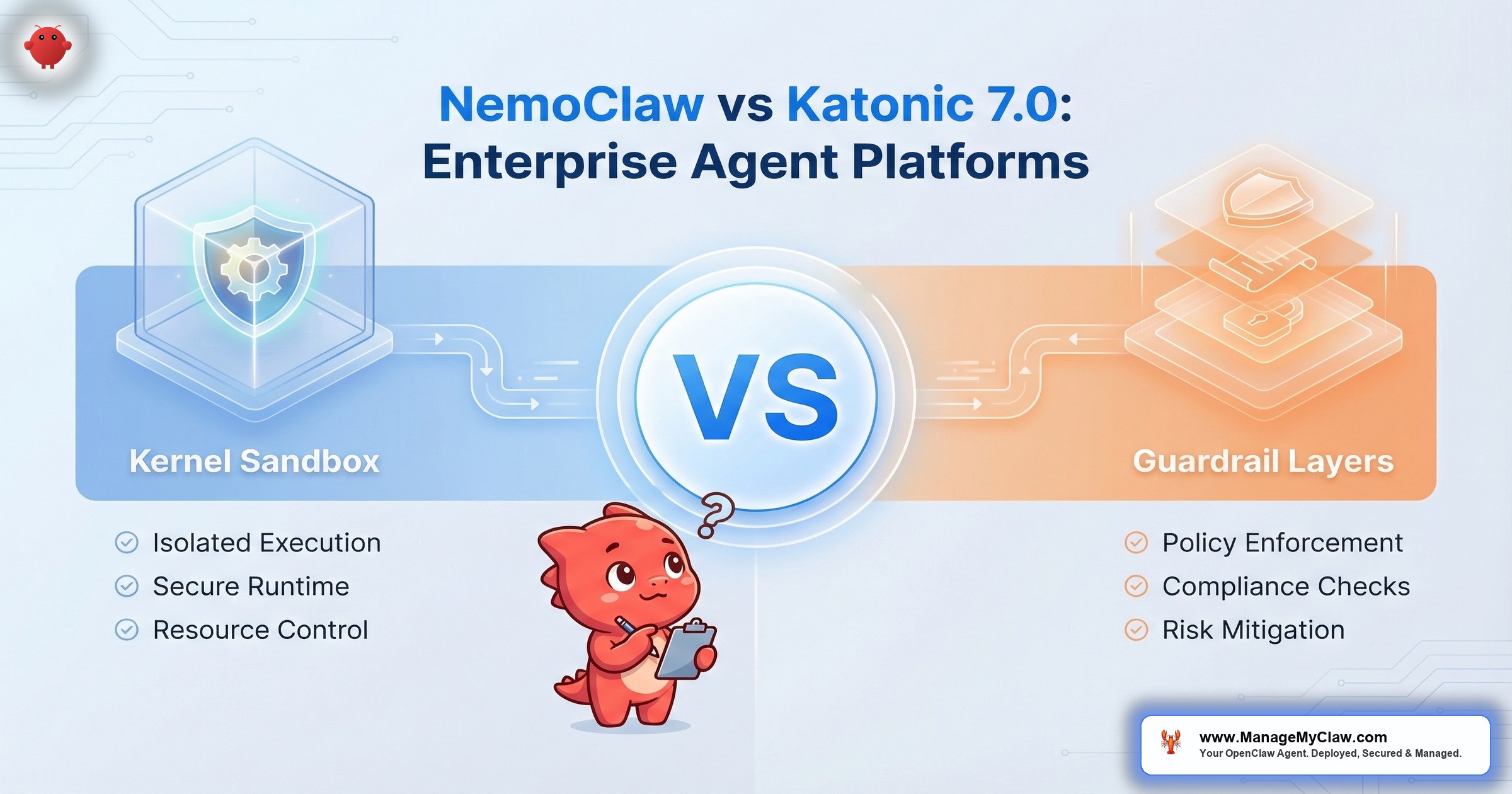
NemoClaw, NVIDIA’s enterprise AI agent security stack, was built to close this gap. Its three-layer architecture — OpenShell kernel-level sandbox, YAML policy engine, and privacy router — maps directly to the technical controls regulators expect. This post examines how NemoClaw addresses the specific compliance requirements of healthcare, finance, and legal — framework by framework, control by control.
of CISOs rank agentic AI as their #1 attack vector
EU AI Act full enforcement deadline
Three Industries, One Architectural Problem
Healthcare, finance, and legal operate under different regulatory bodies and different statutes. But the AI agent compliance challenge they face is structurally identical: sensitive data flows through an AI system that the organization must control, audit, and prove it controls.
Healthcare. The HIPAA Security Rule (45 CFR 164.312) requires technical safeguards that protect ePHI from unauthorized disclosure. When an AI agent processes patient intake forms, lab results, or discharge summaries, every data element — patient name, DOB, medical record number, diagnosis codes, medication lists — is ePHI. Sending that data to a cloud LLM endpoint creates a disclosure event requiring a Business Associate Agreement and exposing the organization to HHS Office for Civil Rights enforcement. IQVIA, a global healthcare data science company and NemoClaw launch partner, represents this challenge at scale: organizations managing clinical trial data across thousands of facilities.
Finance. SOX requires verifiable internal controls over financial reporting. PCI DSS adds cardholder data protection requirements: encryption, access controls, and logging for any system touching payment card information. DORA now layers ICT risk management on top — requiring EU financial institutions to maintain resilience testing, incident classification, and third-party provider oversight for any technology system involved in critical operations, including AI agents. But financial firms face a fourth constraint beyond regulatory compliance: competitive sensitivity. Trading positions, proprietary algorithm parameters, and client portfolio allocations are the firm’s intellectual property. ISO 42001 requires vendors to guarantee data exclusion from model training — but contractual guarantees are not technical guarantees.
Legal. Attorney-client privilege is not a best practice. It is a legal obligation with centuries of precedent. If privileged communications — case strategies, settlement negotiations, deposition analysis — are disclosed to a third party, the privilege may be waived. Courts have held that even inadvertent disclosure can constitute waiver. When a law firm’s AI agent routes case files through a cloud API, the architecture creates a disclosure risk the firm did not intend.
- No data classification at the inference layer — PHI, trading data, and privileged communications treated identically to non-sensitive requests
- No routing controls — every inference call goes to the same cloud endpoint regardless of sensitivity
- No audit trail for data flow — no record of which data elements left the organizational perimeter
- No model training exclusion verification — reliance on contractual terms without technical enforcement
The OWASP Agentic Top 10 categorizes this pattern under ASI06 (Excessive Data Exposure): AI agents that transmit sensitive data to external systems without classification, filtering, or access controls. In regulated industries, ASI06 is not an abstract security risk. It is a compliance violation with specific statutory penalties.
How NemoClaw’s Architecture Maps to Regulatory Requirements
NemoClaw provides three security layers, each addressing a different compliance control category. For compliance officers, the relevant question is not “what does NemoClaw do?” but “which regulatory requirement does each component satisfy?”
Privacy router — intercepts every inference call, classifies data sensitivity using YAML-configurable rules, and routes the request to either a local Nemotron model (sensitive data) or a cloud LLM (general reasoning). Every routing decision is logged: data types detected, model selected, redaction applied, timestamp. This directly addresses OWASP ASI06 by enforcing data sovereignty at the infrastructure layer, outside the agent’s process — where prompt injection cannot bypass it.
OpenShell sandbox — provides kernel-level process isolation using Linux Landlock filesystem controls, seccomp system call filters, and network namespaces. The agent cannot escape its container, access the host filesystem, or escalate privileges. For compliance, this establishes a verifiable audit boundary. OpenShell’s audit trail records every tool invocation, file access, and network call — the evidence trail that SOX audits, HIPAA assessments, and legal malpractice defenses require.
YAML policy engine — implements 4-level permission evaluation: binary (allowed/denied), destination, method, and path. Deny-by-default. Policies are defined in YAML — versionable, diff-able, and readable by non-engineers. A compliance officer can open a policy file and answer: “What can this agent access?” Per-department access controls are configurable — clinical agents get different permissions than administrative agents, trading desk agents different from compliance desk agents. For organizations using OAuth integrations, the credential management architecture adds another auditable control point.
These three layers cover the security dimension of AI agent governance. But as Kiteworks noted in their GTC 2026 analysis: “Jensen Huang defined the strategic imperative but left the hardest part unsolved” — the data governance layer above NemoClaw’s security layer. NemoClaw controls where data goes and what agents can access. It does not classify data lineage, enforce retention policies, or manage cross-jurisdictional data residency at the governance level. Organizations deploying NemoClaw in regulated environments should treat it as the security infrastructure beneath a broader data governance framework — not as the governance framework itself.
For local inference, NemoClaw supports the full Nemotron model family through NIM and vLLM: Nemotron (base reasoning), Nemotron Ultra (advanced multi-step reasoning), and Nemotron 3 Super 120B. This gives compliance teams flexibility — smaller models for routine classification tasks, larger models for complex clinical or legal reasoning — all processed locally without data leaving the organizational perimeter.
JetPatch’s Enterprise Control Plane adds centralized governance across multi-agent deployments — policy distribution, compliance reporting, and fleet-level visibility when managing dozens or hundreds of AI agents across departments and geographies.
“At GTC 2026, NVIDIA Stakes Its Claim on Autonomous Agent Infrastructure.”
— Futurum Group, GTC 2026 Analyst Coverage
Compliance Mapping: HIPAA, SOC2, PCI DSS, SOX, DORA, GDPR, EU AI Act
Compliance officers need a mapping between regulatory requirements and technical controls — not architecture diagrams. The following table maps NemoClaw’s components to the specific regulatory requirements each addresses.
| Regulation | Requirement | NemoClaw Control |
|---|---|---|
| HIPAA (45 CFR 164.312) | Technical safeguards for ePHI: access controls, audit controls, transmission security | Privacy router routes PHI to local Nemotron — no cloud disclosure. OpenShell audit trail logs every agent action for OCR review. YAML policy engine enforces per-agent access controls. |
| SOC2 (CC6.1, CC7.2) | Logical access controls, system monitoring, data classification | YAML policy engine implements deny-by-default access. Privacy router classifies data per request. OpenShell logs export to SIEM for continuous monitoring. |
| PCI DSS (Req. 3, 7, 10) | Protect stored cardholder data, restrict access by need-to-know, track and monitor access | Privacy router prevents cardholder data from reaching cloud APIs. YAML policies restrict agent access to payment systems by role. OpenShell audit trail provides Requirement 10 logging. |
| SOX (Section 404) | Internal controls over financial reporting must be documented and tested | YAML policy files are versionable, auditable control documentation. OpenShell action logs demonstrate control effectiveness. Routing logs prove financial data stayed within controlled boundaries. |
| GDPR (Article 44) | Personal data transfers outside EEA require adequate safeguards | Privacy router detects PII and routes to local model — no cross-border transfer. Redaction strips identifiers from cloud-bound requests. |
| DORA (EU Financial) | ICT risk management, incident reporting, resilience testing, third-party oversight | OpenShell audit trail supports incident classification and reporting. YAML policy engine documents ICT risk controls. Privacy router enforces third-party data boundaries. Sandbox isolation supports resilience testing. |
| EU AI Act (Aug 2026) | Transparency, human oversight, risk management for high-risk AI systems | YAML policies are human-readable (transparency). Policy engine enables human-in-the-loop controls (oversight). Privacy router provides risk-proportionate data handling. Full audit trail for regulatory inspection. |
| ISO 42001 | Vendors must guarantee data excluded from model training | Sensitive data processed by local Nemotron — never sent to a third party. No vendor training exposure. Cloud requests use enterprise API agreements with training exclusion. |
| OWASP ASI06 | Prevent excessive data exposure from AI agents | Privacy router classification prevents sensitive data from reaching uncontrolled endpoints. Infrastructure-level enforcement — agent cannot bypass. |
The common thread: every regulation in that table requires you to know where your data goes, control where it goes, and prove both to an auditor. NemoClaw’s privacy router, policy engine, and OpenShell audit trail address all three at the infrastructure layer.
Deployment Scenarios by Regulated Industry
Healthcare: HIPAA-Compliant Agent Deployment
A health system deploys NemoClaw agents for clinical documentation and administrative workflow automation. The privacy router keeps PHI on local Nemotron — patient intake forms, lab results, discharge summaries, prescription records never reach a cloud API. Non-sensitive tasks — medical research queries, ICD-10 lookups, appointment template generation — route to cloud models for maximum reasoning capability.
Dual Routing
09:14 — Patient intake processing. Agent reads intake form: patient name, DOB, SSN, chief complaint, medication history. Privacy router detects PHI across 6 data categories. Routes to local Nemotron. Logged: LOCAL | PHI: name, DOB, SSN, dx, meds, MRN | Nemotron-70B.
09:17 — Insurance verification template. Standard letter with no patient data. Routes to Claude via cloud API. Logged: CLOUD | No PHI detected | Claude.
09:22 — Lab result analysis. Lab values contain patient MRN and diagnosis codes. Routes to local Nemotron. Logged: LOCAL | PHI: MRN, lab values, dx codes | Nemotron-70B.
09:31 — Drug interaction research. General pharmacological query, no patient identifiers. Routes to GPT-5 via cloud API. Logged: CLOUD | No PHI detected | GPT-5.
Result: 4 tasks. 2 processed locally (PHI present). 2 via cloud (no PHI). Complete audit trail for HHS/OCR review. Zero ePHI transmitted to external APIs.
NemoClaw’s privacy router and OpenShell sandbox are one control in a HIPAA compliance program, not the entire program. Full HIPAA compliance requires a signed Business Associate Agreement (BAA) with every vendor that touches ePHI, encryption at rest for all stored PHI, comprehensive audit logging beyond agent actions, role-based access controls at every system layer, documented staff training on PHI handling, and a formal risk analysis covering all systems in the environment. Organizations that deploy NemoClaw and treat the sandbox as “HIPAA done” will fail their next OCR audit. NemoClaw addresses the technical safeguards at the AI agent layer. The organizational controls above and around it remain your responsibility.
The YAML policy engine separates clinical agents (EHR access, PHI routing to local Nemotron) from administrative agents (scheduling systems, template libraries — no patient record access) and research agents (de-identified datasets only). IQVIA, as a NemoClaw launch partner, is positioned to demonstrate this architecture at scale across thousands of healthcare facilities. Notably, use-apify.com published a “HIPAA-Compliant OpenClaw Deployment for Healthcare Teams (2026)” guide — a signal that real demand for healthcare-specific AI agent deployment guidance is already driving community documentation.
Finance: SOX Compliance and Trading Data Protection
A quantitative trading firm deploys NemoClaw agents for market analysis and document processing. The privacy router configuration: trading positions, client portfolio data, internal risk models, P&L reports, and proprietary algorithm parameters route to local Nemotron. Public market research, SEC filing summarization, and regulatory FAQ lookups route to cloud models. Client names and account numbers are stripped from any request routed to cloud.
For SOX Section 404 compliance, YAML policy files serve as versionable control documentation — every policy change has a timestamp, an author, and a diff. OpenShell’s audit trail provides control effectiveness evidence: every agent action logged during the reporting period. The privacy router’s routing logs verify that sensitive financial data stayed within the controlled environment. Together, these three artifacts give auditors the documentation, evidence, and verification they need.
For PCI DSS, the privacy router detects cardholder data patterns (card numbers, CVVs, expiration dates) and routes those requests locally. The YAML policy engine restricts which agents can access payment processing systems. OpenShell logs every access event for Requirement 10 compliance.
Legal: Privilege Protection and Case File Confidentiality
A mid-size law firm deploys NemoClaw agents for contract review and case research. Case files, client communications, deposition transcripts, and settlement negotiations — anything subject to attorney-client privilege or work-product doctrine — route to local Nemotron. Case law research, statutory interpretation, and template drafting route to cloud models with client identifiers stripped.
Unlike a data breach — where incident response and notification can mitigate harm — privilege waiver is a legal event with no technical fix. If privileged material was sent to a cloud API, opposing counsel can argue the privilege is waived. The privacy router’s local routing for privileged material is a prevention control, not a detective control. The architecture must prevent disclosure, not respond after it occurs.
The YAML policy engine supports matter-level access segmentation: each matter gets its own agent deployment with policies scoped to that matter’s document repository. Cross-matter access is denied at the infrastructure level — critical for conflict-wall enforcement. Dassault Systemes, a NemoClaw launch partner in life sciences and manufacturing, demonstrates the enterprise scale where fleet-level governance across departments with different compliance requirements becomes essential.
of agent inference calls logged with data classification, routing decision, and timestamp
EU AI Act: What Full Enforcement Means for Regulated AI Agents
The EU AI Act reaches full enforcement in August 2026. AI agents used in healthcare diagnostics, financial credit scoring, or legal case assessment are likely to be classified as high-risk AI systems, triggering the regulation’s most stringent requirements. NemoClaw’s architecture addresses the four key technical obligations:
- Transparency: YAML policies are human-readable documentation of every permission and routing rule. The privacy router’s decision log shows exactly where every piece of data went and why.
- Human oversight: The policy engine supports human-in-the-loop controls. The privacy router’s deny-on-failure behavior — sensitive requests are held, not rerouted to cloud — ensures human intervention when the system cannot make a safe routing decision.
- Risk management: Three-layer architecture implements risk controls at each layer. The YAML configuration makes the framework auditable, and the privacy router enables risk-proportionate data handling.
- Record-keeping: OpenShell logs every agent action. The privacy router logs every routing decision. Combined, they produce the operational record the regulation requires — exportable to SIEM platforms for integration with existing compliance reporting.
EU AI Act compliance also requires conformity assessments, registration, and organizational governance processes outside NemoClaw’s scope. NemoClaw provides the technical infrastructure. Your organization provides the governance framework.
DORA: Digital Operational Resilience for Financial AI Agents
The EU’s Digital Operational Resilience Act (DORA), fully enforced since January 2025, adds a distinct compliance layer for financial institutions deploying AI agents. DORA requires ICT risk management frameworks, incident classification and reporting, digital operational resilience testing, and oversight of critical third-party ICT providers. AI agents that interact with core banking systems, payment processing, or client portfolio management fall squarely within DORA’s scope.
NemoClaw’s architecture addresses DORA requirements at the technical layer: OpenShell’s audit trail supports incident classification by recording every agent action with timestamps and data classification. The YAML policy engine documents ICT risk controls in a versionable, auditable format. The privacy router enforces third-party data boundaries — ensuring that agent interactions with cloud providers are logged, classified, and policy-controlled. And sandbox isolation supports the resilience testing DORA mandates by enabling controlled failure scenarios without affecting production systems.
For EU financial institutions, the compliance timeline is compounding: DORA enforcement (active), EU AI Act full enforcement (August 2026), and existing MiFID II, PSD2, and GDPR obligations. NemoClaw’s architecture provides a unified technical control layer across these overlapping frameworks.
Limitations: What Compliance Officers Must Understand
Alpha stage — not yet recommended for production in regulated environments. NemoClaw shipped as early-stage alpha on March 16, 2026. NVIDIA has 17 enterprise launch partners (Adobe, Salesforce, SAP, CrowdStrike, IQVIA, Dassault Systemes) committed to the platform. The core security primitives are functional, but routing rule syntax, classification capabilities, and integration APIs may change before GA. For regulated industries: evaluate now, pilot with synthetic data, build your compliance framework — deploy to production when NemoClaw exits alpha. Organizations that prepare now will be production-ready at GA. Organizations that wait will be 6-12 months behind.
Classification accuracy depends on configuration quality. The privacy router’s data classification is only as good as your YAML routing rules. If your configuration does not account for a proprietary data format — a custom patient identifier scheme, an internal account number format — the router will not detect it. Initial deployment requires a thorough data audit. This is specialist configuration work, not a default setting.
GPU hardware required for full privacy routing. Full privacy router value requires NVIDIA GPU hardware for local Nemotron inference. NemoClaw system requirements: Linux, 4 vCPU, 8GB RAM, Docker — but Nemotron models require significantly more memory for production inference. You can route to Ollama-hosted models on non-NVIDIA hardware, but with reduced reasoning performance. Budget for hardware as part of your deployment TCO.
Compliance is organizational, not just technical. NemoClaw provides technical controls. HIPAA, SOX, DORA, and EU AI Act compliance are organizational obligations. You still need administrative safeguards, physical safeguards, signed BAAs, staff training, documented risk analyses, and a broader governance framework. NemoClaw addresses the technical layer. It does not replace a compliance program.
Data governance sits above NemoClaw’s security layer. NemoClaw controls data routing and agent access. It does not manage data lineage, enforce retention policies, or handle cross-jurisdictional data residency at the governance level. As Kiteworks observed in their GTC 2026 analysis, the data governance layer above NemoClaw’s security layer remains an unsolved problem for most enterprises. Plan for a data governance framework that NemoClaw plugs into — not one that NemoClaw replaces.
Linux, 4 vCPU, 8GB RAM, Docker. NemoClaw installs in one command. Production hardening — policy configuration, privacy router setup, compliance documentation, SIEM integration — is the multi-week implementation effort that requires specialist configuration.
Implementation Path for Regulated Industries
-
1
Compliance Assessment (Week 1). Map regulatory requirements to NemoClaw’s architecture. Classify every data type each agent accesses by sensitivity (PHI, PCI, privileged, proprietary, non-sensitive). Document the controls each agent must satisfy.
-
2
Data Audit and Routing Rules (Week 2). Inventory every data format your agents encounter. Create YAML routing rules for each sensitive data type. Configure per-department access policies and redaction rules for cloud-bound requests.
-
3
Infrastructure Deployment (Week 2-3). Deploy NemoClaw stack: OpenShell sandbox, policy engine, privacy router. Install local Nemotron models on NVIDIA hardware. Configure SIEM integration for audit log export.
-
4
Compliance Validation (Week 3-4). Run test workflows with synthetic data. Verify routing decisions match expected behavior. Generate sample compliance reports. Review with compliance team and legal counsel.
-
5
Pilot and Production Rollout (Week 4-6). Deploy to a single department. Monitor routing and audit logs for 30 days. Expand based on pilot findings.
Enterprise AI agent consulting from firms like Accenture and Wipro runs $75K-$500K+ per implementation. ManageMyClaw’s enterprise implementation covers this entire pipeline — data audit, policy configuration, infrastructure deployment, compliance documentation — at $15K-$45K with 30-day hypercare included.
Pilot Program: 30-Day Compliance Evaluation ($5,000)
- Scope: 1 agent, 1 workflow, full NemoClaw security stack
- Deliverables: Proof-of-concept deployment with privacy router, policy engine, and sandbox
- Compliance output: Written evaluation report mapping NemoClaw controls to your regulatory requirements
- Decision support: Go/no-go recommendation with TCO projection at Day 30
- Credit: Pilot cost credited toward full implementation if approved
Frequently Asked Questions
Does NemoClaw make our AI agents HIPAA-compliant?
No single tool makes you HIPAA-compliant. NemoClaw provides critical technical controls — privacy router for PHI data sovereignty, OpenShell audit trail for access logging, YAML policy engine for access controls. These address the technical safeguards in 45 CFR 164.312. But HIPAA compliance also requires a signed Business Associate Agreement (BAA) with every vendor touching ePHI, encryption at rest, comprehensive audit logging, role-based access controls, documented staff training, and a formal risk analysis. NemoClaw is one control in your compliance program. It does not replace the program itself.
Can we deploy NemoClaw to production in a regulated environment today?
NemoClaw is in alpha stage (shipped March 16, 2026). The core security primitives work, and 17 enterprise partners are committed. However, we do not recommend production deployment with live regulated data at this stage. The recommended path: evaluate now, pilot with synthetic data, build your compliance framework, deploy to production when NemoClaw reaches general availability.
How does the privacy router handle data that matches multiple regulatory categories?
If a data element falls under multiple regulations (e.g., a patient’s credit card information is both PHI under HIPAA and cardholder data under PCI DSS), the privacy router applies the most restrictive routing rule. In practice, any data that triggers a sensitive classification is routed to local Nemotron — kept on-premises regardless of which regulation applies.
Does the YAML policy engine support SOX audit requirements?
Yes. YAML policy files are version-controlled — every change has a timestamp, an author, and a diff. This provides the change management documentation SOX Section 404 requires. Combined with OpenShell’s audit trail, you have both control definition and control effectiveness evidence in auditable formats.
What about the EU AI Act — does NemoClaw satisfy high-risk AI system requirements?
NemoClaw addresses transparency (human-readable YAML policies), human oversight (policy engine controls), risk management (three-layer architecture), and record-keeping (OpenShell + privacy router logs). EU AI Act compliance also requires conformity assessments, registration, and organizational governance that are outside NemoClaw’s scope. NemoClaw provides the technical infrastructure; your organization provides the governance framework.
How does NemoClaw address DORA requirements for EU financial institutions?
DORA (Digital Operational Resilience Act), fully enforced since January 2025, requires ICT risk management, incident reporting, resilience testing, and third-party oversight. NemoClaw’s OpenShell audit trail supports incident classification. YAML policy files document ICT risk controls in auditable format. The privacy router enforces third-party data boundaries. Sandbox isolation supports resilience testing. For EU financial institutions, NemoClaw provides a unified technical control layer across DORA, EU AI Act, GDPR, and existing financial regulations.
Which Nemotron models are supported for local inference?
NemoClaw supports the full Nemotron model family through NIM and vLLM: Nemotron (base reasoning), Nemotron Ultra (advanced multi-step reasoning), and Nemotron 3 Super 120B. This gives compliance teams flexibility to match model capability to task sensitivity — smaller models for routine classification, larger models for complex clinical or legal reasoning — all processed locally without data leaving the organizational perimeter.
How does NemoClaw integrate with existing compliance reporting?
OpenShell audit logs and privacy router decision logs export to standard SIEM platforms (Splunk, Sentinel, Elastic). JetPatch’s Enterprise Control Plane adds centralized compliance reporting across multi-agent deployments. This integrates into existing security operations workflows without requiring separate monitoring infrastructure.
ManageMyClaw Enterprise handles compliance assessment, privacy router configuration, policy engine setup, and regulatory mapping for healthcare, finance, and legal deployments. Start with a $5,000 pilot or a $2,500 architecture review.
Schedule Architecture Review