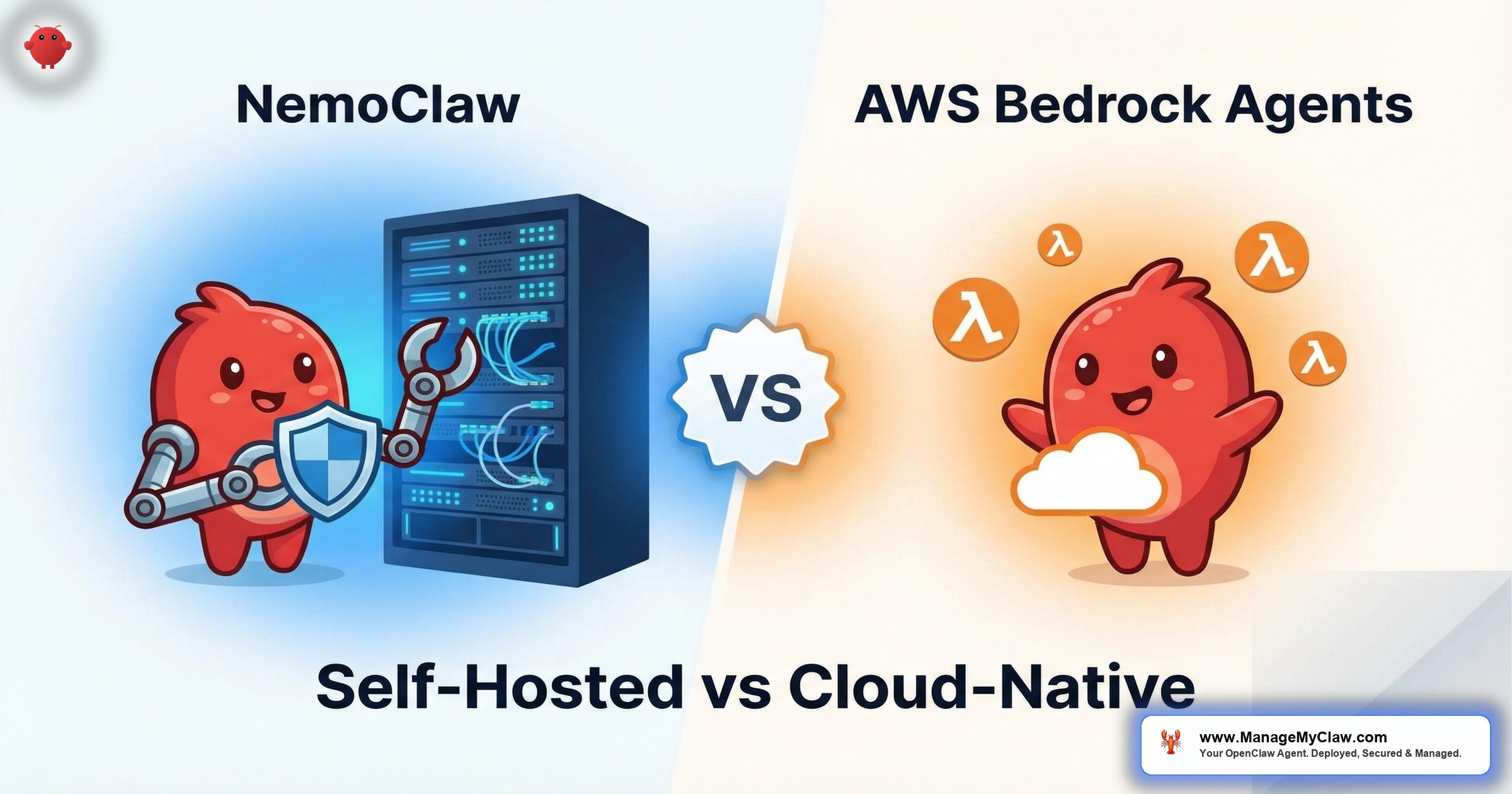
AWS Bedrock Agents and NVIDIA NemoClaw represent two fundamentally different answers to the same question: how do you deploy AI agents with enterprise-grade security? Bedrock is cloud-native — fully managed on AWS infrastructure, integrated with IAM, CloudTrail, and KMS, pay-per-use. NemoClaw is self-hosted — kernel-level OpenShell sandbox, YAML policy engine, privacy router, and your data never leaves infrastructure you control. Same goal. Opposite architectures.
The choice between them is not about which is “better.” It is about which security model, data residency posture, and operational tradeoff matches your organization’s requirements.
Gartner projects 40% of enterprise applications will include AI agents by end of 2026. The $9 billion agentic AI market has made agent deployment a board-level topic. But 48% of CISOs rank agentic AI as their number one attack vector (Dark Reading, 2026). The security architecture you choose now will determine your compliance posture for years. OWASP published the Agentic Security Top 10 (ASI01-ASI10) to give teams a framework for evaluating these decisions — and both Bedrock and NemoClaw map to it differently.
TL;DR — Who Should Choose Which
Choose AWS Bedrock Agents if: your organization is already built on AWS, your security team is comfortable with cloud-native controls (IAM, CloudTrail, KMS), you want pay-per-use pricing without managing infrastructure, you do not have data residency requirements that mandate on-premises deployment, and your compliance framework accepts cloud provider certifications (SOC2, HIPAA on AWS).
Choose NemoClaw if: your data must stay on infrastructure you control (not cloud provider infrastructure), you need kernel-level isolation beyond container sandboxing, your compliance requirements demand provable data sovereignty, you want a YAML policy engine with 4-level evaluation (binary, destination, method, path) that your security team can audit directly, or you need to route sensitive data to local models while using cloud models for general reasoning.
Head-to-Head Architecture Comparison
| Dimension | NemoClaw | AWS Bedrock Agents |
|---|---|---|
| Deployment model | Self-hosted (your servers, on-prem or private cloud) | Cloud-native (fully managed on AWS) |
| Sandbox isolation | Kernel-level (Landlock filesystem, seccomp filters, network namespaces) | Cloud-level (Lambda isolation, VPC boundaries) |
| Policy engine | YAML-based, 4-level evaluation (binary, destination, method, path) | IAM policies + Bedrock Guardrails |
| Data residency | Your infrastructure — data never leaves your control | AWS regions (you choose region, data stays on AWS infrastructure) |
| Privacy routing | Privacy router: local Nemotron for sensitive data, cloud models for general reasoning | All inference runs through Bedrock (AWS-managed) |
| Identity and access | YAML-defined per-agent policies | AWS IAM (roles, policies, service-linked roles) |
| Audit trail | Self-hosted logging (your SIEM integration) | CloudTrail (native AWS logging) |
| Encryption | Your encryption infrastructure | AWS KMS (managed key service) |
| Pricing model | Open source + infrastructure costs + implementation labor | Pay-per-use (per-session, per-step, per-token) |
| Infrastructure management | Your team (or managed service provider) | AWS-managed (serverless) |
| Hardware requirements | Linux, minimum 4 vCPU, 8 GB RAM (NVIDIA GPU for local Nemotron) | None — serverless |
| Maturity | Alpha / early access (March 2026) | Generally available |
| Enterprise partners | 17 launch partners (Adobe, Salesforce, SAP, CrowdStrike) | AWS ecosystem (broad partner network) |
NemoClaw data from NVIDIA technical documentation and GTC 2026 announcements. AWS Bedrock data from AWS documentation. Both verified March 2026.
The Security Architecture Difference
The core divergence is where security enforcement happens and who controls it.
AWS Bedrock: cloud-native security stack
Bedrock Agents inherits the AWS security model. IAM controls who can invoke agents and what resources they can access. CloudTrail logs every API call. KMS handles encryption. Bedrock Guardrails provide content filtering and safety controls at the application layer. VPC configurations isolate network traffic. The security is real, mature, and well-documented — but it runs on AWS infrastructure, enforced by AWS controls.
For organizations already on AWS, this integration is a significant advantage. Your security team already knows IAM. Your SOC already monitors CloudTrail. Your compliance team already has AWS’s SOC2 and HIPAA attestations. Adding Bedrock Agents to this stack is incremental, not foundational.
NemoClaw: kernel-level self-hosted security
NemoClaw’s OpenShell sandbox operates at the kernel level — not the container level. Landlock filesystem restrictions control which directories the agent can access. Seccomp filters restrict which system calls it can make. Network namespaces isolate agent traffic. This is deny-by-default isolation: the agent can only do what the policy explicitly permits.
The YAML policy engine provides 4-level evaluation: binary (allow/deny), destination (which services), method (which HTTP methods), and path (which API endpoints). Your security team writes the policies in plain YAML — no proprietary configuration language, no cloud console navigation.
The privacy router is the third architectural distinction. It routes sensitive data to local Nemotron models running on your hardware, while sending general reasoning tasks to cloud models. PII detection, data classification, and routing happen before data leaves your network boundary. This hybrid approach gives you the performance of cloud models without sending sensitive data to cloud infrastructure.
CrowdStrike published a Secure-by-Design Blueprint specifically for NemoClaw integration, validating the architecture with their Falcon AIDR (AI Detection and Response) platform. That partnership signals enterprise readiness from the security vendor side — not just the AI vendor side.
Why this matters: The OWASP Agentic Security Top 10 identifies ASI01 (Excessive Agency) and ASI06 (Unsafe Input/Output Handling) as critical agent risks. NemoClaw’s kernel-level sandbox addresses ASI01 at the OS level — the agent literally cannot exceed its policy-defined permissions. Bedrock’s Guardrails address similar risks at the application layer. Both approaches work. The question is which enforcement layer your security team trusts and can audit.
Where AWS Bedrock Agents Wins
Fully managed — zero infrastructure burden
Bedrock is serverless. No servers to provision, no OS to patch, no hardware to procure. AWS handles availability, scaling, and infrastructure security. For organizations that do not want to own and operate AI agent infrastructure, this is the simplest operational model. Your team focuses on agent logic and workflows — AWS handles everything underneath.
Mature, generally available service
Bedrock Agents is GA. Production-ready. NemoClaw is alpha/early-access as of March 2026. For organizations that need to deploy AI agents this quarter with enterprise SLAs, production support, and a track record, Bedrock has the maturity advantage. NVIDIA shipped NemoClaw with 17 launch partners — Adobe, Salesforce, SAP, CrowdStrike — but the core product is still pre-GA.
AWS ecosystem integration
If your infrastructure is on AWS, Bedrock integrates natively with S3, Lambda, DynamoDB, SageMaker, and the full AWS service catalog. IAM policies you already maintain extend to agent access control. CloudTrail feeds your existing SIEM. KMS encrypts agent data with keys you already manage. The operational overhead of adding Bedrock to an AWS-native stack is minimal compared to standing up new self-hosted infrastructure.
Pay-per-use pricing
Bedrock charges per session, per step, and per token. No upfront infrastructure investment. No hardware procurement. For teams testing AI agent workflows or running low-volume deployments, pay-per-use is more capital-efficient than provisioning dedicated servers.
Why this matters: For organizations that prioritize operational simplicity, immediate deployment, and deep AWS integration, Bedrock Agents reduces the AI agent question to a configuration problem rather than an infrastructure problem. The tradeoff is control — you are trusting AWS to enforce security rather than enforcing it yourself.
Where NemoClaw Wins
Data sovereignty — provable, not promised
With NemoClaw, your data stays on servers you own and operate. Not on servers in a cloud region you selected — on servers in your data center, your rack, your network. For organizations subject to data residency regulations (EU AI Act enforcement begins August 2026, HIPAA for healthcare, SOX for financial services), provable data sovereignty is a compliance requirement, not a preference.
The privacy router reinforces this: sensitive data routes to local Nemotron models, never leaving your network boundary. General reasoning tasks route to cloud models for performance. Your security team controls the routing table. That hybrid architecture is not possible with a fully cloud-managed service where all inference runs through the provider’s infrastructure.
Kernel-level isolation — deeper than container or cloud boundaries
OpenShell’s Landlock + seccomp + network namespace isolation operates at the OS kernel level. A container escape gives the attacker access to the host. A Lambda boundary relies on AWS’s isolation guarantees. Kernel-level sandboxing means even if the agent’s process is compromised, the OS itself enforces the boundary. For organizations where “what if the sandbox fails?” is a real threat model question, kernel-level is a different answer than cloud-level.
Auditable policy engine
NemoClaw’s YAML policy engine is human-readable, version-controllable, and auditable by your security team without cloud console access. Policies live in your Git repository. Changes are tracked. Reviews happen in your existing code review workflow. For organizations with SOC2 or HIPAA audit requirements, policy-as-code in a repo you control is a stronger evidence artifact than screenshots of cloud console configurations.
No cloud vendor dependency
NemoClaw is open source. No vendor lock-in. No cloud provider dependency for the core agent infrastructure. If your organization’s strategy includes multi-cloud or cloud-exit contingency planning, self-hosted NemoClaw runs anywhere you have Linux servers with the minimum 4 vCPU and 8 GB RAM (plus NVIDIA GPU for local Nemotron inference).
Why this matters: For regulated industries — healthcare, financial services, legal, government — the data sovereignty and audit requirements often make self-hosted the only viable path. NemoClaw’s architecture was designed for this buyer. The tradeoff is operational complexity: you own the infrastructure, which means you staff the infrastructure.
The Maturity Question
NemoClaw is alpha software as of March 2026. That requires honest framing.
NVIDIA shipped NemoClaw with 17 enterprise launch partners including Adobe, Salesforce, SAP, and CrowdStrike. The core security primitives — OpenShell sandbox, YAML policy engine, privacy router — work today. CrowdStrike’s Secure-by-Design Blueprint validates the integration path. JetPatch announced an enterprise control plane for NemoClaw management.
But alpha means: expect breaking changes, limited documentation, and production readiness that varies by component. Organizations that build governance frameworks now will be production-ready when NemoClaw reaches GA. Organizations that wait will be 6 to 12 months behind. The 74% of enterprises planning agentic AI deployment within 2 years (r/AI_Agents survey) cannot all afford to wait for GA.
Bedrock Agents is GA. It works now. The production support, documentation, and enterprise SLAs are available today. If your timeline does not accommodate alpha software, that is the decisive factor.
The independent consultant market has already priced NemoClaw implementation. nemoclawconsulting.com charges $150/hour. That market signal confirms enterprise demand, but also confirms the complexity: production NemoClaw configuration requires specialist expertise, not just a quick install.
OWASP Agentic Security Mapping
| OWASP ASI Risk | NemoClaw Approach | AWS Bedrock Approach |
|---|---|---|
| ASI01: Excessive Agency | Kernel-level sandbox restricts OS-level actions; YAML policy defines allowed operations | IAM policies restrict resource access; Guardrails filter outputs |
| ASI06: Unsafe Input/Output | Policy engine validates at 4 levels before execution | Bedrock Guardrails filter content; VPC isolates network |
| Data Residency | On-prem — data never leaves your network boundary | AWS region selection — data stays in selected region on AWS infrastructure |
| Audit Trail | Self-hosted logs fed to your SIEM | CloudTrail integration (native) |
Who Should Choose AWS Bedrock Agents
- Your organization runs on AWS. IAM, CloudTrail, KMS, VPC — you already have the security stack. Adding Bedrock is incremental.
- You need production-ready, GA software today. No tolerance for alpha-stage breaking changes or limited documentation.
- You prefer managed infrastructure. No servers to provision, patch, or monitor. Serverless agent deployment.
- You want pay-per-use pricing without upfront hardware or infrastructure investment.
- Your compliance framework accepts cloud provider certifications. AWS SOC2, HIPAA, and FedRAMP attestations satisfy your audit requirements.
Who Should Choose NemoClaw
- Your data must stay on-premises. Regulatory requirements mandate physical control over infrastructure where AI agents process sensitive data.
- You need kernel-level isolation. Container escapes and cloud boundary assumptions are in your threat model. OpenShell’s Landlock + seccomp stack operates below the container layer.
- You want policy-as-code. YAML policies in your Git repo, reviewed in your code review workflow, version-controlled for audit evidence.
- You need privacy routing. Sensitive data to local Nemotron, general reasoning to cloud models. Your security team controls the routing table.
- You want to build governance ahead of GA. Organizations that configure NemoClaw policies now will be production-ready when the platform matures. Early movers gain 6 to 12 months of governance development time.
The Bottom Line
AWS Bedrock Agents is the right choice for organizations that are already on AWS, need production-ready software today, and are comfortable delegating infrastructure security to their cloud provider. The integration depth, maturity, and operational simplicity are real advantages.
NemoClaw is the right choice for organizations that need provable data sovereignty, kernel-level isolation, and auditable policy-as-code — and are willing to invest in implementation now while the platform is pre-GA. The 17 enterprise launch partners and CrowdStrike’s Secure-by-Design Blueprint validate the architecture. The alpha status requires honest expectation-setting.
The question is not cloud vs. self-hosted in the abstract. It is: where must your data live, who must control the security enforcement, and what is your timeline? Those 3 answers determine the architecture. ManageMyClaw Enterprise provides NemoClaw implementation and managed care for organizations that need the self-hosted path with professional configuration and ongoing support. See enterprise assessment options starting at $2,500. For context on how OpenClaw security risks map to the enterprise threat landscape, see our OpenClaw security deep-dive and our ClawHavoc attack analysis.
Frequently Asked Questions
Is NemoClaw ready for production use?
As of March 2026, NemoClaw is in alpha/early-access. The core security primitives (OpenShell sandbox, YAML policy engine, privacy router) work today, and 17 enterprise partners including Adobe, Salesforce, SAP, and CrowdStrike committed at GTC 2026. However, alpha means expect breaking changes and limited documentation. Organizations can build governance frameworks now to be production-ready when NemoClaw reaches GA.
Does AWS Bedrock support on-premises deployment?
No. Bedrock is a cloud-native service that runs on AWS infrastructure. You can select your AWS region for data residency, but the data stays on AWS servers. For organizations that need data on infrastructure they physically own and operate, Bedrock does not satisfy that requirement. NemoClaw’s self-hosted model is designed for this use case.
What is the privacy router and why does it matter?
NemoClaw’s privacy router splits AI inference between local models and cloud models based on data sensitivity. Sensitive data (PII, financial records, health information) routes to Nemotron models running on your local hardware — never leaving your network. General reasoning tasks route to cloud models for performance. Your security team defines the routing rules. This hybrid approach gives you cloud model capability without sending sensitive data to cloud infrastructure.
How does ManageMyClaw Enterprise help with NemoClaw implementation?
ManageMyClaw Enterprise provides NemoClaw implementation starting at $2,500 for an architecture assessment and up to $15,000 to $45,000 for full implementation. This includes OpenShell sandbox configuration, YAML policy engine setup, privacy router deployment, CrowdStrike Falcon integration (if applicable), SIEM integration, compliance documentation (SOC2, HIPAA), and 30-day hypercare. Enterprise Managed Care from $2,500/month provides ongoing monitoring, policy updates, CVE patching, and quarterly security reviews with a 99.9% uptime SLA.
Can I run NemoClaw and Bedrock Agents simultaneously?
Yes. Some organizations use a hybrid approach: NemoClaw for agents that handle sensitive data requiring on-premises processing, and Bedrock for agents that handle general business tasks where cloud deployment is acceptable. The architectures are independent. The decision should map to the sensitivity of the data each agent handles, not a blanket organizational mandate for one approach.
Need NemoClaw implementation with enterprise governance?
ManageMyClaw Enterprise handles NemoClaw deployment, OpenShell configuration, YAML policy engine setup, privacy router tuning, CrowdStrike integration, and compliance documentation. Assessment from $2,500. Implementation from $15,000. Enterprise Managed Care from $2,500/month.
Schedule Architecture Review