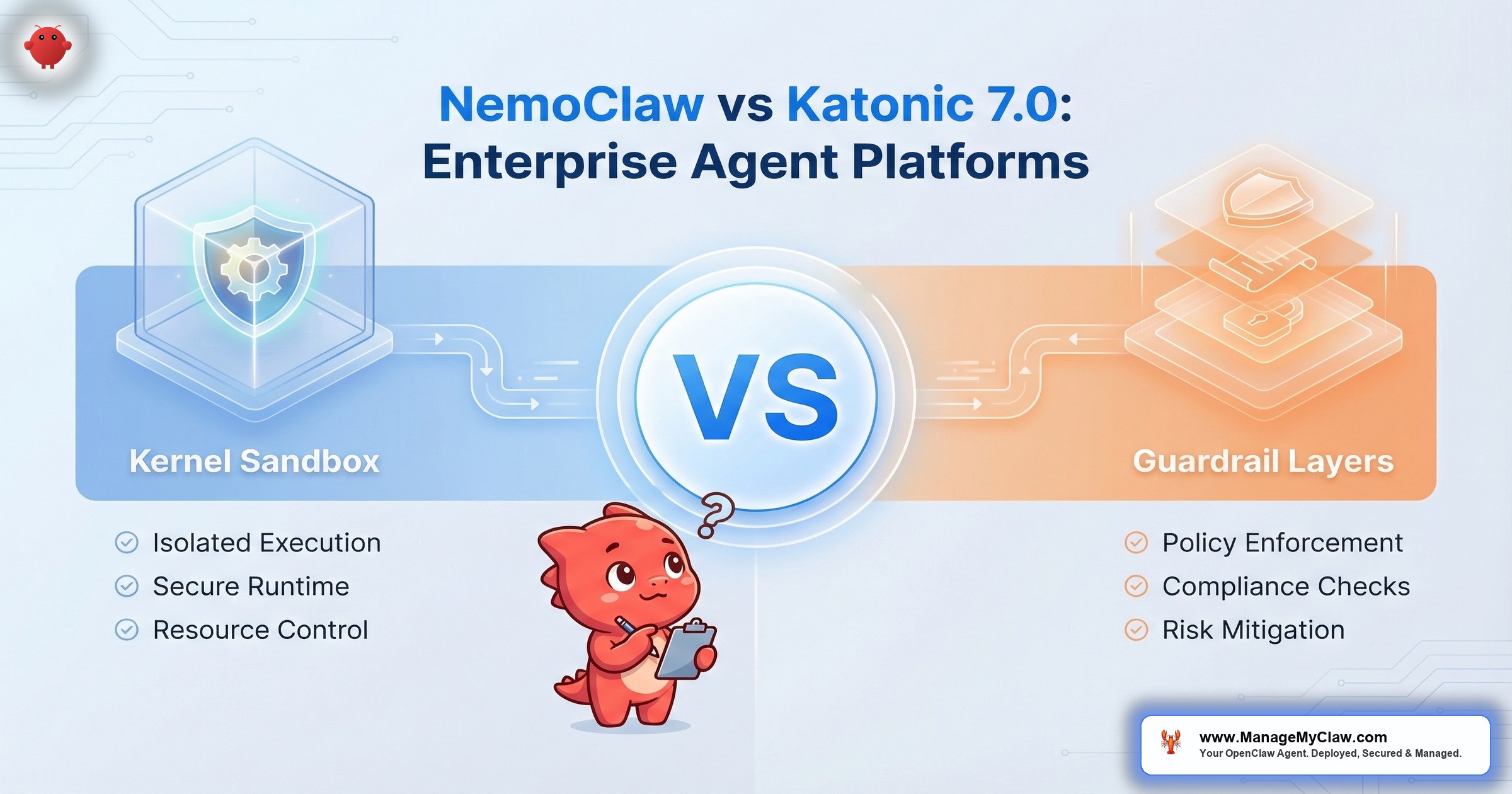
Katonic 7.0 ships with 8 guardrail types, 50+ pre-built connectors, and a zero data egress guarantee. NemoClaw ships with a kernel-level sandbox, a YAML policy engine that evaluates at 4 levels, and a privacy router that splits sensitive data to local Nemotron models. Both target the same buyer: enterprise security teams that need to say “yes” to AI agents without saying “yes” to uncontrolled data flow.
The architectures are fundamentally different. Katonic controls agents at the application layer with guardrails and connectors. NemoClaw controls agents at the operating system kernel. That distinction shapes every decision downstream — from deployment flexibility to lock-in risk to what “control” actually means.
If your organization is evaluating nemoclaw vs katonic enterprise agent platforms for regulated workloads, this comparison covers the architecture, the governance model, the data sovereignty approach, and the trade-offs that procurement needs to weigh. Both platforms have genuine strengths. The right choice depends on your infrastructure philosophy, your compliance requirements, and whether you want a managed platform or self-hosted control.
Architecture: Kernel-Level vs. Application-Layer Control
The fundamental difference between NemoClaw and Katonic is where agent control happens.
NemoClaw’s approach — kernel-level isolation: NemoClaw’s OpenShell sandbox uses Landlock filesystem isolation, seccomp filters, and network namespaces. These are Linux kernel primitives. An agent running inside OpenShell cannot access files, networks, or system calls that the sandbox has not explicitly permitted — regardless of what the agent’s prompts say or what the application layer allows. The YAML policy engine adds a second control layer with 4-level evaluation: binary (allow/deny), destination (which endpoints), method (what HTTP methods), and path (which routes). Even if an agent is instructed to access unauthorized resources, the kernel blocks it before the request leaves the process.
Katonic’s approach — application-layer guardrails: Katonic 7.0 implements 8 guardrail types that operate at the application layer: content filtering, toxicity detection, PII redaction, hallucination detection, prompt injection defense, output validation, access control, and rate limiting. These guardrails sit between the user and the agent, intercepting and filtering at the API level. The 50+ pre-built connectors handle integration with enterprise systems like Salesforce, SAP, ServiceNow, and Jira.
Why this matters: Kernel-level control cannot be bypassed by prompt injection, context manipulation, or application-layer exploits. Application-layer guardrails can be more granular in content-level decisions (PII redaction, toxicity scoring) but depend on the application functioning as expected. For CISOs evaluating against OWASP’s Agentic Top 10, NemoClaw’s architecture addresses ASI01 (Excessive Agency) and ASI03 (Insecure Agent Communication) at the OS level. Katonic addresses these through application logic.
Head-to-Head Comparison Table
| Feature | NemoClaw | Katonic 7.0 |
|---|---|---|
| Agent isolation | Kernel-level (Landlock, seccomp, namespaces) | Application-layer (8 guardrail types) |
| Policy engine | YAML-based, 4-level evaluation | UI-configured guardrail rules |
| Data sovereignty | Privacy router (local Nemotron + cloud split) | Zero data egress guarantee |
| Deployment model | Self-hosted, open-source | SaaS + on-premise options |
| Connectors / integrations | Open ecosystem (ClawHub + custom) | 50+ pre-built enterprise connectors |
| LLM flexibility | Local Nemotron + any cloud model via router | Multi-model (GPT, Claude, Gemini, Llama) |
| Vendor lock-in | None (open-source, self-hosted) | Platform-dependent (SaaS) |
| Compliance | OWASP ASI01–ASI10, SOC2, HIPAA (via implementation) | SOC2 Type II, HIPAA, GDPR, ISO 27001 |
| Maturity | Alpha / early-access (March 2026) | Production (version 7.0) |
| Pricing model | Open-source + implementation services | Subscription SaaS |
| NVIDIA ecosystem | Native (NVIDIA-built, 17 launch partners) | Cloud-agnostic |
NemoClaw data from NVIDIA technical documentation and GTC 2026 announcements. Katonic data from katonic.ai product pages and documentation, March 2026. Feature availability may vary by Katonic plan tier.
Where Katonic 7.0 Wins
1. Production maturity and time-to-value
Katonic is a production platform at version 7.0. NemoClaw is alpha software as of March 2026. For organizations that need agent governance deployed and auditable this quarter, Katonic’s maturity is a genuine advantage. The 50+ pre-built connectors for enterprise systems (Salesforce, SAP, ServiceNow, Jira, Zendesk) mean faster integration without custom development.
2. Zero data egress guarantee
Katonic’s zero data egress guarantee means customer data never leaves the deployment boundary. For regulated industries where the compliance requirement is binary — data stays local, period — this is a simpler story to tell an auditor than NemoClaw’s privacy router, which routes some data locally and some to cloud models based on sensitivity classification. The privacy router is more flexible, but the zero-egress model is more audit-friendly.
3. Built-in compliance certifications
Katonic holds SOC2 Type II, HIPAA, GDPR, and ISO 27001 certifications as a platform. NemoClaw deployments can be configured for compliance, but the certifications attach to the implementation, not the software itself. If your procurement team evaluates based on platform-level certifications, Katonic’s existing credentials reduce the documentation burden.
Why this matters: If your organization needs production-ready agent governance with existing compliance certifications and pre-built enterprise connectors today, Katonic 7.0 delivers that. The maturity gap is real — NemoClaw is building something architecturally deeper, but it is not production-stable yet.
Where NemoClaw Wins
1. Kernel-level isolation that application-layer exploits cannot bypass
Application-layer guardrails can be sophisticated, but they operate within the application’s trust boundary. If an attacker or a prompt injection bypasses the application layer, the guardrails are bypassed with it. NemoClaw’s OpenShell sandbox enforces constraints at the Linux kernel level — Landlock filesystem restrictions, seccomp system call filters, and network namespaces. These controls are enforced by the operating system, not the application. A compromised agent cannot escalate beyond its sandbox regardless of what happens at the application layer.
CrowdStrike’s Secure-by-Design Blueprint validates this architecture. Their Falcon AIDR integration with NemoClaw treats AI agent security as an endpoint security problem — the same way they treat any process running on a workstation. That framing is significant: it means your existing CrowdStrike deployment can monitor your AI agents through the same console and the same alert pipeline.
2. No vendor lock-in
NemoClaw is open-source. It deploys on your infrastructure. Your YAML policies, your privacy router configuration, and your agent workflows are portable. If you decide to change providers, bring management in-house, or modify the stack, everything is yours. SaaS platforms create dependency by design — your configurations, your integrations, and your agent logic live inside the vendor’s system. Migration from a SaaS agent platform to an alternative requires rebuilding, not exporting.
3. Flexible data sovereignty via privacy routing
Zero data egress is simple but inflexible. NemoClaw’s privacy router classifies data and routes it accordingly: sensitive data (PII, financial records, regulated data) stays on local Nemotron models; general reasoning and non-sensitive tasks route to cloud models for performance and cost efficiency. This gives organizations the compliance benefits of local processing for regulated data without sacrificing the capabilities of cloud models for everything else.
For organizations under GDPR that also serve global markets, the privacy router provides data residency compliance where regulations require it and cloud model performance where regulations permit it. A zero-egress approach forces all processing local — including the 80% of tasks that have no regulatory sensitivity.
4. NVIDIA ecosystem alignment
17 launch partners committed to NemoClaw at GTC 2026: Adobe, Salesforce, SAP, CrowdStrike, and others. NVIDIA’s investment in the NemoClaw ecosystem signals long-term infrastructure support. For organizations that have committed to NVIDIA hardware (DGX, Grace Hopper, Jetson) or NVIDIA software (CUDA, NIM, Omniverse), NemoClaw integrates natively rather than through an abstraction layer.
Why this matters: NemoClaw offers deeper isolation, zero lock-in, and flexible data routing — but requires implementation expertise and carries the risk of alpha software. The architecture is stronger for organizations with a 12–24 month planning horizon where early adoption creates a governance advantage.
The Maturity Question: Alpha vs. Production
NemoClaw is alpha software. That needs to be stated plainly because it is the single most important variable in this comparison.
Alpha means the core security primitives — OpenShell sandbox, policy engine, privacy router — work today. It also means APIs may change, documentation is evolving, and edge cases are still being discovered. NVIDIA shipped NemoClaw with 17 launch partners, CrowdStrike built a Secure-by-Design Blueprint for it, and JetPatch built an enterprise control plane around it. The ecosystem signals strong commitment. But production stability is not guaranteed in 2026.
Katonic 7.0 is a production platform. It handles enterprise workloads today. If your timeline is “deploy agent governance by Q2 2026,” Katonic can deliver that. If your timeline is “build the governance framework that will scale through 2027 and 2028,” NemoClaw’s architecture positions you ahead of organizations that will need to migrate later.
Gartner projects 40% of enterprise applications will include AI agents by end of 2026. Both platforms are positioned for that wave. The question is whether you need governance now (Katonic) or whether you are building governance infrastructure for the next 3 years (NemoClaw).
The Bottom Line
Katonic 7.0 is a production-ready enterprise agent platform with mature guardrails, pre-built connectors, and existing compliance certifications. NemoClaw is an architecturally deeper solution with kernel-level isolation, open-source portability, and NVIDIA ecosystem backing — but it is alpha software with an evolving feature set.
Choose Katonic if you need production agent governance this quarter with pre-built enterprise integrations and a zero data egress guarantee. Choose NemoClaw if you are building agent infrastructure on a 12–24 month horizon, need kernel-level isolation for OWASP ASI compliance, want zero vendor lock-in, or are committed to the NVIDIA ecosystem.
For organizations that choose NemoClaw, the implementation challenge is configuration, not installation. NemoClaw installs in 1 command. Production-hardening — kernel-level sandbox policies, privacy router tables, compliance documentation, multi-agent governance — takes 2–6 weeks of specialist work. The specialist vs. generalist comparison and the build-vs-buy analysis provide context on how to approach that implementation decision.
Frequently Asked Questions
Can NemoClaw and Katonic be used together?
Architecturally, yes. NemoClaw provides kernel-level agent isolation while Katonic provides application-layer guardrails and connectors. Some organizations may choose defense-in-depth by running Katonic’s guardrails on top of NemoClaw’s sandbox. Whether this is practical depends on the complexity cost of maintaining 2 agent governance layers versus the security benefit of layered controls.
Which platform is better for HIPAA compliance?
Katonic holds HIPAA certification as a platform. NemoClaw deployments can be configured for HIPAA compliance through privacy router settings, audit trail configuration, and access controls, but the certification attaches to the implementation, not the software. If your procurement requires platform-level HIPAA certification, Katonic provides that out of the box. If your compliance team evaluates based on technical controls and configuration evidence, NemoClaw’s kernel-level isolation and privacy routing provide deeper architectural controls.
What happens when NemoClaw reaches general availability?
Organizations that build NemoClaw governance now will be production-ready when GA ships. Organizations that wait will need 2–6 weeks of implementation work plus internal change management. The EU AI Act reaches full enforcement in August 2026. Early adopters who establish governance frameworks during the alpha period avoid the compliance rush when the regulation takes full effect.
Is Katonic’s zero data egress truly zero?
Katonic’s documentation guarantees zero data egress in their on-premise deployment option. This means customer data does not leave the customer’s network boundary. The SaaS deployment option processes data within Katonic’s infrastructure. Organizations evaluating the zero-egress claim should verify which deployment model is in scope and whether the guarantee covers metadata, telemetry, and model training data in addition to customer content.
How does NemoClaw implementation work with ManageMyClaw?
ManageMyClaw Enterprise provides NemoClaw implementation ($15,000–$45,000), including OpenShell sandbox configuration, YAML policy engine setup, privacy router deployment, CrowdStrike Falcon integration, SIEM/SOC integration, up to 10 agents, and compliance documentation. Enterprise Managed Care ($2,500–$10,000/month) provides ongoing monitoring, patching, and optimization with a 99.9% SLA. The Pilot Program ($5,000 for 30 days) offers a proof of concept before committing to full implementation.
Evaluate NemoClaw for your enterprise without a 6-month commitment.
ManageMyClaw Enterprise deploys a fully hardened NemoClaw stack in 2–6 weeks. Start with the $5,000 Pilot Program — 30 days, 1 agent, full security stack, written evaluation with go/no-go recommendation.
See Enterprise Pricing Learn About Managed Deployment