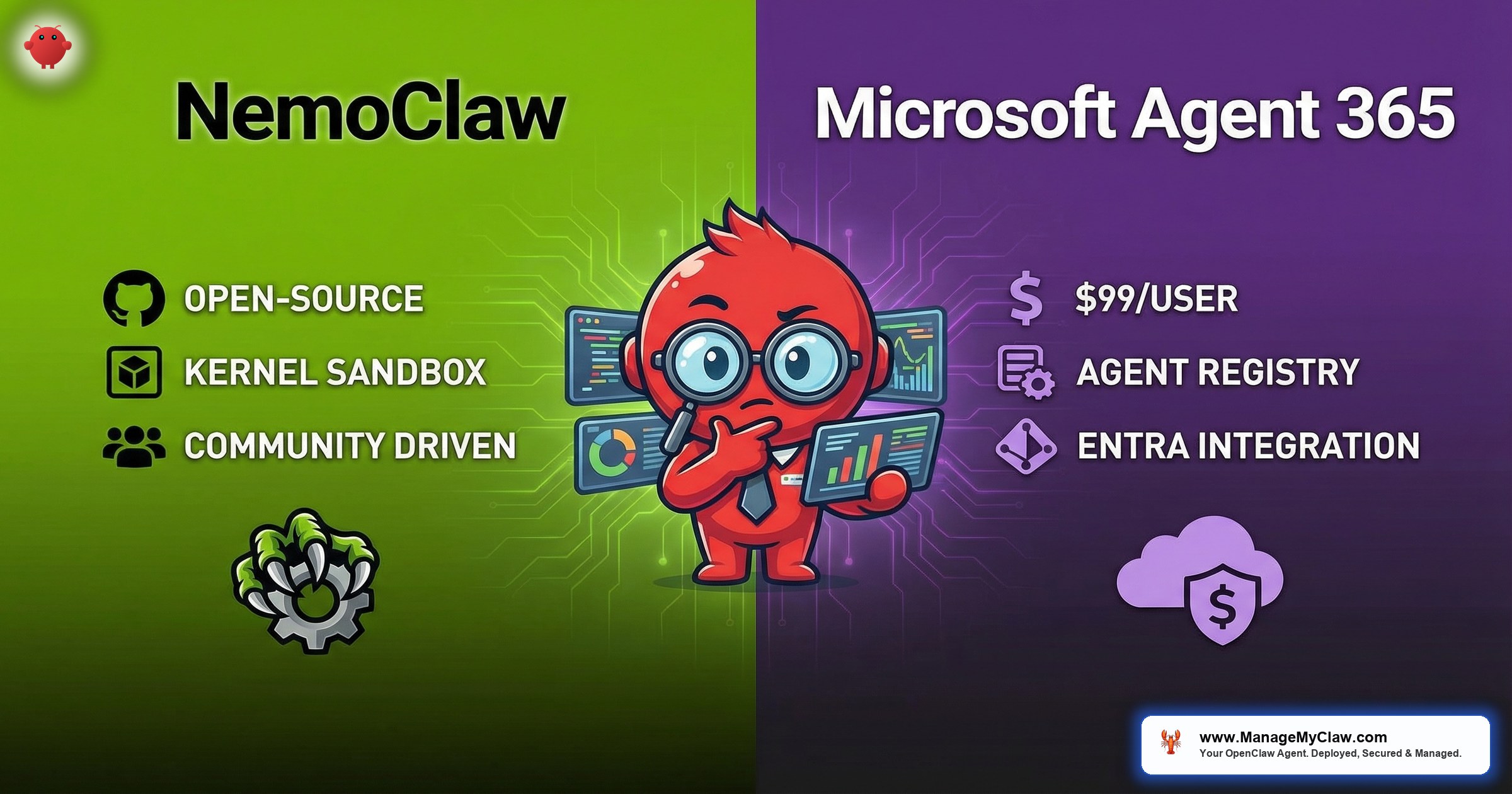
“Microsoft says ungoverned AI agents could become corporate ‘double agents.’ Their fix costs $99/month per user. NVIDIA’s fix costs $0 in software licensing. They solve fundamentally different problems — and your enterprise probably needs both.”
— VentureBeat, March 2026
Microsoft Agent 365 reached general availability on May 1, 2026, introducing enterprise governance for AI agents at $15/user/month standalone or $99/user/month as part of the Microsoft 365 E7 suite. NemoClaw, NVIDIA’s open-source security runtime for OpenClaw, launched in alpha at GTC 2026 with 17 enterprise partners and a $0 software licensing cost. Both products address the same board-level question — “how do we control AI agents in production?” — from architecturally opposite directions.
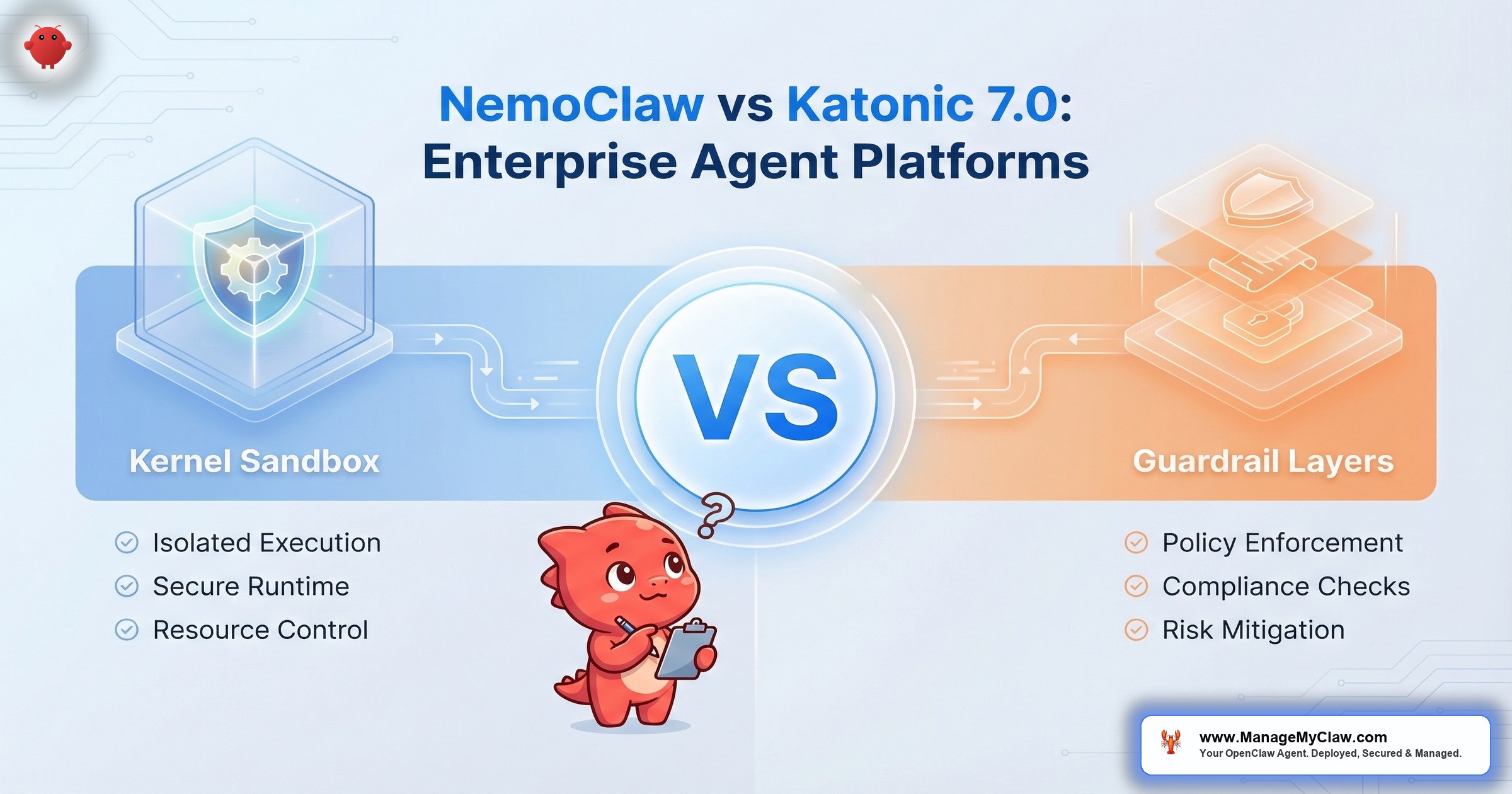
Agent 365 is a governance and observability control plane: it catalogs agents, manages identities, monitors behavior, and enforces data security policies across your Microsoft ecosystem. NemoClaw is a runtime security sandbox: it wraps individual agents in kernel-level isolation, YAML-configured policies, and a privacy router that keeps sensitive data on-premises. One governs from above. The other enforces from below. For CISOs evaluating both, the question is not which to choose — it’s whether your architecture needs a control plane, a runtime sandbox, or both.
This analysis maps each product’s capabilities against the OWASP Agentic Security Index, identifies where they overlap, where they’re complementary, and where neither covers the gap.
NemoClaw software licensing (Apache 2.0 open-source)
Agent 365 per user/month in Microsoft 365 E7
What Agent 365 Actually Delivers
Agent 365 is built on three pillars: Observability, Security, and Governance. Microsoft positioned it as the extension of their existing enterprise security stack — Defender, Entra, Purview — to cover non-human entities (AI agents) alongside human users. The premise is straightforward: if your organization already manages identities, threats, and data compliance through Microsoft’s stack, Agent 365 extends those same controls to AI agents.
Agent Registry
The centerpiece feature. Agent Registry catalogs every AI agent operating in your organization — whether built on Copilot Studio, third-party frameworks, or custom code — into a single inventory. For enterprises that discovered they had dozens of unsanctioned AI agents deployed by individual teams (a pattern CrowdStrike’s 2026 Threat Report documented as increasingly common), the registry solves the visibility problem: you can’t govern what you can’t see.
Defender for AI Agents
Extends Microsoft Defender’s threat protection to agent-specific attack vectors: prompt injection detection, data exfiltration attempts, and anomalous agent behavior patterns. This is Microsoft applying its existing threat intelligence infrastructure — built on trillions of daily signals — to the new surface area that agentic AI creates.
Entra Agent ID
Gives AI agents their own identity objects in the Entra directory, subject to the same conditional access policies, role-based permissions, and lifecycle management as human users. When an agent is decommissioned, its access is revoked through the same identity lifecycle that offboards a human employee. For compliance teams accustomed to Entra-based audit trails, this maps directly to existing workflows.
Purview for Data Security
Extends data loss prevention (DLP) and sensitivity labeling to agent interactions. If an agent processes a document labeled “Confidential,” Purview’s policies apply to the agent’s output the same way they would to a human user copying that content into an email.
Agent 365 operates at the governance layer. It does not execute agent code, does not sandbox agent processes, and does not control what happens inside the agent’s runtime. It observes, catalogs, applies identity policies, and enforces data governance rules from the organizational level. Think of it as Active Directory for AI agents — essential for enterprise governance, but not a substitute for the agent’s own security boundaries.
What NemoClaw Actually Delivers
NemoClaw is a security runtime that wraps OpenClaw at the operating system level. It is open-source (Apache 2.0), hardware-agnostic (runs on any Linux system, not just NVIDIA GPUs), and currently in alpha with 17 launch partners including Adobe, Atlassian, Cisco, CrowdStrike, Salesforce, SAP, and ServiceNow. The software cost is $0. The infrastructure cost depends on your hardware choices.
Kernel-Level Sandbox (OpenShell)
OpenShell wraps the agent process in Landlock filesystem policies, seccomp system call filters, and network namespace rules. The agent cannot override these controls because they operate outside the agent’s process space. Even if an agent is compromised through prompt injection or a malicious skill, the sandbox prevents escalation to host-system access.
YAML Policy Engine
A 4-level policy hierarchy (binary, destination, method, path) that runs out-of-process. The agent cannot modify its own permissions. Every allow/deny decision is logged with full audit trail. Policy updates apply live without agent restart.
Privacy Router
Routes inference requests based on data classification: sensitive data (PII, PHI, proprietary) stays on-premises and is processed by local Nemotron models. Non-sensitive requests route to frontier cloud models. PII is stripped using differential privacy before anything reaches an external API.
NemoClaw operates at the execution layer. It does not catalog agents across your organization, does not manage agent identities in a directory, and does not integrate with enterprise DLP systems. It enforces security boundaries around individual agent processes at the kernel level. Think of it as AppArmor for AI agents — essential for runtime isolation, but not a substitute for organizational governance.
Head-to-Head: Control Plane vs Runtime Security
| Capability | Agent 365 | NemoClaw |
|---|---|---|
| Architecture layer | Control plane (governance) | Runtime (sandbox) |
| Pricing | $15/user/mo standalone; $99/user/mo in E7 | $0 software (Apache 2.0); hardware costs vary |
| Agent discovery/catalog | Agent Registry (full inventory) | Not included |
| Agent identity management | Entra Agent ID (directory-level) | Not included |
| Process-level sandboxing | Not included | OpenShell (Landlock, seccomp, namespaces) |
| Threat detection | Defender for AI Agents | Policy engine deny logging |
| Data loss prevention | Purview integration | Privacy router (inference routing) |
| Data residency enforcement | Purview policies + cloud region | Privacy router (on-prem Nemotron) |
| Maturity | Enterprise GA (May 2026) | Alpha (March 2026) |
| Ecosystem lock-in | Microsoft 365 ecosystem | Hardware-agnostic, vendor-neutral |
| Launch partners | Microsoft ecosystem | 17 partners (Adobe, Cisco, CrowdStrike, SAP, etc.) |
| Open source | No (proprietary SaaS) | Yes (Apache 2.0) |
The table makes the pattern clear: these products have almost zero feature overlap. Agent 365 covers governance, identity, and organizational visibility. NemoClaw covers runtime isolation, process-level enforcement, and data routing. An enterprise running AI agents at scale likely needs controls at both layers.
Why You Might Need Both — Not One or the Other
The framing of “NemoClaw vs Agent 365” is intuitive but architecturally misleading. They operate at different layers of the security stack and address different threat categories from the OWASP Agentic Security Index.
Both Products
A financial services firm deploys 30 AI agents across trading, compliance, and client communication. Agent 365 catalogs all 30 agents in the registry, gives each an Entra identity with scoped permissions, monitors for anomalous behavior through Defender, and applies Purview DLP to prevent client PII from appearing in agent outputs.
NemoClaw wraps each agent’s runtime in OpenShell sandboxing, preventing a compromised trading agent from accessing the compliance agent’s filesystem. The privacy router ensures proprietary trading data routes through local Nemotron models and never reaches external APIs.
Agent 365 answers: “Which agents exist and what are they permitted to do?” NemoClaw answers: “What happens when an agent tries to do something it shouldn’t?”
“You don’t choose between a firewall and access control lists. You deploy both because they operate at different layers. The same logic applies to agent governance and agent runtime security.”
The risk of choosing only one: Agent 365 without runtime sandboxing means a compromised agent can still execute arbitrary code within its process space — the governance layer observes the breach but cannot prevent the execution. NemoClaw without organizational governance means you have isolated agents but no centralized visibility into which agents exist, who deployed them, or whether they comply with data policies.
The $0 vs $99 Headline Obscures the Real Cost
NemoClaw’s $0 software cost is genuine — Apache 2.0, no licensing fees, no per-seat charges. But the total cost of a production NemoClaw deployment includes GPU hardware for local Nemotron inference, Linux infrastructure for OpenShell sandboxing, and engineering time for YAML policy configuration and ongoing management. For an enterprise deploying NemoClaw at scale, the infrastructure and personnel costs can exceed Agent 365’s per-seat licensing.
Agent 365 annual cost for 100 users at $99/user/month in E7 suite
Agent 365 at $99/user/month for 100 users is $118,800/year. But that’s the E7 bundle price, which includes the full Microsoft 365 E7 suite — not just agent governance. The standalone Agent 365 license at $15/user/month for 100 users is $18,000/year. For organizations already on Microsoft 365 E5 considering the E7 upgrade, the incremental cost of adding Agent 365 capabilities needs to be evaluated against the full E7 bundle value, not attributed entirely to agent governance.
NemoClaw’s cost at the same scale depends entirely on hardware decisions. A ManageMyClaw Enterprise assessment ($2,500) can help quantify the infrastructure requirements for your specific deployment before you commit to hardware purchases.
Agent 365 is enterprise GA with Microsoft’s full support infrastructure. NemoClaw is in alpha. For organizations that need production-grade agent governance today, Agent 365 is deployable now. NemoClaw’s runtime security is architecturally compelling but not yet production-hardened. Enterprises evaluating NemoClaw should plan for a multi-quarter evaluation timeline as it matures toward GA.
When to Deploy Which — Or Both
Deploy Agent 365 first if: your organization is already in the Microsoft 365 ecosystem, you need agent governance and visibility today (not next quarter), your primary concern is agent sprawl and identity management, and your compliance team requires integration with existing Purview DLP policies.
Deploy NemoClaw first if: your primary concern is runtime security and process isolation, you need on-premises data residency for regulated workloads (HIPAA, GDPR), you want to avoid per-seat licensing costs, and your engineering team can manage alpha-stage open-source infrastructure.
Plan for both if: you’re deploying 10+ agents across multiple departments, you need both organizational visibility (who deployed what) and runtime enforcement (what can each agent actually do), and your security architecture follows defense-in-depth principles where controls exist at every layer.
- Small team (under 10 agents): NemoClaw alone may suffice — the governance overhead of Agent 365 may exceed the visibility benefit at this scale
- Mid-market (10–50 agents): Agent 365 for governance + NemoClaw for runtime on your most sensitive agents
- Enterprise (50+ agents): Both products at full deployment, with Agent 365 as the organizational control plane and NemoClaw providing runtime isolation per agent
Frequently Asked Questions
Are NemoClaw and Agent 365 competitors?
Not architecturally. Agent 365 is a governance control plane (catalogs, identities, DLP). NemoClaw is a runtime security sandbox (process isolation, kernel enforcement, data routing). They have almost zero feature overlap. For enterprises running AI agents at scale, they’re complementary: Agent 365 answers “which agents exist and what should they do?” while NemoClaw answers “what happens when an agent tries to exceed its boundaries?” See our OWASP Agentic Top 10 analysis for the full threat taxonomy.
Can NemoClaw work within a Microsoft 365 environment?
Yes. NemoClaw is hardware-agnostic and runs on any Linux system. In a Microsoft 365 environment, you could deploy Agent 365 for organizational governance while running NemoClaw on Linux infrastructure for runtime sandboxing of specific agents. The two products don’t conflict because they operate at different layers of the stack. The integration point would be logging: NemoClaw’s audit logs could feed into Microsoft Sentinel for unified security monitoring.
Is $99/user/month for Agent 365 actually worth it?
The $99 figure is for the full Microsoft 365 E7 suite, not Agent 365 alone. Standalone Agent 365 licensing is $15/user/month. Whether it’s worth it depends on what you’re currently spending on ad-hoc agent governance. If your security team is manually tracking agent deployments, building custom identity management, and creating DIY DLP rules for agent outputs, $15/user/month for a unified control plane may be a net cost reduction. Evaluate it against your current agent governance spend, not against $0.
How does ManageMyClaw Enterprise relate to these products?
ManageMyClaw Enterprise provides NemoClaw implementation services: assessment, deployment, YAML policy configuration, privacy router setup, and ongoing managed care. We do not resell Agent 365. For organizations that decide they need NemoClaw’s runtime security (with or without Agent 365 for governance), we handle the implementation so your engineering team doesn’t have to manage alpha-stage infrastructure directly. Schedule an architecture review to evaluate which layers your deployment needs.
$2,500 architecture assessment. Security gap analysis. Prioritized remediation plan.
Schedule Architecture Review