On March 9, 2026, Microsoft announced the E7 licensing tier — the first new 365 tier in 11 years. On May 1, 2026, Agent 365 goes GA at $15/user/month standalone or bundled inside E7 at $99/user/month. By the time you read this, tens of millions of agents are already indexed in Microsoft’s global registry from the preview period alone. That’s one approach to enterprise governance: a centralized, cloud-native registry bolted onto your existing tenant.
NVIDIA’s NemoClaw takes a fundamentally different approach: kernel-level sandboxing, a YAML policy engine that runs out-of-process, and a privacy router that keeps sensitive data on local Nemotron models. Same problem — enterprise agent governance. Different philosophy on where the controls live and who holds the keys.
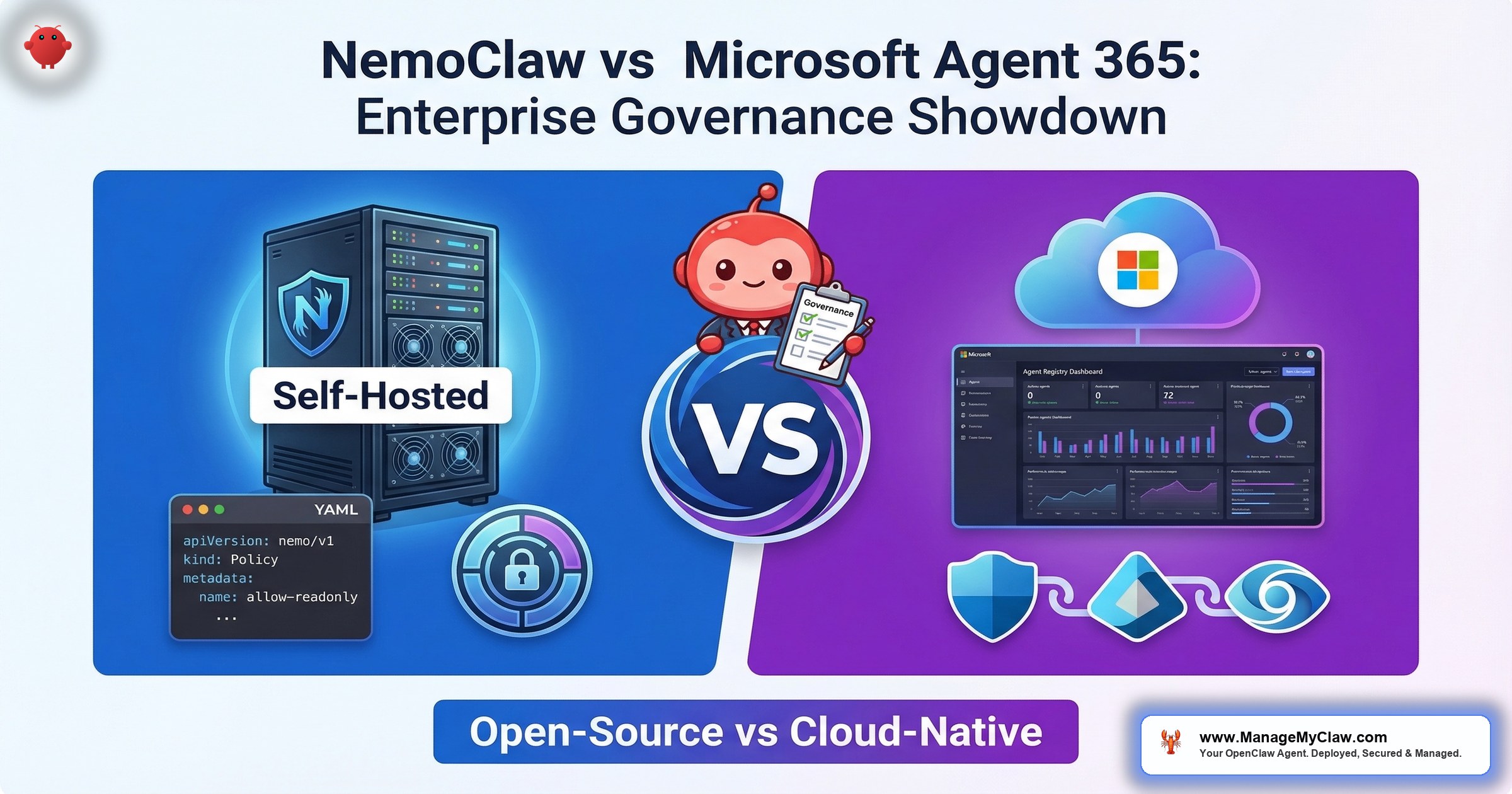
This isn’t a “which is better” post. These 2 platforms serve different infrastructure realities. One assumes you’re inside Microsoft’s tenant. The other assumes you want governance you can inspect, modify, and host on your own metal. The nemoclaw vs microsoft agent 365 enterprise decision is about where your organization wants its control plane to live.
What Each Platform Actually Ships
Microsoft Agent 365 launched during the E7 announcement as the governance layer for the Copilot agent ecosystem. The core value prop: a unified Agent Registry providing complete visibility into every agent in your tenant — who built it, what it accesses, how it behaves. During preview, tens of millions of agents were already cataloged globally. The stack integrates with Defender (threat detection), Entra (identity), and Purview (compliance), with detailed logging, reporting, and audit trails layered on top.
NemoClaw starts from a different assumption: the agent’s execution environment itself must be isolated at the kernel level. OpenShell uses Landlock filesystem restrictions, seccomp system call filters, and network namespaces to create a deny-by-default execution boundary. The agent can’t touch files, make network calls, or execute system commands unless the YAML policy engine explicitly permits it.
NemoClaw’s privacy router adds a data-sovereignty layer Agent 365 doesn’t have: sensitive queries route to local Nemotron models on your hardware, general reasoning queries go to cloud models. The routing decision happens before data leaves your premises. The entire stack is open-source and self-hosted.
Think of it as the difference between a managed building with cameras in every hallway and a reinforced vault where you hold the only key. One provides visibility and centralized control. The other provides isolation and local sovereignty.
Head-to-Head Comparison Table
| Dimension | NemoClaw | Microsoft Agent 365 |
|---|---|---|
| Architecture | Self-hosted, kernel-level sandbox (OpenShell) | Cloud-native, Microsoft tenant-integrated |
| Policy engine | YAML-based, 4-level evaluation (binary, destination, method, path) | Integrated via Defender + Entra + Purview policies |
| Agent visibility | Local audit logs, SIEM integration | Unified Agent Registry (tens of millions indexed in preview) |
| Data sovereignty | Privacy router: sensitive data stays on-premises (local Nemotron models) | Microsoft cloud tenant; data residency per region selection |
| Identity management | Integrates with corporate identity providers | Native Entra ID (formerly Azure AD) |
| Threat detection | CrowdStrike Falcon AIDR integration | Microsoft Defender integration |
| Pricing | Open-source (free) + hardware/infrastructure costs | $15/user/month standalone; $99/user/month in E7 suite |
| Source model | Open-source, inspectable, modifiable | Closed-source, Microsoft-managed |
| Maturity | Alpha / early-access (March 2026) | GA May 1, 2026 |
| Ecosystem partners | 17 launch partners (Adobe, Salesforce, SAP, CrowdStrike) | Full Microsoft 365 ecosystem + ISV marketplace |
| Vendor lock-in | No lock-in — open-source stack, your infrastructure | Tied to Microsoft 365 tenant and licensing |
NemoClaw status as of March 2026: alpha/early-access. Agent 365 GA: May 1, 2026. Agent 365 pricing confirmed at E7 announcement, March 9, 2026.
The Governance Philosophy Split
Agent 365’s bet: centralized visibility solves governance. If IT can see every agent, who created it, what data it touches, and when it last ran — they can govern it. The Agent Registry is a single pane of glass for agent sprawl across the tenant.
NemoClaw’s bet: isolation solves governance. Rather than watching what agents do and flagging violations after the fact, NemoClaw prevents unauthorized actions at the kernel level before they execute. The YAML policy engine evaluates every request through 4 levels: binary allow/deny, destination filtering, method restrictions, and path-level controls. The policy runs out-of-process — the agent can’t modify its own constraints.
This isn’t a minor difference. It’s the difference between a surveillance camera and a locked door. Agent 365 tells you when someone walks into a restricted room. NemoClaw makes it physically impossible to open that door.
The Reddit community is already doing the math. On r/Office365, “Microsoft 365 E7 — New licensing tier after 11 years” captured IT admins reacting to the announcement. On r/SysAdminBlogs, “Microsoft 365 E7 just dropped — $99/user/month and available May 1, 2026” drew sysadmins running governance calculations. The math: for a 500-person org, E7 is $594,000/year. For 5,000, it’s $5.94 million/year.
Why this matters: Your choice isn’t just a feature comparison — it’s a governance model decision. Observe-and-respond vs. prevent-by-default. Organizations subject to HIPAA, SOC2, or EU AI Act (full enforcement August 2026) should evaluate which model maps better to their compliance framework.
Where Agent 365 Wins
Agent 365 has 3 advantages that are genuine, structural, and hard to replicate.
1. If you’re already in Microsoft 365, governance is additive — not net-new
Most enterprises already have Defender, Entra, and Purview deployed. Agent 365 plugs into that existing stack. Your security team doesn’t learn a new console, your identity provider doesn’t change. For IT teams already stretched thin, adding Agent 365 is operationally simpler than standing up a parallel governance infrastructure.
2. The Agent Registry solves a real problem at scale
With tens of millions of agents indexed during the preview alone, Microsoft has proven agent sprawl is happening at a scale manual tracking can’t handle. The Agent Registry gives IT complete visibility: who built each agent, what it accesses, how often it runs. For a 5,000-person organization where departments are building Copilot agents independently, that registry is the difference between governance and chaos.
It’s like the difference between a library catalog and a padlocked bookshelf. If your problem is that you don’t even know what agents exist in your org, the catalog comes first.
3. GA maturity vs. alpha
Agent 365 ships GA on May 1, 2026, with enterprise support and SLAs. NemoClaw is alpha/early-access as of March 2026. 17 NVIDIA launch partners validate NemoClaw’s direction, but alpha software carries alpha risk. For organizations that need production governance this quarter, that maturity gap is real.
Where NemoClaw Wins
1. Kernel-level isolation vs. application-layer controls
Agent 365 governs at the application layer — monitoring, logging, and enforcing policies through the Microsoft 365 control plane. NemoClaw’s OpenShell governs at the kernel level: Landlock filesystem restrictions, seccomp system call filters, and network namespaces. If an application-layer policy has a misconfiguration or bypass, the agent can potentially exceed its permissions. A kernel-level sandbox fails closed — the agent literally can’t execute operations the kernel blocks. For organizations where “the policy said no but the agent did it anyway” is an unacceptable audit finding, the isolation depth matters.
2. Data never leaves your premises
NemoClaw’s privacy router routes sensitive queries — PII, financial data, health records — to local Nemotron models on your hardware. General reasoning queries go to cloud models. The routing decision happens before data leaves your network perimeter. Agent 365 offers region-based data residency, but the data still lives in Microsoft’s cloud. For defense contractors, healthcare organizations under HIPAA, and government agencies with data sovereignty mandates, the distinction between “stored in your region” and “never leaves your building” can determine procurement approval.
3. No per-user licensing at scale
NemoClaw is open-source. You pay for hardware (NVIDIA GPUs for local inference), infrastructure, and engineering time. Agent 365 charges $15/user/month standalone. At scale, the math diverges:
- 500 users: Agent 365 = $90,000/year. NemoClaw = hardware + implementation (amortized).
- 5,000 users: Agent 365 = $900,000/year. NemoClaw = same hardware, same implementation.
- 50,000 users: Agent 365 = $9 million/year. NemoClaw = incremental GPU capacity.
NemoClaw’s cost is infrastructure-based, not seat-based. The 500th user costs the same as the 5,000th once hardware is provisioned.
4. You can read the source code
NemoClaw’s governance stack is open-source. Your security team can audit the sandbox implementation, review the policy engine’s evaluation logic, and verify the privacy router’s routing decisions line by line. Agent 365 is closed-source. For organizations with internal security review requirements — common in financial services and government — source code auditability can remove a procurement blocker entirely.
Why this matters: Kernel isolation, data sovereignty, no per-seat licensing, auditable source — these matter most to organizations with strict compliance requirements or scale that makes per-user pricing prohibitive. If those describe your environment, NemoClaw’s architecture is purpose-built for your constraints.
What the Community Is Actually Saying
The Reddit signal on both sides is telling — and not uniformly positive for either platform.
On r/CopilotPro, a thread titled “No One is Using CoPilot” surfaced a persistent adoption problem inside Microsoft’s ecosystem. If agents aren’t being used, the governance layer is governing empty rooms. The E7 bundle at $99/user/month is partly Microsoft’s answer: combine AI, security, and agent governance into a single SKU so adoption and governance ship together.
On r/cybersecurity, “Insecure Copilot” raised security concerns about the ecosystem Agent 365 is designed to govern. The implication: if the agents themselves have security gaps, the governance layer needs to do more than log — it needs to prevent unauthorized behavior.
On r/microsoft365, “How the 2026 Shift in the AI-First ‘365 Copilot’ Ecosystem Is Changing Adoption” captured the broader tension: organizations are simultaneously being told to adopt AI agents aggressively and govern them carefully. Agent 365 and NemoClaw are both responses to that tension.
Why this matters: Community signals reveal friction that marketing pages don’t. If adoption is low, governance tools solve the wrong problem. If security concerns are active, governance tools need to prevent — not just observe. Factor the community’s lived experience into your evaluation alongside the spec sheet.
Who Should Choose Agent 365
- You’re already a Microsoft 365 shop. Identity in Entra, security in Defender, compliance in Purview. Agent 365 extends what you have.
- Agent sprawl is your primary problem. Departments spinning up Copilot agents faster than IT can track them. The Agent Registry solves that immediately.
- You need production governance this quarter. GA May 1, 2026, with enterprise support and SLAs. No alpha caveats.
- Your data classification allows cloud processing. Agent 365’s region-based residency satisfies most compliance requirements that don’t mandate on-premises.
- Your user count is under 1,000. At $15/user/month, the licensing is manageable. Economics favor Agent 365 when speed-to-governance matters more than scale optimization.
Who Should Choose NemoClaw
- Data sovereignty is non-negotiable. Healthcare, defense, government, financial services — if sensitive data can’t leave your premises, NemoClaw’s privacy router is built for that constraint.
- You need kernel-level isolation, not just policy enforcement. If “the agent tried but the system prevented it” needs to be your audit answer, OpenShell delivers that.
- Your scale makes per-seat licensing prohibitive. At 5,000+ users, Agent 365 is $900,000/year. NemoClaw’s infrastructure cost model changes the procurement math.
- Your security team requires source code auditability. NemoClaw is open-source. Agent 365 is not.
- You’re building governance now for deployment in 6-12 months. Organizations that build governance during alpha will be production-ready when GA arrives. Those that wait will be 6-12 months behind.
The Bottom Line
This isn’t a contest between a good platform and a bad one. Agent 365 and NemoClaw represent 2 architecturally different approaches to the same problem: how do you let your organization deploy AI agents without losing control?
Agent 365 is the right choice if your organization lives inside Microsoft’s ecosystem, needs governance this quarter, and processes data that doesn’t require on-premises residency.
NemoClaw is the right choice if your organization needs kernel-level isolation, on-premises data sovereignty, auditable source code, or a cost model that doesn’t scale with headcount. It requires more upfront engineering, but it delivers controls that live at a fundamentally different layer of the stack.
The honest caveat: NemoClaw is alpha software backed by 17 enterprise partners, including CrowdStrike’s Secure-by-Design Blueprint. The security primitives work today. But production hardening — YAML policy configuration, privacy router tuning, compliance documentation — takes specialist work. That’s the gap between downloading NemoClaw and running it in a way your CISO will sign off on. ManageMyClaw’s enterprise practice exists to close that gap.
Frequently Asked Questions
Is NemoClaw better than Microsoft Agent 365 for enterprise governance?
Neither is universally better — they solve governance differently. NemoClaw provides kernel-level isolation via OpenShell, on-premises data sovereignty through its privacy router, and open-source auditability. Agent 365 provides centralized visibility through its Agent Registry, native integration with Defender/Entra/Purview, and GA-level maturity with Microsoft enterprise support. Choose based on whether your primary need is isolation and sovereignty (NemoClaw) or visibility and ecosystem integration (Agent 365).
How much does Microsoft Agent 365 cost compared to NemoClaw?
Agent 365 is $15/user/month standalone or $99/user/month in the E7 bundle. At 500 users, that’s $90,000–$594,000/year. NemoClaw is open-source — the software is free. Costs come from hardware (NVIDIA GPUs for local Nemotron inference), infrastructure, and engineering time for production configuration. NemoClaw’s cost doesn’t scale per-user, so the economics increasingly favor it above 1,000 users.
Can I run NemoClaw and Agent 365 together?
Yes. They govern different agent ecosystems. Agent 365 governs Copilot agents inside your Microsoft 365 tenant. NemoClaw governs agents built on the OpenClaw/NemoClaw stack. An enterprise running both Copilot-based agents and custom NemoClaw agents would use Agent 365 for the former and NemoClaw’s governance stack for the latter. They’re complementary, not mutually exclusive.
Is NemoClaw ready for production?
As of March 2026, NemoClaw is in alpha/early-access. The core security primitives — OpenShell kernel sandbox, YAML policy engine, privacy router — work today and are backed by 17 NVIDIA launch partners including CrowdStrike. However, alpha software carries alpha risk: APIs may change, documentation is evolving, and enterprise support channels are limited compared to GA products. Organizations deploying now should plan for configuration adjustments as NemoClaw approaches GA.
What is the Microsoft 365 E7 suite and why does it matter for agent governance?
E7 is Microsoft’s first new 365 licensing tier in 11 years, announced March 9, 2026, and available May 1, 2026 at $99/user/month. It bundles AI capabilities (Copilot), security tooling (Defender), and agent governance (Agent 365) into a single SKU. The significance is strategic: Microsoft is positioning agent governance not as an optional add-on but as part of the core enterprise platform. For organizations already on E5, the E7 upgrade path means governance arrives alongside the agents rather than chasing them after deployment.
Does NemoClaw work without NVIDIA hardware?
NemoClaw’s governance stack — OpenShell sandbox and YAML policy engine — runs on standard Linux infrastructure (minimum 4 vCPU, 8 GB RAM). The privacy router’s local inference capability requires NVIDIA GPUs to run Nemotron models on-premises. Without NVIDIA hardware, you can still use the sandbox and policy engine but would route all model queries to cloud providers, losing the on-premises data sovereignty advantage. Agent 365 has no specific hardware requirements beyond the standard Microsoft 365 cloud subscription.
Evaluating NemoClaw for your organization?
ManageMyClaw’s enterprise practice handles NemoClaw assessment, implementation, and managed care — from OpenShell configuration and YAML policy setup to privacy router deployment and compliance documentation. See enterprise pricing or learn about our NemoClaw services.
Schedule Architecture Review