A founder on r/ClaudeAI posted: “My OpenClaw agent burned through $47 in API credits overnight. It got stuck in a retry loop on a failed email triage and just kept calling the API.” The thread got 89 upvotes and 34 comments. Half the responses were people sharing similar stories.
OpenClaw doesn’t ship with API rate limiting by default. No token budgets. No daily spend caps. No circuit breakers for retry loops. The agent will happily call the Anthropic or OpenAI API as many times as it needs to complete a task — and if it gets stuck, “as many times as it needs” becomes “until your credit balance hits zero.”
The API bill is the silent cost that turns a $60/month operating expense into a $200 surprise. Rate limiting is the guardrail you don’t think you need until the bill arrives.
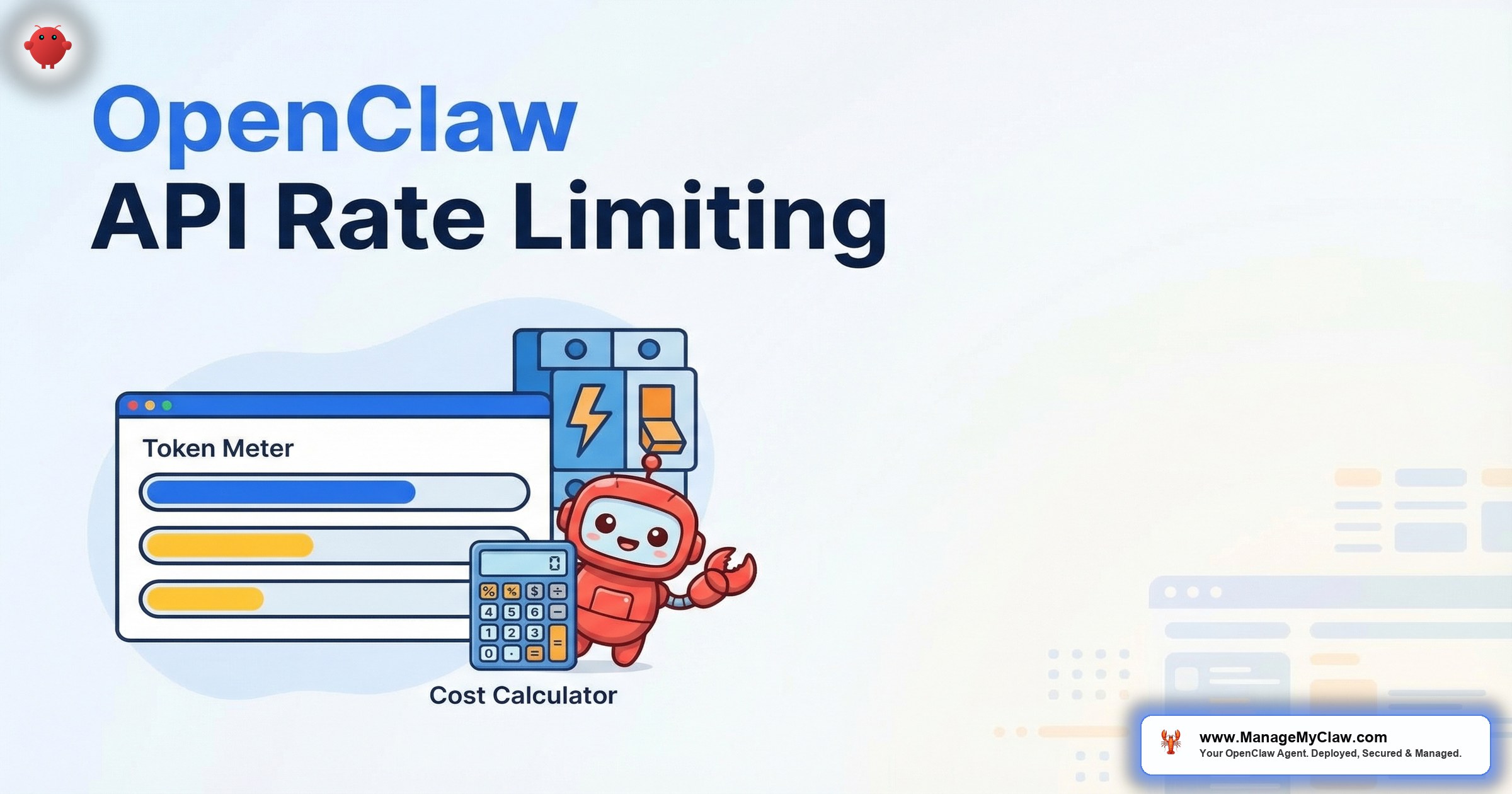
This guide covers the full OpenClaw API rate limiting and token cost management setup — from setting hard spending limits with your API provider to configuring per-workflow token budgets inside OpenClaw.
The Real Cost of Running OpenClaw (Monthly Breakdown)
Before configuring limits, you need to know what normal looks like. Here’s the typical API cost for each workflow at standard volume:
| Workflow | Volume | Monthly API Cost |
|---|---|---|
| Morning Briefing | 1x daily | $5–$15 |
| Email Triage | 50 emails/day | $15–$40 |
| Client Onboarding | 10 clients/month | $10–$30 |
| Social Media Pipeline | 3–5 posts/week | $10–$25 |
| KPI Reporting | Daily + weekly | $5–$15 |
| Customer Service | 50 conversations/day | $30–$80 |
| Typical 3-workflow setup | — | $60–$100 |
Those numbers are for normal operation. Without rate limiting, a single runaway loop can exceed a month’s budget in a few hours.
Layer 1: API Provider Spending Limits
Your first line of defense isn’t in OpenClaw — it’s in your API provider’s dashboard. Both Anthropic and OpenAI offer hard spending limits that cut off API access when reached.
Anthropic: Console > Settings > Plans & Billing > Monthly spending limit. Set this to 150% of your expected monthly usage. For a $100/month expected bill, set the limit to $150. This gives headroom for normal variation without letting a runaway loop burn indefinitely.
OpenAI: Platform > Settings > Billing > Usage limits. Set both the “soft limit” (email notification) and “hard limit” (API cutoff). Set the soft limit at 100% of expected spend and the hard limit at 150%.
This is the financial kill switch. Even if every other safeguard fails, the API provider cuts you off before the bill goes catastrophic. Configure this before you configure anything else.
Layer 2: Per-Workflow Token Budgets
API provider limits are blunt instruments — they cut off everything. Per-workflow token budgets let you cap individual workflows so one runaway task doesn’t kill your entire agent.
In your OpenClaw configuration, you can set token limits per task:
{
  "workflows": {
    "email-triage": {
      "max_tokens_per_run": 50000,
      "max_runs_per_hour": 10,
      "max_daily_tokens": 500000
    },
    "morning-briefing": {
      "max_tokens_per_run": 30000,
      "max_runs_per_hour": 2,
      "max_daily_tokens": 100000
    }
  }
}
How to set the right limits: Run your workflow normally for 1 week. Check the average token consumption per run. Set your limit at 3x that average. This gives enough headroom for complex tasks (long emails, large datasets) without enabling infinite loops. If a run hits the limit, it fails gracefully instead of burning credits.
On r/AI_Agents, a user shared their approach: “I set aggressive daily limits for the first month, then adjusted based on actual usage. Better to have a few tasks fail on a limit than to wake up to a $200 bill.” (23 upvotes)
Layer 3: Circuit Breakers for Retry Loops
The $47 overnight incident happened because of a retry loop. The agent tried to triage an email, hit an error (expired OAuth token), retried, hit the same error, retried again — hundreds of times. Each retry consumed tokens for the prompt, even though the task couldn’t possibly succeed.
Circuit breakers stop this pattern:
{
  "error_handling": {
    "max_retries": 3,
    "retry_backoff_seconds": [30, 120, 300],
    "circuit_breaker": {
      "failure_threshold": 5,
      "reset_timeout_minutes": 30
    }
  }
}
max_retries: 3. If a task fails 3 times, stop trying and log the failure. Don’t retry 300 times hoping the API provider magically fixes itself.
retry_backoff_seconds. Wait 30 seconds before the first retry, 2 minutes before the second, 5 minutes before the third. Exponential backoff reduces the blast radius of transient failures.
circuit_breaker. If 5 tasks fail within the tracking window, stop executing that workflow entirely for 30 minutes. This prevents cascading failures where a broken upstream service causes every queued task to fail and retry.
A circuit breaker isn’t an admission of failure. It’s the engineering decision that says “something is wrong upstream, and burning tokens on retries isn’t going to fix it.”
Layer 4: Model Selection for Cost Optimization
Not every task needs the most expensive model. Email categorization doesn’t require the same model as legal document analysis. Routing tasks to the right model is the single biggest lever for reducing API costs.
| Task Type | Recommended Model Tier | Cost Ratio |
|---|---|---|
| Email categorization, spam filtering | Small/fast (Haiku, GPT-4o mini) | 1x (baseline) |
| Email drafting, briefing generation | Medium (Sonnet, GPT-4o) | 3–5x |
| Complex analysis, multi-step reasoning | Large (Opus, GPT-4) | 15–30x |
A ClawRouter configuration that routes categorization to a small model and drafting to a medium model can cut API costs by 40-60% without any loss in workflow quality. The categorization step doesn’t need the reasoning depth of a large model — it needs speed and accuracy on a simple classification task.
Why this matters: Most OpenClaw setups use a single model for everything. That’s like using a helicopter for every commute — it works, but the fuel bill is absurd. Route tasks to appropriately sized models and your monthly API bill drops from $100 to $50-60 without changing a single workflow.
Monitoring Your Token Spend
Rate limiting without monitoring is a guardrail without a speedometer. You need visibility into what’s being spent, where, and whether the trend line is stable or climbing. A Grafana dashboard with token tracking panels gives you this visibility in real time.
At minimum, track these 3 metrics daily:
- Total tokens consumed per workflow per day. This is your cost attribution layer — it tells you which workflows are expensive and which are cheap.
- Cost per task completion. If your email triage costs $0.02 per email today and $0.08 per email next week, something changed — prompt bloat, model switch, or context window growth.
- Failed task token waste. Tokens consumed on tasks that ultimately failed. This is pure waste. If your failure rate is 10% and each failure still burns tokens on the prompt, that’s 10% of your API bill going to nothing.
The Bottom Line
OpenClaw doesn’t limit itself. Without rate limiting and token budgets, a single retry loop can consume a month’s API budget in hours. The 4-layer approach — API provider limits, per-workflow budgets, circuit breakers, and model routing — prevents cost surprises while keeping your workflows running reliably.
Set the API provider hard limit first. Everything else builds on top of it. If you configure nothing else, that single setting is the difference between a $47 overnight surprise and a hard stop at your budget ceiling.
Frequently Asked Questions
What’s a reasonable monthly API budget for a solopreneur running OpenClaw?
$50-$100/month covers most solopreneur setups. A morning briefing ($5-$15) plus email triage ($15-$40) runs $20-$55. Add KPI reporting or social media automation and you’re in the $30-$80 range. Set your API provider hard limit at $150 to give yourself headroom without risking a surprise bill.
How do I know if my OpenClaw agent is stuck in a retry loop?
Watch for 3 signals: token consumption spiking well above the daily average, the same task appearing repeatedly in your agent’s logs, and the error count climbing while the success count stays flat. A monitoring dashboard with cost anomaly alerts catches this automatically. Without monitoring, you’ll find out when the API provider emails you about hitting your spending limit.
Can I use different API keys for different workflows to separate costs?
Yes, and it’s a good practice for cost attribution. Create separate API keys for email triage, morning briefing, and other workflows. Each key gets its own spending limit in the provider dashboard. This gives you per-workflow cost tracking and prevents one workflow’s runaway loop from affecting others. The overhead is minimal — just a few extra keys in your configuration.
Does ManageMyClaw Managed Care include API cost optimization?
Yes. Managed Care includes quarterly API cost optimization reviews with typical savings of 20-40%. We analyze your token consumption patterns, identify workflows using oversized models for simple tasks, optimize prompt lengths, and configure model routing. The quarterly review alone usually saves more than the cost of Managed Care.
What happens when my agent hits a token limit mid-task?
The task fails gracefully and logs the failure with the reason (token limit reached). It doesn’t crash the agent or affect other workflows. You’ll see it in your monitoring dashboard as a failed task with a “budget exceeded” error. The fix is usually either increasing the limit for that specific workflow or optimizing the prompt to use fewer tokens.
API Costs Managed for You
ManageMyClaw configures rate limiting, token budgets, and model routing on every deployment — plus quarterly cost optimization that saves 20-40% on API spend. Starting at $499 for setup.
See Plans and Pricing