SaaS companies average 5–7% monthly churn. That number looks small on a dashboard. On a 1,000-customer base, it means losing 50–70 customers every month — $50,000–$350,000 in annual recurring revenue walking out the door every 30 days. Most of those churned customers never filed a support ticket. They just stopped logging in.
The customers who complain are not the problem. The customers who disappear silently are. An AI agent that monitors usage patterns can flag the silence before it becomes a cancellation.
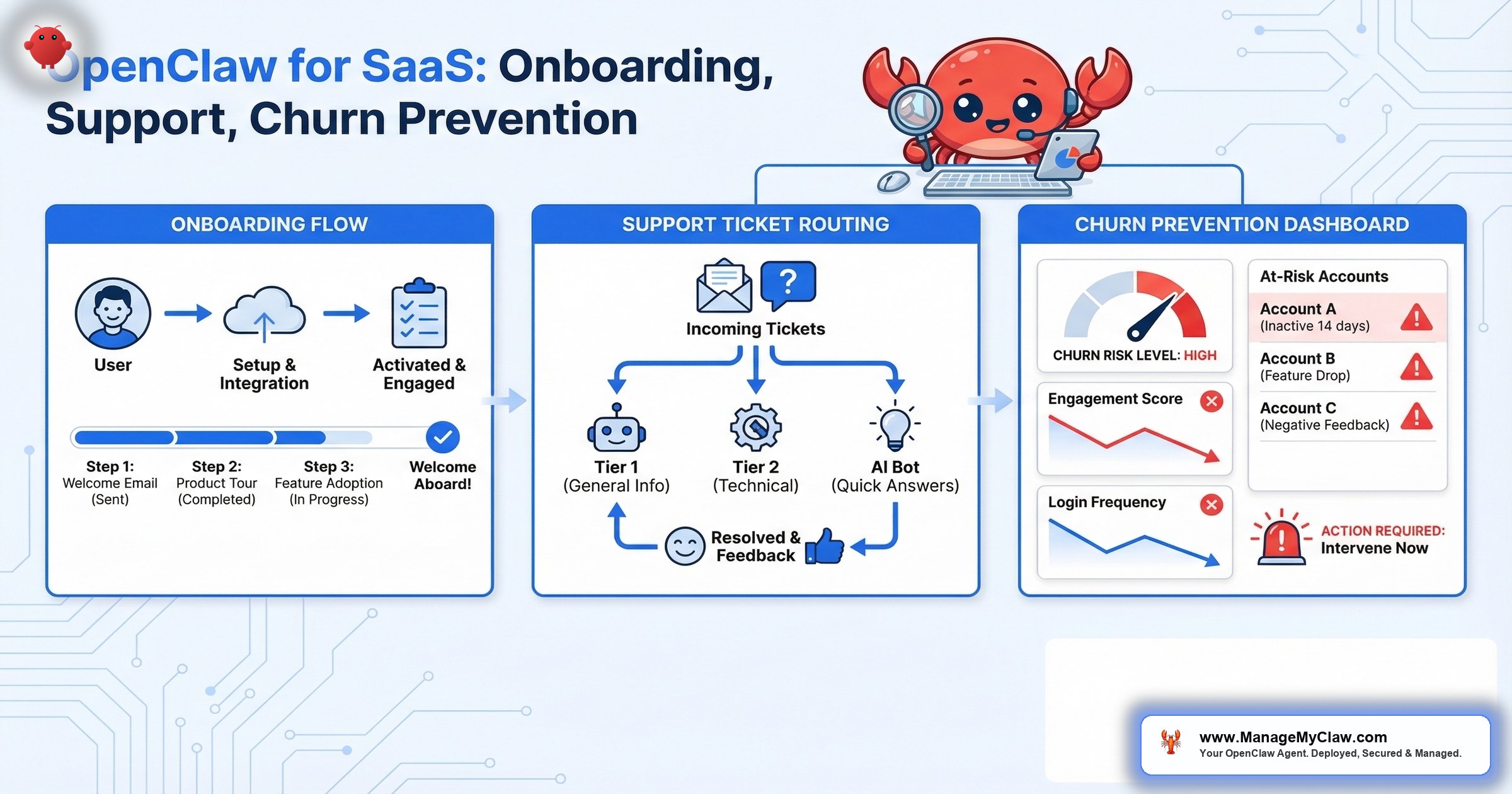
OpenClaw SaaS automation covers 3 workflows that directly attack churn: customer onboarding flows that reduce time-to-value, support ticket routing that cuts response time and volume, and usage pattern monitoring that detects churn risk before the customer decides to leave. This guide covers the architecture, the numbers, and the configuration approach for each workflow.
Workflow 1: Customer Onboarding Automation
Lincoln Murphy’s research on SaaS onboarding found that customers who reach their “first value moment” within the first 7 days retain at 3x the rate of customers who take longer than 14 days. The onboarding window is not a nice-to-have. It is the single highest-leverage period in the customer lifecycle.
What the agent does: When a new customer signs up (triggered by a Stripe webhook, a form submission, or a CRM event), the OpenClaw agent runs a multi-step onboarding sequence:
- Account provisioning: Creates the customer’s workspace in your product, sets default configurations, and provisions any API keys or integration tokens they need.
- Personalized welcome sequence: Sends a welcome email within 2 minutes of signup — not a generic template, but a message that references their plan tier, their stated use case (captured during signup), and the 3 features most relevant to that use case.
- Guided activation: Monitors whether the customer has completed key activation steps (first login, first feature use, first integration connection). If a step is not completed within 24 hours, the agent sends a targeted nudge with a direct link to that specific step.
- Kickoff scheduling: For higher-tier customers, the agent checks calendar availability and schedules a kickoff call automatically. For self-serve tiers, it offers an optional walkthrough booking.
- Team notification: Alerts your customer success team in Slack with the new customer’s details, plan, and activation status so the human follow-up happens with context, not cold.
The numbers: Manual onboarding takes 1–2 hours per customer for a SaaS team doing it properly. OpenClaw automates the sequence to under 10 minutes of active work per customer. At 50 new customers per month, that is 50–100 hours of team time recovered. At $150/hour team cost, the monthly savings are $7,500–$15,000.
On r/SaaS, a thread titled “What’s your onboarding flow look like in 2026?” (12 upvotes, 28 comments) surfaced a consistent pattern: the SaaS companies retaining best have automated the mechanical parts of onboarding (account setup, email sequences, step tracking) and reserved human time for the strategic parts (kickoff calls, use-case consultation, relationship building). That split is exactly what OpenClaw enables.
Why this matters: Every day a new customer spends not using your product is a day closer to churn. Automated onboarding does not replace human relationship-building — it eliminates the 90% of onboarding work that is mechanical so your team can focus on the 10% that builds loyalty.
Workflow 2: Support Ticket Routing and Resolution
AI agents can reduce support ticket volume by 40–60%. That figure comes from production deployments where the agent handles routine inquiries (password resets, billing questions, feature documentation lookups) automatically and routes complex issues to the right human with full context.
How the agent processes tickets:
- Classification: Incoming tickets are classified by category (billing, technical, feature request, bug report) and urgency (critical, normal, low). The agent uses your product’s knowledge base and historical ticket data to classify with 85–90% accuracy.
- Auto-resolution for routine tickets: Billing questions, password resets, documentation lookups, and common how-to questions are resolved automatically with personalized responses. The agent pulls the customer’s account status, plan tier, and usage data to give answers that are specific to their situation — not generic FAQ pastes.
- Smart routing for complex tickets: Issues that require human judgment — bugs, feature negotiations, account escalations — are routed to the right team member based on expertise and current workload. The agent attaches the customer’s full context: account age, plan tier, recent activity, previous tickets, and a summary of what was already tried.
- Follow-up automation: After resolution, the agent sends a satisfaction check and logs the outcome for reporting. If the customer responds with additional issues, the agent picks up the thread with full history intact.
The numbers: A SaaS company processing 200 support tickets per week can expect 80–120 of those to be handled automatically. At an average resolution cost of $15–$25 per ticket (support agent time + tooling), that is $1,200–$3,000 per week in direct savings. Monthly: $4,800–$12,000.
The indirect savings are larger: faster response times improve NPS scores, and support agents working on complex problems instead of password resets report higher job satisfaction and lower turnover. Support team attrition in SaaS runs 30–45% annually. Reducing the proportion of repetitive work directly addresses the primary driver of support burnout.
Your support team did not sign up to answer the same password reset question 40 times a week. Neither did the customer who submitted it and waited 4 hours for a 1-sentence answer.
Why this matters: Support ticket automation is not about replacing your support team. It is about routing every ticket to the right handler — human or agent — based on complexity. The agent handles the predictable. Your team handles the valuable.
Workflow 3: Churn Detection via Usage Pattern Monitoring
The average SaaS customer who churns showed warning signs 3–4 weeks before cancellation. Login frequency dropped. Feature usage narrowed. Integration activity flatlined. These signals are visible in your analytics — but nobody is watching your analytics at the per-customer level for 1,000+ accounts.
What the agent monitors:
- Login frequency decline: A customer who logged in daily and now logs in twice a week. A customer who logged in twice a week and has not logged in for 10 days.
- Feature usage narrowing: A customer who used 8 features last month and is now using 2. They are not getting value from the product — they are looking for a reason to stay.
- Integration disconnection: A customer who disconnects a Slack integration, removes an API key, or stops using a connected workflow. Disconnections are leading indicators of intent to cancel.
- Support ticket patterns: A customer who filed 3 tickets in a week after filing zero for 6 months. Sudden support activity often indicates frustration, not engagement.
What the agent does with the signals: When usage patterns cross configured thresholds, the agent triggers an intervention sequence. For mild signals (login frequency drop), it sends a personalized check-in email highlighting a feature the customer has not tried or a tip relevant to their use case. For strong signals (integration disconnection + login drop), it alerts the customer success team with a full risk report and recommended outreach approach.
The numbers: Reducing monthly churn from 6% to 4% on a 1,000-customer base with $100 average MRR means retaining 20 additional customers per month. That is $24,000 in preserved ARR per year from a 2-percentage-point improvement — and the compound effect is larger because retained customers continue generating revenue in every subsequent month.
On r/SaaS, churn reduction is a perennial topic. A thread titled “How are you tracking leading indicators for churn?” (9 upvotes, 22 comments) had a top response that resonated: “By the time they submit a cancellation request, the decision was made weeks ago. You have to catch the behavior change, not the cancellation click.”
Why this matters: A human customer success team cannot monitor usage patterns for 1,000+ accounts in real time. An agent can. The agent does not replace the relationship — it surfaces the customers who need a relationship intervention before they decide to leave.
The Security Baseline for SaaS Deployments
An AI agent connected to your Stripe account, your customer database, your support system, and your analytics pipeline is an extremely powerful tool. It is also an extremely powerful attack surface if misconfigured.
OpenClaw has 9 disclosed CVEs, including a CVSS 8.8 remote code execution vulnerability. The ClawHavoc attack planted 2,400+ malicious skills on ClawHub. CNCERT issued a formal security warning in March 2026. For a SaaS company deploying OpenClaw with access to customer data, the security configuration is not optional.
Minimum security requirements for SaaS deployments:
- Docker sandboxing with non-root user, read-only root filesystem, and cap-drop=ALL
- DOCKER-USER iptables chain configured (UFW alone does not apply to Docker containers)
- Composio OAuth for all credential handling — the agent never touches raw API keys
- Tool permission allowlists scoped to each workflow (the support agent reads tickets but cannot modify billing)
- Kill switch for instant agent access revocation
- Audit logging for compliance and incident response
The full security hardening guide covers each component in detail.
Why this matters: Your customers trust you with their data. An AI agent that accesses that data inherits that trust obligation. If the agent’s credentials are compromised because the Docker socket was mounted or the firewall was misconfigured, the breach is yours — not OpenClaw’s.
The Bottom Line
SaaS churn is a compounding problem. Every customer you lose is revenue you need to replace before you can grow. OpenClaw addresses the 3 highest-leverage intervention points: onboarding (get customers to value faster), support (resolve issues before they become frustrations), and churn detection (catch disengagement before it becomes cancellation).
The combined impact — 12x faster onboarding, 40–60% support ticket reduction, early churn detection 3–4 weeks before cancellation — addresses the operational mechanics of retention. The security baseline ensures you get these benefits without putting your customer data at risk. The complete business automation guide covers the workflow selection framework and ROI math in detail.
Frequently Asked Questions
How does OpenClaw connect to my SaaS product’s database?
OpenClaw connects through Composio OAuth, which handles credential management through a secure middleware layer. For SaaS integrations, the agent typically connects to your API endpoints rather than directly to your database. This means you control exactly what data the agent can access through your existing API permissions and rate limits. Read-only API access is the recommended default for monitoring workflows.
What is the monthly API cost for running these 3 workflows?
For a SaaS company with 50 new customers/month, 200 weekly support tickets, and 1,000 monitored accounts: onboarding automation runs approximately $15–$30/month, support routing runs $30–$80/month, and churn monitoring runs $10–$25/month. Total API cost: $55–$135/month. The hosting VPS adds $12–$24/month. Combined infrastructure cost: approximately $70–$160/month for all 3 workflows.
Can OpenClaw integrate with Intercom, Zendesk, or Freshdesk?
Yes. OpenClaw connects to 60+ tools through Composio OAuth, including the major support platforms. For ticket routing, the agent monitors incoming tickets through the support platform’s API, processes them according to your classification rules, and either resolves automatically or routes to the appropriate agent with context attached. The integration uses your existing support platform’s interface — your team does not need a new tool.
How accurate is the churn prediction?
The agent monitors behavioral signals (login frequency, feature usage, integration activity, support patterns), not predictions. It flags customers whose behavior crosses thresholds you define based on your product’s engagement patterns. False positives are low-cost — a check-in email to an engaged customer does no harm. False negatives (missed churn signals) decrease as you tune the thresholds based on actual churn data. Most SaaS companies see reliable signal detection within 60–90 days of configuration.
Do I need technical expertise to set this up?
Setting up OpenClaw for SaaS workflows requires Docker configuration, API integration setup, workflow rule definition, and security hardening. The technical work takes 15+ hours for a proper deployment with all 3 workflows. Services like ManageMyClaw handle the deployment and security hardening so your team can focus on defining the workflow rules and thresholds that are specific to your product. Starting at $499 for a single workflow deployment.
Stop losing customers you could have saved.
ManageMyClaw deploys OpenClaw for SaaS companies with onboarding automation, support routing, and churn detection — fully hardened with Docker sandboxing, Composio OAuth, and tool allowlists. Starting at $499. No phone call required.
Get Started — From $499 Learn About Managed Deployment