“You run a 12-room boutique hotel. You don’t have a 24/7 front desk. You don’t have a call center. What you have is a phone that buzzes at 2 AM with ‘Is breakfast included?’ from a guest arriving tomorrow — in Italian.”
AI for boutique hotels is the application of autonomous agents to handle guest communication, review management, and operational coordination for small independent hotels — typically 1 to 20 rooms — that face the same guest interaction challenges as short-term rental operators but at a different scale. See our scaling playbook for more. OpenClaw is an open-source AI agent framework with 250,000+ GitHub stars that runs on your own bare-metal server via systemd, connecting to email, SMS, WhatsApp, and other channels through Gog OAuth. It reads incoming messages, understands the question, checks your property knowledge base, and responds with a contextual reply — in any language, at any hour.
This post covers why boutique hotels have nearly identical guest communication problems to STR hosts, how OpenClaw adapts to the hotel context (room types, shared facilities, breakfast service, reception hours), and why the economics work even better at the boutique hotel scale than for individual STR listings. If you’ve been thinking “AI automation is for Airbnb hosts, not for hotels,” you’re about to realize the overlap is closer to 90% than you expected.
Why Boutique Hotels Face the Same Problems as STR Hosts
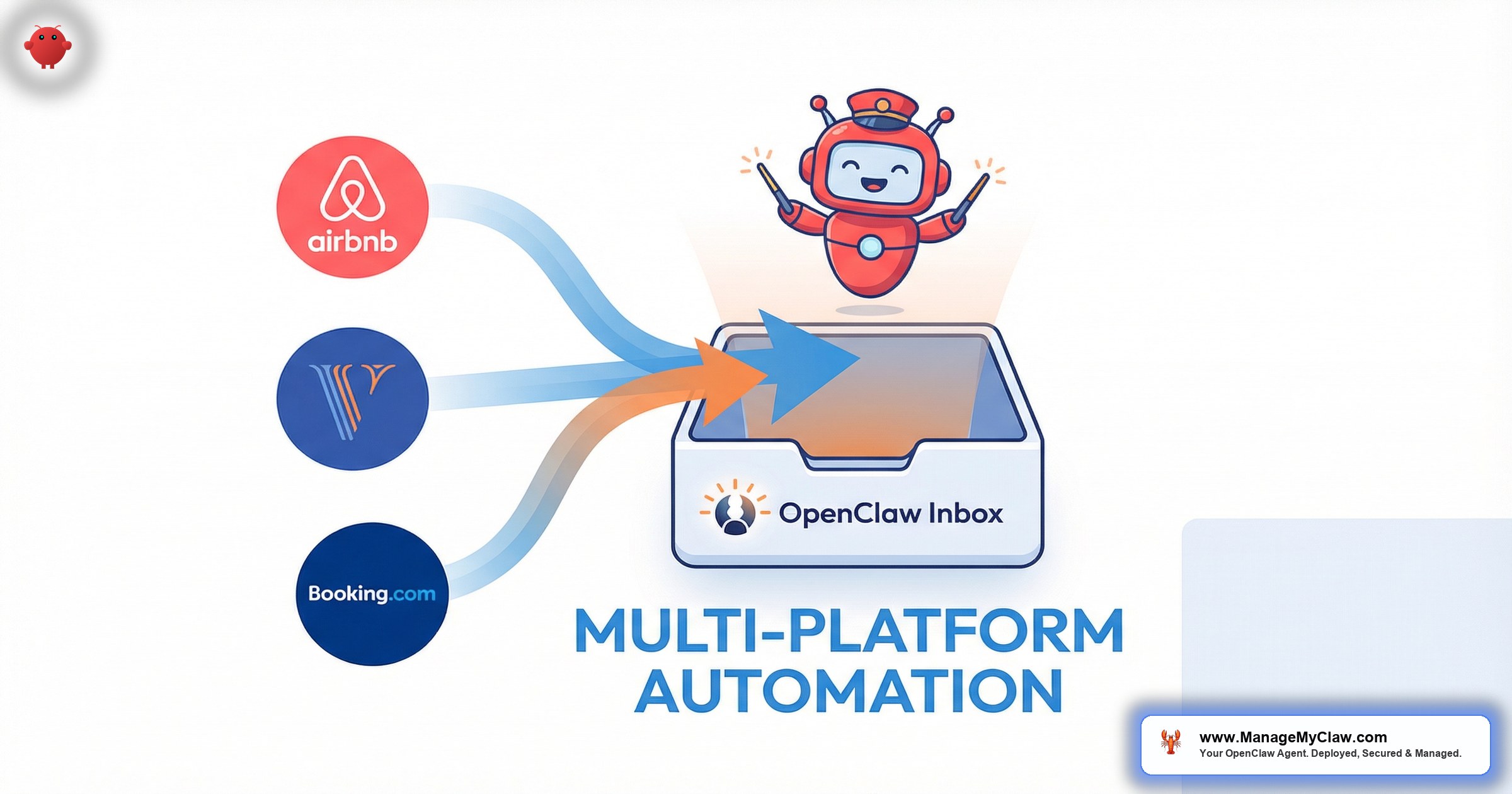
The STR and boutique hotel industries have converged. Small hotels now list on Airbnb, VRBO, and Booking.com alongside individual apartment hosts. They compete in the same search results, get measured by the same review systems, and face the same guest expectations for instant communication.
Here’s what a 12-room boutique hotel’s guest communication looks like in a typical month.
| Message Category | Volume (12 rooms, 75% occupancy) | Typical Timing | Automatable? |
|---|---|---|---|
| Pre-booking inquiries | 30–50/month | Anytime (global travelers) | Yes (80–90%) |
| Pre-arrival questions | 60–80/month | 1–7 days before check-in | Yes (90%+) |
| During-stay requests | 40–60/month | Peaks 6–10 PM and overnight | Yes (70–80%) |
| Review-related exchanges | 20–30/month | 1–7 days after checkout | Yes (95%) |
| OTA-specific admin messages | 15–25/month | Throughout month | Partially (50%) |
| Total | 165–245/month | — | 70–85% overall |
That’s 165–245 messages per month. If you’re answering them manually at an average of 3 minutes each, that’s 8–12 hours per month. For a boutique hotel owner who’s also managing housekeeping, maintenance, breakfast service, and business operations, those 8–12 hours are a significant burden — especially the ones that arrive between 10 PM and 8 AM.
The irony is that boutique hotels pride themselves on personal service. But personal service doesn’t mean the owner personally answering every “What time is checkout?” message. It means guests getting thoughtful, helpful responses instantly. AI delivers that better than a sleep-deprived human checking their phone at midnight.
How OpenClaw Adapts to Boutique Hotel Operations
OpenClaw’s power comes from its property knowledge base. For STR hosts, that knowledge base covers 1 listing with specific details. For boutique hotels, the knowledge base is richer — covering multiple room types, shared facilities, services, and operational details that vary by room.
Room-Specific Knowledge
Each room type gets its own knowledge base section. The Deluxe Suite has a balcony, espresso machine, and king bed. The Standard Room has a courtyard view and queen bed. When a guest in Room 7 asks “How does the coffee machine work?” OpenClaw knows Room 7 is a Deluxe Suite with a Nespresso machine and provides specific instructions. A guest in Room 3 asking the same question gets directed to the common area coffee station.
Shared Facilities
Boutique hotels have shared spaces that STR listings typically don’t: breakfast rooms, lobbies, terraces, pools, gardens, libraries. OpenClaw’s knowledge base includes hours, rules, and details for each facility. “What time is the pool open?” “Can I have breakfast on the terrace?” “Is there a quiet space to make a work call?” All handled automatically.
Service Information
Breakfast hours and menu, laundry service availability, airport transfer booking, bike rental, spa treatments, cooking classes, wine tastings — boutique hotels offer experiences beyond just a room. OpenClaw handles inquiries about all of these, including pricing, availability, and booking instructions.
That response at 11:23 PM isn’t just answering the question. It’s upselling a romance package, suggesting the best table, and making the guest feel cared for — all while you’re asleep. Try getting that from a scheduled message template.
Why the ROI Works Even Better for Hotels
The economics of ai boutique hotels guest automation are actually more favorable than for individual STR listings. Here’s why.
Higher Message Volume, Same Flat Cost
A 12-room hotel generates 165–245 messages per month. A 5-listing STR host generates 300–500. But the hotel’s messages are more concentrated and more predictable (same facility questions across all rooms), which means higher automation rates. OpenClaw costs the same $25/month for VPS hosting regardless of room count. No per-room fees.
Revenue Per Guest Is Higher
Boutique hotel ADRs (average daily rates) are typically $150–400+ per night, often higher than STR listings in the same market. The revenue impact of a missed booking inquiry is proportionally larger. If OpenClaw recovers 2 bookings per month through faster response times, at an average 3-night stay and $200 ADR, that’s $1,200/month in recovered revenue.
Upsell Opportunities
Hotels have more upsell inventory than STR listings: room upgrades, breakfast packages, spa treatments, airport transfers, experience packages. OpenClaw surfaces these organically when relevant to the guest’s message. A guest asking about dinner gets a wine tasting suggestion. A guest mentioning an anniversary gets offered the romance package. These aren’t forced upsells — they’re contextual suggestions that enhance the guest experience while generating revenue.
| ROI Component | Monthly Value (12-room hotel) | Calculation |
|---|---|---|
| Time savings (10 hrs/mo × $40) | $400 | Staff hours recovered from guest messaging |
| Recovered bookings (2 × $600 avg) | $1,200 | Inquiries that would’ve been lost to slow response |
| Upsell revenue (15 upsells × $40 avg) | $600 | Contextual offers triggered by guest messages |
| Review score improvement | $500–800 | ADR premium from higher communication scores |
| Total Monthly ROI | $2,700–$3,000 | — |
Against a cost of $25/month for VPS hosting + $15–25/month for LLM API + $499 one-time deployment, the ROI is clear within the first month. You’re spending less on AI automation than you spend on breakfast supplies for a single week. And the AI generates more revenue than a part-time front desk hire at a fraction of the cost.
Multi-Channel Coverage: Where Hotel Guests Actually Message
STR guests primarily message through Airbnb’s app. Hotel guests are more distributed across channels, which creates both a challenge and an opportunity for AI automation.
| Channel | Typical Hotel Guest Usage | OpenClaw Coverage |
|---|---|---|
| Email (direct + OTA forwarded) | 35–45% of messages | Full coverage via Gog OAuth |
| 25–35% (dominant in EU, Latin America, Asia) | Full coverage via Gog OAuth | |
| SMS | 10–15% (US domestic travelers) | Full coverage via Gog OAuth |
| Booking.com messaging | 10–20% | Via email forwarding |
| Phone calls | 5–10% | Not covered (voicemail transcription possible) |
OpenClaw covers 85–95% of hotel guest messaging channels through Gog OAuth connections. WhatsApp alone accounts for 25–35% of messages for European and Latin American hotels — a channel that most STR automation tools like Hospitable, HostBuddy, and Host Tools don’t support natively.
For a boutique hotel in Lisbon, Porto, or Barcelona, WhatsApp isn’t optional — it’s the primary way European and South American guests communicate. If your automation tool doesn’t cover WhatsApp, you’re manually handling a third of your messages.
AI and the “Personal Touch” Concern
The most common objection from boutique hotel operators: “Our guests expect a personal touch. AI feels impersonal.” This concern is valid — and misplaced.
Here’s what actually happens. Guest messages “Is there a restaurant nearby with vegetarian options and outdoor seating, preferably walking distance?” Without AI, this message waits until you or your staff see it, remember or research local restaurants, and type a response. With OpenClaw, the guest gets a detailed, specific response within 90 seconds that includes restaurant names, distances, price ranges, and a note about which ones accept walk-ins versus reservations.
Which response feels more “personal” — the one that arrives instantly with specific, helpful details, or the one that arrives 3 hours later because you were dealing with a plumbing issue in Room 9?
The personal touch isn’t about who types the response. It’s about the guest feeling cared for, informed, and attended to. OpenClaw delivers that feeling more consistently than any human can, because it never gets distracted, never forgets details, and never takes 4 hours to respond because the front desk person went home at 6 PM.
OpenClaw handles 70–90% of messages autonomously. The remaining 10–30% are situations where your personal judgment, empathy, or authority adds genuine value: guest complaints, special circumstance requests, VIP arrivals, emergency situations. AI handles the volume so you can invest your energy where it matters most.
Setting Up OpenClaw for a Boutique Hotel
The setup process through ManageMyClaw is the same as for STR hosts, with a richer knowledge base.
The knowledge base is where you invest your time — about 2–3 hours of documenting your hotel’s details during onboarding. After that, updates take 10–15 minutes per month as menus, hours, or policies change. The return on that time investment is 8–12 hours per month of messaging you no longer do manually.
Frequently Asked Questions
Can OpenClaw handle reservation changes and cancellations?
OpenClaw can communicate your cancellation policy and modification procedures. For actual reservation changes (date modifications, room upgrades), it escalates to you or your PMS. OpenClaw handles the communication layer — it doesn’t connect directly to your booking system’s database.
Does it work with our existing PMS (Cloudbeds, Little Hotelier, etc.)?
OpenClaw operates on the communication layer, not the PMS layer. It connects to your messaging channels (email, WhatsApp, SMS), not to your PMS directly. Your PMS continues to manage reservations, rates, and inventory. OpenClaw handles the guest-facing communication that your PMS doesn’t automate.
What about in-person guests at the front desk?
OpenClaw handles digital communication — email, WhatsApp, SMS, OTA messaging. In-person interactions at the front desk still require your staff. The value is that your staff spends less time on digital messaging (which OpenClaw handles) and more time on the in-person service that defines boutique hospitality.
How does it handle different room types within the same hotel?
The knowledge base includes room-specific sections. OpenClaw identifies the guest’s room from their booking details and pulls the correct information. A guest in Room 12 (Deluxe Suite with kitchenette) gets different appliance instructions than a guest in Room 4 (Standard with shared facilities). See our setup guide for knowledge base configuration details.
Is $499 realistic for a small hotel budget?
Consider the alternative costs: a part-time front desk hire for evening/overnight coverage is $1,500–3,000/month. A virtual assistant handling guest messages is $500–1,000/month. OpenClaw’s $499 one-time + $25/month VPS is less than 1 month of any human alternative, and it covers 24/7 with sub-90-second response times. See pricing details.