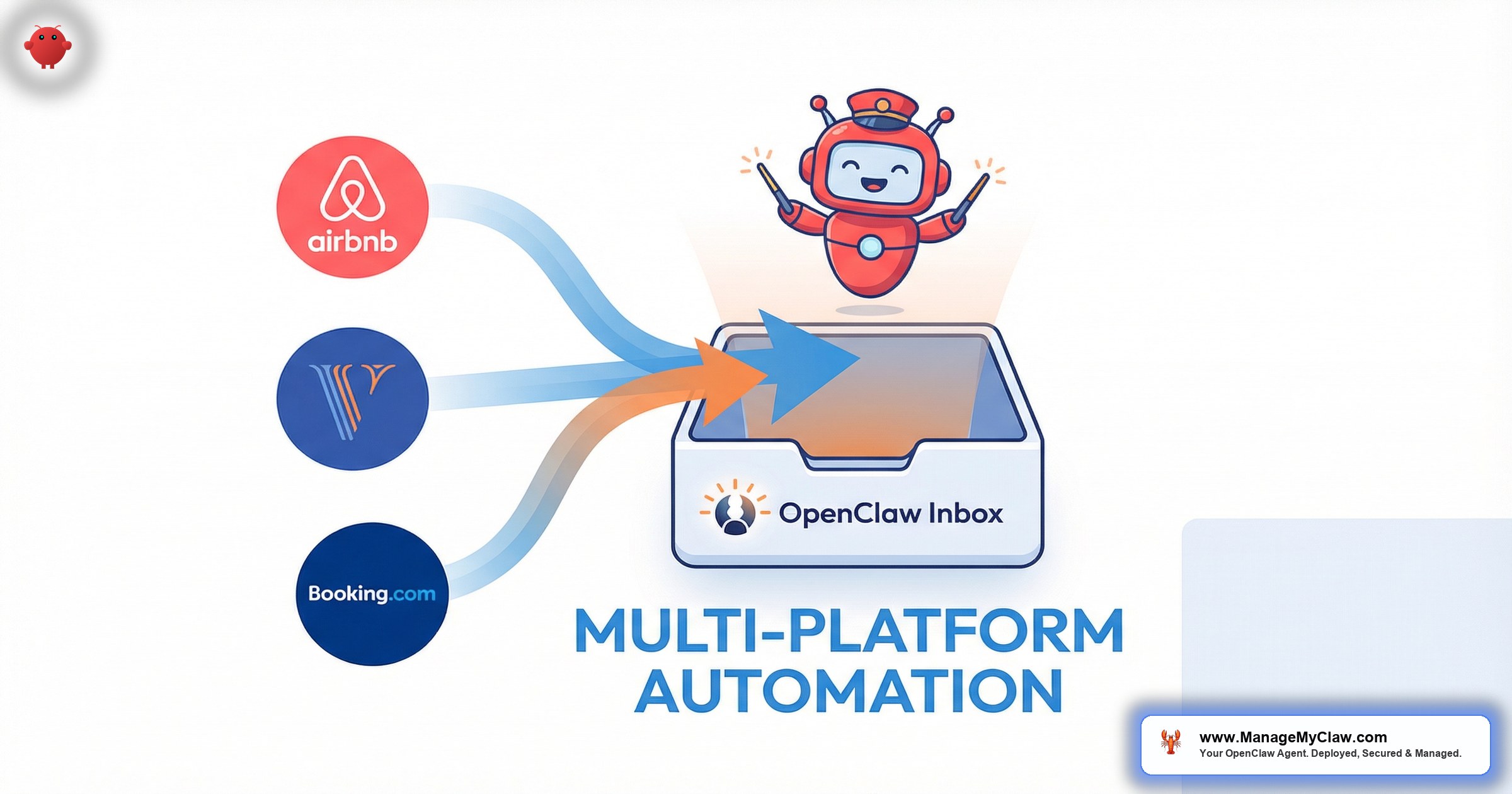
“3 platforms. 3 inboxes. 3 different notification formats. Every missed message is a penalty to your response rate, your search ranking, and your next booking. OpenClaw collapses all 3 into 1 Gmail thread.”
OpenClaw for VRBO and Booking.com is where multi-platform hosting stops being a logistical nightmare and starts being a competitive advantage. OpenClaw is an open-source AI agent framework — 250,000+ GitHub stars, deployed on bare-metal servers via systemd — that monitors your Gmail inbox 24/7, reads incoming guest notifications from every booking platform you use, and takes action: triaging messages, drafting replies, escalating emergencies, and keeping your response time under 90 seconds across Airbnb, VRBO, Booking.com, and direct bookings simultaneously.
If you only host on Airbnb, you’ve got 1 inbox to watch. But the moment you list on VRBO (Expedia Group’s vacation rental platform) and Booking.com (the world’s largest OTA with 28+ million listings), your messaging volume doesn’t just double — it fragments. Each platform sends notifications in a different format, uses different subject lines, and has different expectations for response time. This guide breaks down exactly how OpenClaw handles each one.
You expanded to multiple platforms to increase bookings. What nobody mentioned is that you also signed up for 3 separate customer support jobs. The question isn’t whether to automate — it’s whether you do it with 3 separate tools or 1 agent that handles all of them.
Why Multi-Platform Hosting Breaks Your Workflow
Multi-platform hosting is the standard for serious STR operators. AirDNA’s 2025 data shows that hosts listing on 2+ platforms see 18–26% higher occupancy rates compared to single-platform hosts. The diversification math is obvious: you’re not dependent on 1 algorithm, 1 set of search results, or 1 company’s policy changes.
The operational math is less obvious. Each platform has its own messaging system, its own notification emails, and its own response time expectations. Airbnb sends guest messages as email notifications with the conversation threaded in the app. VRBO (part of Expedia Group since 2015) sends messages through the Expedia partner dashboard and emails them to your inbox in a completely different format. Booking.com routes messages through its extranet and sends notification emails that look nothing like either Airbnb or VRBO.
The result: you’re checking 3 inboxes, context-switching between 3 dashboards, and trying to maintain response times on 3 platforms with 3 different algorithms measuring you. According to Lodgify’s 2026 channel management survey, 47% of multi-platform hosts report that managing cross-platform communication is their biggest operational pain point — ahead of pricing, cleaning coordination, and maintenance.
Airbnb factors response time into Superhost eligibility and search ranking. VRBO’s Premier Host badge requires a 90% response rate. Booking.com gives “quick responder” badges and penalizes hosts who exceed 24 hours. Miss any of these thresholds and you lose visibility on that platform. Miss all 3 and you’re effectively invisible during peak booking season.
Here’s the thing about multi-platform hosting: the revenue upside is real, but so is the operational tax. You can’t scale to 3 platforms and keep answering messages manually. The math breaks somewhere between your 2nd platform and your 5th listing.
How OpenClaw Turns Gmail Into Your Universal Inbox
Here’s what makes this work: every major booking platform sends email notifications to your registered email address. Airbnb, VRBO, Booking.com, and most direct booking engines all send message alerts, booking confirmations, and guest inquiries to your Gmail. OpenClaw connects to that Gmail account through Gog OAuth — a middleware authentication layer that handles token management securely, so the agent never stores your raw credentials.
Once connected, OpenClaw monitors your inbox in real time. Here’s how the full process works — but for multi-platform hosts, the key is what happens when a new email arrives. The agent does 4 things:
- Identifies the platform. The agent parses the sender address and email format to determine whether the message came from Airbnb (
@airbnb.com), VRBO (@vrbo.comor@homeaway.com), Booking.com (@booking.com), or a direct booking form. - Extracts the guest message. Each platform wraps the guest’s actual words in different HTML templates, subject lines, and metadata. OpenClaw’s parsing rules strip the platform chrome and extract the guest’s raw message, their name, the property they booked, and the dates of their stay.
- Classifies the intent. Is this a check-in question, a WiFi request, a maintenance report, an early check-in ask, or something that needs your personal attention? The agent classifies the message using your property knowledge base and predefined escalation rules.
- Takes action. For automatable categories, the agent drafts a reply using property-specific details (the correct WiFi password, the correct door code, the correct parking instructions for that specific unit) and either sends it directly or holds it for your review. For escalations, it notifies you via Telegram or WhatsApp with full context.
The key insight: your guests don’t know (or care) which platform they booked through. They just want an answer. OpenClaw doesn’t care either. A WiFi question from a VRBO guest gets the same instant, accurate response as a WiFi question from an Airbnb guest. The platform is metadata. The guest experience is universal.
VRBO: How Expedia Group’s Messaging Actually Works
VRBO joined Expedia Group in 2015, and the integration means VRBO’s backend is now part of Expedia’s Partner Central platform. For you, this means guest messages arrive via 2 paths: the VRBO app inbox and email notifications sent to your registered address. The email notifications are the path OpenClaw uses.
What makes VRBO different from Airbnb messaging:
- Subject line format. VRBO notifications typically use “New message from [Guest Name]” or “Booking inquiry for [Property Name]” — different from Airbnb’s “[Guest Name] sent you a message” format. OpenClaw’s parsing rules handle both.
- Inquiry-first model. VRBO historically allowed more inquiry-before-booking communication than Airbnb. This means you get pre-booking questions that need fast, detailed responses to convert the inquiry into a booking. Slow response = lost booking. OpenClaw handles these with the same sub-90-second speed as post-booking messages.
- Payment splits. VRBO’s fee structure differs from Airbnb’s, and some guests ask about payment breakdowns. The agent can pull this from your property knowledge base and respond accurately, referencing the specific VRBO pricing structure you’ve set up.
- Premier Host requirements. VRBO’s Premier Host badge requires a 90% response rate. OpenClaw keeps you at 100% because it never sleeps, never misses a message, and never takes 6 hours to notice a notification buried in your inbox.
VRBO’s inbox is the 1 most hosts check last. It’s also the 1 where lost inquiries cost the most — because VRBO guests skew toward families booking higher-value, longer stays. A missed inquiry on VRBO often costs more than a missed inquiry on Airbnb.
Since VRBO is part of Expedia Group, your VRBO listing may also appear on Expedia.com, Hotels.com, and Travelocity. Notifications from bookings on these partner sites still route through VRBO’s system to your email — so OpenClaw captures them through the same Gmail monitoring. No additional configuration needed.
Booking.com: Extranet Messages and Instant Booking
Booking.com is a different beast. With 28+ million listings and over 1.5 million room nights booked per day (Booking Holdings 2025 annual report), it’s the largest OTA in the world. The platform operates on an instant booking model by default — guests book without your approval, which means the first message you receive is often a confirmation, not an inquiry.
This changes the messaging dynamic significantly:
- Post-booking questions dominate. Since the booking is already confirmed, most guest messages are logistical: “How do I get to the property?”, “What time is check-in?”, “Is there an elevator?” These are 100% automatable from your property knowledge base.
- Extranet message format. Booking.com sends message notifications with subject lines like “New message from your guest [Name] for reservation [ID].” The email body includes the guest’s message plus reservation details. OpenClaw parses the reservation ID to match the message to the correct property and booking dates.
- Quick responder badge. Booking.com awards a “quick responder” badge to hosts who reply to messages within a specific timeframe. This badge is visible to potential guests browsing your listing. Losing it means losing a trust signal that directly affects conversion rates.
- Guest review invitations. Booking.com sends automated review invitations to guests after checkout. When a review comes in, OpenClaw detects the notification, reads the review content, and drafts a response — personalized using conversation history from that guest’s stay.
The instant booking challenge: Because Booking.com guests book without prior conversation, your first interaction with the guest often sets the tone for the entire stay. A fast, detailed, welcoming message within seconds of booking confirmation creates a fundamentally different guest experience than silence for 3 hours while you’re at your day job.
“We added Booking.com to our channel mix and our guest message volume jumped 40% overnight. Not because Booking.com guests message more — but because instant booking means every reservation starts with a logistical conversation that Airbnb’s pre-booking flow already handled.”
— Multi-platform host, r/STRowners, 2026Booking.com is the platform where automation pays for itself fastest. Every reservation triggers a messaging sequence, and the guest expects a near-instant welcome. If you’re doing that manually across 10 listings, you’re not hosting — you’re running a call center.
Direct Bookings: Your Website, Your Rules, Same Agent
Direct bookings — through your own website using tools like Lodgify, Hostaway, or a custom WordPress form — are the highest-margin channel because you skip the 12–18% platform commissions. The tradeoff: you’re responsible for the entire guest communication lifecycle. No platform handling the initial inquiry flow. No automated check-in reminders. No review solicitation. Just you and your inbox.
OpenClaw handles direct bookings the same way it handles platform bookings. Your booking form sends a confirmation email to your Gmail. The agent detects the new reservation, creates a guest record in its memory, and triggers the same automated sequence: welcome message, pre-arrival info, check-in details (timed to send at the right moment), mid-stay check-in, checkout instructions, and review request.
The configuration difference is minimal. You set up 1 additional parsing rule that tells OpenClaw: “Emails from bookings@yourdomain.com are direct reservations. Extract guest name, dates, and property from the form fields.” That’s it. From that point forward, direct booking guests get the same instant, property-specific responses as guests who booked through Airbnb, VRBO, or Booking.com.
Guests who book directly often chose your site specifically to avoid platform fees or because they’re repeat visitors. They expect a more personal experience, not a less responsive one. OpenClaw’s property knowledge base lets you customize direct booking responses with details like loyalty discounts, returning guest acknowledgments, and VIP instructions — things you’d never put in a platform auto-reply.
Direct bookings are where most hosts drop the ball on response time. There’s no Airbnb algorithm punishing you for slow replies — but there’s also no platform safety net. A guest who emails your website and doesn’t hear back in 2 hours books elsewhere. The booking platform didn’t lose that reservation. You did.
How Each Platform’s Messaging Hits Your Inbox
Here’s a side-by-side comparison of how each platform’s guest communication reaches your Gmail — and how OpenClaw handles the differences.
| Feature | Airbnb | VRBO | Booking.com | Direct |
|---|---|---|---|---|
| Notification sender | @airbnb.com | @vrbo.com / @homeaway.com | @booking.com | Your domain |
| Primary message type | Pre & post-booking | Inquiry-heavy | Post-booking (instant book) | Inquiry + post-booking |
| Booking model | Instant or request | Inquiry or instant | Instant by default | Varies |
| Response time metric | Search ranking + Superhost | Premier Host badge (90%) | Quick responder badge | No algorithm — but guest expectation |
| Email format complexity | Moderate | Complex (Expedia templates) | Moderate | Simple (your form) |
| OpenClaw parsing | Built-in | Built-in | Built-in | 1 custom rule |
The important column is the last one: OpenClaw handles all 4 with built-in parsing for the major platforms and a single custom rule for direct bookings. You don’t need 4 tools, 4 integrations, or 4 separate automations. You need 1 agent monitoring 1 inbox.
Your Morning Briefing: Every Platform, 1 Summary
Here’s what your morning looks like with OpenClaw managing multi-platform messaging. Instead of opening Airbnb, VRBO, Booking.com, and your email separately, you get 1 consolidated briefing delivered to Telegram or WhatsApp at the time you choose:
Sample Morning Briefing — 7:00 AM
- Overnight activity: 12 messages received, 10 handled automatically, 2 need your review
- Unit A (Airbnb): Guest asked about late checkout — draft ready, awaiting your approval
- Unit B (VRBO): New inquiry from family of 6 — pre-booking question about pet policy, draft ready
- Unit C (Booking.com): New reservation confirmed at 2:14 AM — welcome message sent automatically
- Unit D (Direct): Returning guest booked via website — personalized welcome sent with loyalty discount code
- Cleaning: Units A and C have turnovers today. Cleaning crew notified at 6:00 AM
- Reviews: 1 new 5-star review on Booking.com — response posted. 1 new 4-star on Airbnb — draft held for review
10 of 12 messages handled without you. The 2 that need your attention arrive pre-packaged with full context: guest name, booking platform, property, dates, conversation history, and a draft response. You approve, edit, or override. Total time: under 5 minutes.
This is the operational difference between “I manage 8 listings across 3 platforms” and “I manage 8 listings across 3 platforms and it takes me 5 minutes every morning.” Same portfolio. Completely different business.
Getting Up and Running: What the Deployment Looks Like
OpenClaw runs on your own server — a VPS from providers like Hetzner, DigitalOcean, or Linode, typically costing $12–24/month. It’s deployed as a systemd service on bare-metal, secured with non-root permissions, firewall rules, and Gog OAuth for Gmail access. No containers. No shared cloud infrastructure. Your guest data stays on your server.
For multi-platform hosts, the deployment includes:
- Gmail connection via Gog OAuth. Your agent authenticates through a middleware layer — it never stores your raw Gmail credentials. Read and send permissions are scoped to exactly what the agent needs.
- Platform parsing rules. OpenClaw ships with built-in parsers for Airbnb, VRBO, and Booking.com notification formats. These rules extract the guest message, booking details, and property identifier from each platform’s email template.
- Property knowledge base. Each property gets its own entry: address, WiFi password, door codes, parking instructions, checkout procedures, appliance guides, local recommendations, and house rules. The agent pulls the correct details based on which property the guest booked.
- Escalation rules. You define which message types the agent handles autonomously and which get escalated to you. Most hosts start with “auto-respond to check-in, WiFi, parking, and restaurant questions; escalate everything else.” After 2 weeks, they expand the auto-respond list.
- Morning briefing schedule. Choose when and where you receive your daily summary: Telegram, WhatsApp, or email. Set the timezone, and the agent adapts to your schedule.
ManageMyClaw handles the full deployment — server provisioning, security hardening, Gog OAuth setup, platform parsers, and property knowledge base configuration — for $499 one-time. Your agent is up and running within 60 minutes. For ongoing monitoring, updates, and configuration changes, Managed Care starts at $99/month.
“I was paying Hospitable $89/month and it only handled Airbnb templates. Switching to OpenClaw with ManageMyClaw’s deployment covered Airbnb, VRBO, and Booking.com from day 1 — and the Year 1 cost was less than 6 months of Hospitable.”
— Multi-platform host managing 7 unitsYour Guest Data Stays on Your Server
When you use a SaaS messaging tool, your guest data — names, phone numbers, booking dates, payment info, communication history — sits on the vendor’s cloud servers. You’re trusting a 3rd-party startup with your guests’ personal information and your business data.
OpenClaw runs on your VPS. Guest data never leaves your server. The agent connects to Gmail via Gog OAuth (no raw credentials stored), runs as a non-root systemd service (can’t escalate permissions), and operates behind firewall rules configured specifically for OpenClaw’s listening ports. Tool permission allowlists mean the agent can read and reply to messages but can’t delete emails, modify your calendar, or access data outside its defined scope.
For hosts operating in the EU or hosting EU guests, this matters. GDPR requires a legal basis for processing personal data, and data processor agreements with every SaaS vendor in your stack. Our deployment process includes security hardening that addresses data residency requirements. With OpenClaw on your own server, you’re the data controller and the data processor. Fewer parties. Simpler compliance. Full control over data retention and deletion.
Every ManageMyClaw deployment includes systemd sandboxing, firewall rules (including the UFW chain most tutorials skip), Gog OAuth, and tool permission allowlists. This isn’t an upsell. It’s standard. Read more about OpenClaw security for STR hosts.
Frequently Asked Questions
Does OpenClaw work with VRBO and Booking.com, or just Airbnb?
OpenClaw works with all 3 platforms plus direct bookings. It monitors your Gmail inbox where all platforms send notifications, and uses built-in parsing rules to extract guest messages from Airbnb, VRBO (including Expedia Group partner sites), and Booking.com. Direct bookings need 1 custom parsing rule — about 5 minutes of configuration. See how guest messaging automation works.
Do I need separate OpenClaw agents for each platform?
No. 1 OpenClaw agent handles all platforms from 1 Gmail inbox. The agent identifies which platform sent the notification, extracts the guest message, matches it to the correct property, and responds using property-specific details. No duplication. No extra cost.
What happens when VRBO or Booking.com changes their email format?
Platforms update their email templates periodically. If a format change breaks parsing, the agent flags the unparseable message and escalates it to you while we update the parsing rules. On Managed Care, we monitor for format changes and push fixes before they affect your operations. Self-managed hosts would need to update the parsing rules themselves.
Can the agent respond differently based on which platform the guest booked through?
Yes. The agent tags each conversation with the source platform. You can set different response tones, include platform-specific details (like VRBO payment breakdown explanations or Booking.com cancellation policy references), and customize escalation rules per platform.
How much does this cost?
ManageMyClaw deploys your multi-platform OpenClaw agent for $499 one-time. That includes server setup, security hardening, Gog OAuth, platform parsers for Airbnb, VRBO, and Booking.com, your property knowledge base, and 30 days of monitoring. Ongoing API costs (the LLM that powers the agent) run $50–200/month depending on message volume. Managed Care for ongoing updates and monitoring starts at $99/month.
Will this help me get Superhost on Airbnb and Premier Host on VRBO?
OpenClaw responds in under 90 seconds, 24/7, which keeps your response rate at 100% across all platforms. Superhost (Airbnb) and Premier Host (VRBO) both require high response rates. The agent doesn’t guarantee the badge — those programs have other criteria like review scores and cancellation rates — but it eliminates response time as a failure point.