“You’re standing in a $900K listing explaining crown moulding to a buyer. Your phone rings. You can’t answer. 3 minutes later, that caller is talking to another agent.”
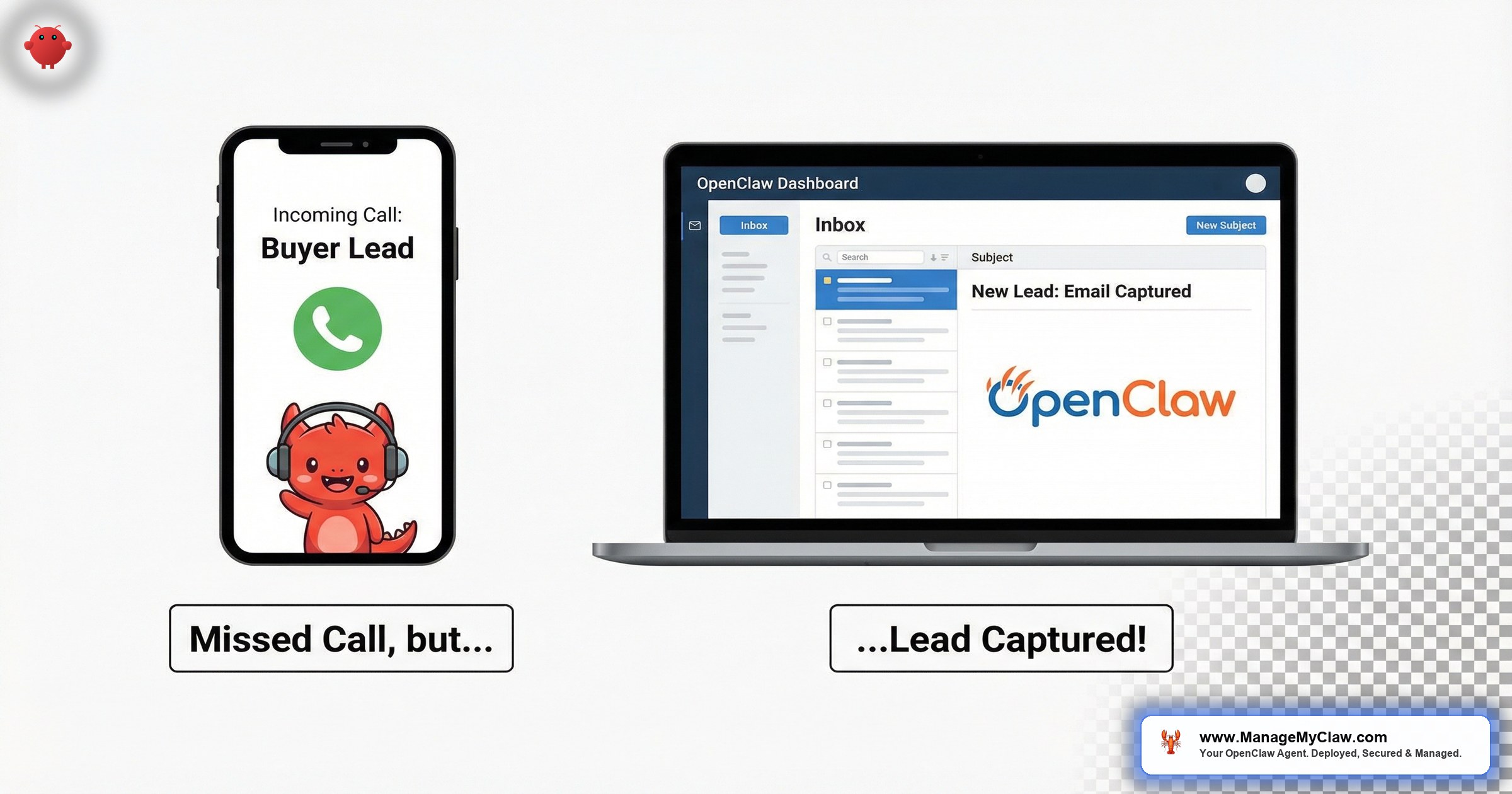
AI call answering for real estate is the fastest-growing category in proptech right now — and it exists because of a brutal statistic. According to data from the National Association of Realtors and industry call-tracking platforms, 68% of inbound calls to real estate agents go unanswered. Not because agents are lazy. Because they’re physically showing properties, sitting in closings, driving between appointments, or sleeping when a prospect in a different time zone decides to inquire at 11 PM.
The missed-call problem in real estate isn’t a minor inconvenience — it’s a revenue leak. Ylopo, CallBird, Phonely, Smith.ai — dozens of vendors promise to answer your phone with an AI voice agent that qualifies leads, books showings, and never takes a day off. OpenClaw — an open-source AI agent framework with 250,000+ GitHub stars, running bare-metal under systemd on your own server — takes a fundamentally different approach. It doesn’t try to replace your voice. It covers every other channel instead.
Here’s the honest take. Voice AI has gotten impressively good in 2026. But “impressively good” and “good enough for a $1.2M buyer who wants to talk to a human” are 2 different things. You’ll see what we mean.
This post breaks down the ai call answering real estate landscape — what voice AI vendors actually offer, where they break down, why OpenClaw’s email-first architecture captures more leads than most phone bots, and how the 2 approaches can work together. If you’ve read the pillar guide to OpenClaw for real estate, this is the channel-strategy deep dive.
Why Estate Agents Can’t Answer the Phone
Let’s be specific about when calls go unanswered. It’s not random. It clusters around the exact moments when high-intent leads are most likely to call:
- During showings — you’re physically with another buyer. Answering your phone mid-showing signals to the buyer in front of you that someone else is more important.
- Driving between properties — you’re in the car, hands on the wheel, and the call goes to voicemail. The caller doesn’t leave one.
- After hours — Realtor.com data shows 43% of property searches happen between 8 PM and midnight. That’s when browsers become buyers and pick up the phone. You’re asleep.
- During closings and inspections — 2–4 hour blocks where you’re completely unavailable, often at the most critical point of an existing transaction.
The math is brutal. If you get 30 inbound calls per month and miss 68% of them, that’s 20 missed connections. At a conservative 10% conversion rate from call-to-appointment, you’re losing 2 appointments per month. At an average commission of $12,000 per closing (3% on a $400K home), and a 25% appointment-to-close rate, that’s $6,000 in annual lost commission from missed calls alone.
85% of callers who reach voicemail don’t leave a message (Vonage research). They hang up and call the next agent on their list. Voicemail isn’t a safety net — it’s a dead end. If your current missed-call strategy is “they’ll leave a voicemail,” you’re losing the vast majority of those leads permanently.
Voice AI Call Answering: What’s on the Market in 2026
The voice AI call answering market for real estate has exploded. Here’s what the major players offer and where each sits:
| Platform | How It Works | Pricing | Limitation |
|---|---|---|---|
| Ylopo | AI voice assistant (“rAIya”) calls and texts leads from your Ylopo CRM. Handles outbound follow-up, inbound screening. | $399–$999/mo (bundled with Ylopo platform) | Locked to Ylopo ecosystem. Can’t use standalone. |
| CallBird | AI receptionist for real estate. Answers calls, takes messages, qualifies leads by budget and timeline. | $199–$499/mo by call volume | Voice-only. No email/text follow-up integration. |
| Phonely | General AI phone agent with real estate templates. Conversational, can handle scheduling. | $99–$349/mo | Generic platform — not built for real estate specifically. |
| Smith.ai | Human receptionists + AI hybrid. Answers calls, qualifies, transfers warm leads. | $292–$1,110/mo | Highest quality but most expensive. Human staff = variable quality. |
Every one of these services solves the same problem: when your phone rings and you can’t answer, something else picks up. The question isn’t whether they work — they do, to varying degrees. The question is what happens after the call.
Voice AI can answer your phone. That’s table stakes. The real question is: can it draft a follow-up email, check your calendar for showing availability, send a market report, and nurture the lead for 30 days if they go quiet? That’s where the wheels come off.
To be fair: voice AI in 2026 is genuinely impressive for structured conversations. If a caller asks “what are your office hours?” or “is the property at 742 Evergreen still available?” — these platforms handle it cleanly. The breakdown happens with nuanced conversations: negotiation signals, emotional buyers, complex scheduling across multiple parties, or callers who want to feel heard rather than processed.
Where AI Call Answering Breaks Down for Real Estate
Voice AI for real estate has 4 structural problems that no amount of prompt engineering fixes:
1. The uncanny valley of trust
A $1.2M purchase is the largest financial transaction most people will ever make. When a buyer calls you, they’re not just requesting information — they’re evaluating whether they trust you with that transaction. An AI voice that’s 95% human-like triggers suspicion in exactly the wrong moment. Buyers who detect they’re talking to a bot often hang up and don’t call back. Industry surveys from Inman report that 62% of homebuyers say they’d be “uncomfortable” or “very uncomfortable” knowing their initial call was handled by AI.
2. The handoff gap
Voice AI qualifies the lead on the phone. Then what? The call data needs to get into your CRM, trigger a follow-up email, schedule a showing, and start a nurture sequence. Most voice AI platforms generate a call summary that gets emailed to you or pushed to a CRM — but the follow-through is manual. You still have to read the summary, draft the follow-up, check your calendar, and send the confirmation yourself.
It’s like having a receptionist who takes excellent messages but leaves them on a sticky note on your desk. Great handwriting. Zero action.
3. Single-channel coverage
Voice AI answers phone calls. That’s it. But leads don’t only call. They email from Zillow. They text from Realtor.com. They submit forms on your website. They reply to your Google Business listing. According to NAR’s 2025 buyer survey, only 28% of initial buyer contacts happen by phone. The other 72% are email, text, web forms, and social media messages. A voice AI solution that covers 28% of your inbound channels leaves 72% unprotected.
4. Cost per lead economics
At $299–$999/month for voice AI, you’re paying $3,588–$11,988 per year for a tool that covers 1 channel. If it captures 5 additional leads per month at a 10% close rate, that’s 6 closings per year. Your cost-per-captured-lead ranges from $50 to $167/month. For solo agents doing 12–20 transactions per year, that’s a meaningful percentage of gross commission income going to a tool that only answers the phone.
OpenClaw’s Email-First Approach: Cover 72% of Leads Automatically
OpenClaw doesn’t answer your phone. It doesn’t pretend to be you on a call. What it does is cover every channel except voice — and in real estate, that’s where the majority of leads actually land.
Here’s how the architecture works for ai call answering real estate workflows when you pair voice with OpenClaw’s coverage:
-
1
Phone calls ring through to you. If you’re available, you answer. If you’re not, the call goes to voicemail — or to a voice AI service if you use one. OpenClaw doesn’t touch this channel.
-
2
Emails get triaged instantly. Every email that hits your inbox — Zillow lead notifications, Realtor.com inquiries, direct emails from buyers — gets classified into URGENT, ACTION, FYI, or NOISE. URGENT leads trigger an immediate phone notification. ACTION leads get a draft response within 90 seconds. For the full triage mechanics, see the email agents deep dive.
-
3
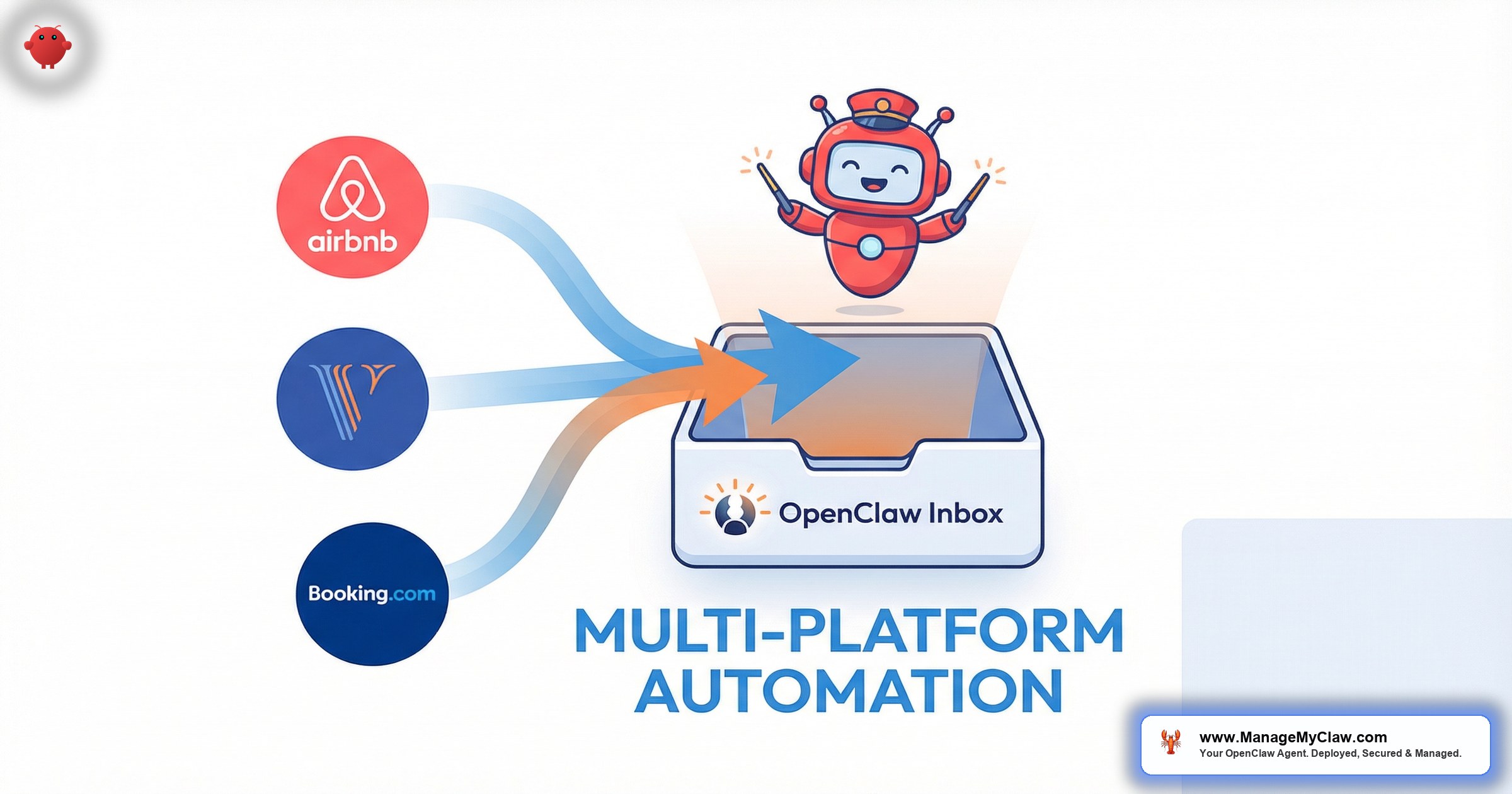
Web form submissions are captured via email. Your website contact form sends an email notification. OpenClaw reads it, extracts the lead data, qualifies by budget and timeline, and drafts a response. Same for Zillow Premier Agent notifications, Realtor.com lead alerts, and BoomTown/kvCORE CRM notifications.
-
4
Text message inquiries are forwarded to email. Using Google Voice or a carrier forwarding rule, inbound texts get copied to your Gmail. OpenClaw reads the forwarded text, qualifies the lead, and drafts a response email — or flags it for a direct text reply from you.
-
5
Follow-up happens automatically. The 30-day nurture sequence — Day 3 check-in, Day 7 market update, Day 14 price drop alert, Day 30 monthly digest — runs without your involvement. Cold leads stay warm. Hot leads get immediate attention.
“The best lead capture system isn’t the one that answers every call. It’s the one that responds to every inquiry — regardless of which channel it came through — before the lead has time to contact your competitor.”
— Principle behind OpenClaw’s multi-channel architectureVoice AI vs OpenClaw: Side-by-Side for Estate Agents
| Capability | Voice AI (Ylopo, CallBird, etc.) | OpenClaw (Email-First) |
|---|---|---|
| Phone call answering | Yes — AI voice responds to inbound calls | No — calls ring through to you or voicemail |
| Email triage & response | No (some offer email templates, not contextual AI) | Yes — 4-label triage, draft responses in 90 seconds |
| Lead qualification | On-call only (budget, timeline via conversation) | From any channel (email, form, text, CRM notification) |
| Calendar integration | Limited (some can book appointments) | Full Google Calendar — checks availability, suggests slots |
| 30-day follow-up nurture | Rarely included (manual or separate CRM drip) | Built-in: Day 3, 7, 14, 30 sequences with auto-send |
| CRM integration | Direct API (locked to specific CRMs) | Via email notifications (works with any CRM) |
| Channels covered | 1 (voice) | Email, web forms, text, CRM notifications (all except voice) |
| Data ownership | Vendor’s cloud | Your server, bare-metal, systemd |
| Monthly cost | $199–$999/mo | ~$12/mo VPS + API usage |
Notice the asymmetry. Voice AI excels at exactly 1 thing: answering the phone. OpenClaw excels at everything that happens after the phone stops ringing. For most agents, the after is where leads are actually won or lost.
The strongest play isn’t voice AI or OpenClaw. It’s both. Use a voice AI service for the 28% of leads that call. Use OpenClaw for the 72% that email, text, and submit forms. Your phone is covered. Your inbox is covered. Your follow-up is automated. Nothing falls through.
US vs UK: How AI Call Answering Needs Differ
The missed-call problem exists in both markets, but the dynamics are different enough to warrant separate strategies:
United States
- Lead volume is portal-driven. Zillow, Realtor.com, and Homes.com generate the majority of inbound leads, and they deliver them via email notification. Phone calls are a smaller percentage of first contact.
- Commission structure incentivizes speed. The typical 2.5–3% buyer agent commission on a $400K home is $10K–$12K. Losing 1 lead per month to slow response costs $30K–$36K per year in potential GCI.
- CRM adoption is high. Most US agents use Follow Up Boss, kvCORE, LionDesk, or BoomTown — all of which send email notifications that OpenClaw can process.
- Voice AI market is mature. Ylopo, Real Geeks, Cinc, and Sierra Interactive all offer voice AI integrations. The competition is between vendors, not between AI and no-AI.
United Kingdom
- Rightmove and Zoopla dominate. 90%+ of property searches start on these 2 portals. Lead notifications come via email, making OpenClaw’s email-first approach particularly effective.
- Estate agents handle both sides. UK estate agents typically manage both buyer and seller relationships, meaning higher per-transaction workload and more communication to manage.
- Fee structure is percentage-based but lower. UK fees average 1–1.5% + VAT, so each missed lead costs less in absolute terms but agents handle higher volume to compensate.
- Phone remains more important. UK buyers are more likely to phone the estate agent directly from a Rightmove listing. Voice AI has a stronger case in the UK market for this reason.
- GDPR adds data handling requirements. Any AI processing buyer data needs to comply with GDPR. OpenClaw running on your own server in your own jurisdiction simplifies the data controller question vs. US-hosted cloud voice AI services.
For UK estate agents, the voice AI + OpenClaw combination is even more compelling than in the US. Higher phone call volume makes voice AI more valuable, while Rightmove/Zoopla email notifications make OpenClaw’s triage essential. The 2 together cover nearly 100% of your inbound channels.
Different markets, same underlying problem: you can’t be in 2 places at once. Whether you’re showing a semi-detached in Clapham or a colonial in Connecticut, the lead that comes in while you’re busy doesn’t care about your schedule.
How to Get OpenClaw Up and Running for Lead Capture
OpenClaw deploys on bare-metal infrastructure under systemd — a VPS you control, with your data staying on your hardware. The setup for real estate lead capture covers 3 layers:
-
1
Gmail connection via Gog OAuth. OpenClaw authenticates with your Gmail using Gog — a lightweight OAuth wrapper that handles token refresh and scoped permissions. Read + draft access only. No password stored. Revocable from your Google account settings in 3 clicks.
-
2
System prompt configured for real estate. The system prompt tells OpenClaw how to classify emails, what qualifies as URGENT vs ACTION, and how to draft responses using your tone. For real estate, it includes your listing inventory, service areas, office hours, and scheduling preferences.
-
3
Progressive trust model activated. Start with read-only mode (OpenClaw classifies but doesn’t respond). Move to draft mode (responses wait for your approval). Graduate to auto-send for tested templates you’ve verified. You control the pace.
The full deployment — including security hardening with the 9-point configuration — takes about 4 hours for a managed setup. ManageMyClaw handles the deployment end to end, including the real estate system prompt, email template library, and calendar integration. You go from zero to up and running in an afternoon.
You don’t need to know Linux. You don’t need to touch a command line. You just need to know which email address gets your leads and what your calendar looks like this week.
The Hybrid Strategy: Voice AI + OpenClaw Together
The argument isn’t voice AI vs. email-first AI. It’s whether you’re covering all your channels or just 1. Here’s how the hybrid looks in practice:
| Scenario | What Handles It | Outcome |
|---|---|---|
| Buyer calls at 9 PM about a listing | Voice AI answers, qualifies, takes message | Lead captured, message forwarded to your email |
| Zillow sends lead notification email | OpenClaw triages, qualifies, drafts response | Lead gets reply in 90 seconds with showing availability |
| Website contact form submitted at 2 AM | OpenClaw reads notification email, qualifies lead | Draft response ready when you wake up (or auto-sent) |
| Voice AI takes a call → sends you summary email | OpenClaw reads the summary, starts follow-up sequence | Call data feeds into 30-day nurture automatically |
| Lead goes quiet after day 3 | OpenClaw sends market update on day 7 | Lead re-engages, requests showing |
The key insight: voice AI services send you email summaries of their calls. OpenClaw reads those summaries. That means the voice AI’s output becomes input for OpenClaw’s follow-up engine. The 2 systems stack without any custom integration. You don’t need an API bridge or a Zapier workflow. The connection is your inbox.
If you’re on a budget and can only choose 1: start with OpenClaw. It covers 72% of your inbound channels at ~$12/month. Add voice AI later when your lead volume justifies the $200–$999/month spend. Going the other direction — voice AI first, email coverage later — leaves the majority of your leads unprotected.
Frequently Asked Questions
Does OpenClaw answer phone calls?
No. OpenClaw is an email-first AI agent. Phone calls ring through to you normally. OpenClaw handles email, web form notifications, text message forwarding, and CRM alerts — covering the 72% of real estate leads that arrive through non-voice channels.
Can I use voice AI and OpenClaw together?
Yes, and that’s the recommended setup. Voice AI handles inbound calls. OpenClaw handles everything else. When your voice AI sends you a call summary email, OpenClaw reads it and starts the follow-up sequence automatically. No custom integration needed.
What about GDPR compliance for UK estate agents?
OpenClaw runs on your own server under systemd — you’re the data controller. Buyer data never leaves your hardware except through API calls you’ve explicitly configured. This simplifies GDPR compliance compared to US-hosted cloud voice AI services. For the security details, check the receptionist and brokerage security guide.
How much does the full setup cost?
OpenClaw itself runs on a ~$12/month VPS plus API usage (typically $15–$30/month depending on lead volume). ManageMyClaw’s managed deployment handles the server setup, security hardening, system prompt configuration, and email template library so you’re up and running in an afternoon.
Will buyers know they’re talking to AI?
With voice AI, there’s always a detection risk — and 62% of buyers report discomfort with AI-handled calls. With OpenClaw’s email responses, the output reads like a professional email from your office. Buyers interact with your brand voice, not a synthetic voice on a phone call.
See how ManageMyClaw works — from initial setup to your first automated response.