“The toilet is overflowing.” “The AC stopped working.” “There’s a weird smell in the kitchen.” — 3 texts, 3 different property managers, all received at 9:47 PM on a Friday.
If you’re a maintenance contractor or handyman company that services short-term rental properties, your workload is unpredictable by design. STR maintenance isn’t scheduled. It’s reactive. A guest reports a leaking faucet, the property manager texts you, you figure out if it’s urgent, you drive to the property, you fix it, you report back, you invoice. Multiply that by 30-60 properties across 5-8 different property managers, and you’re spending as much time triaging and communicating as you are repairing.
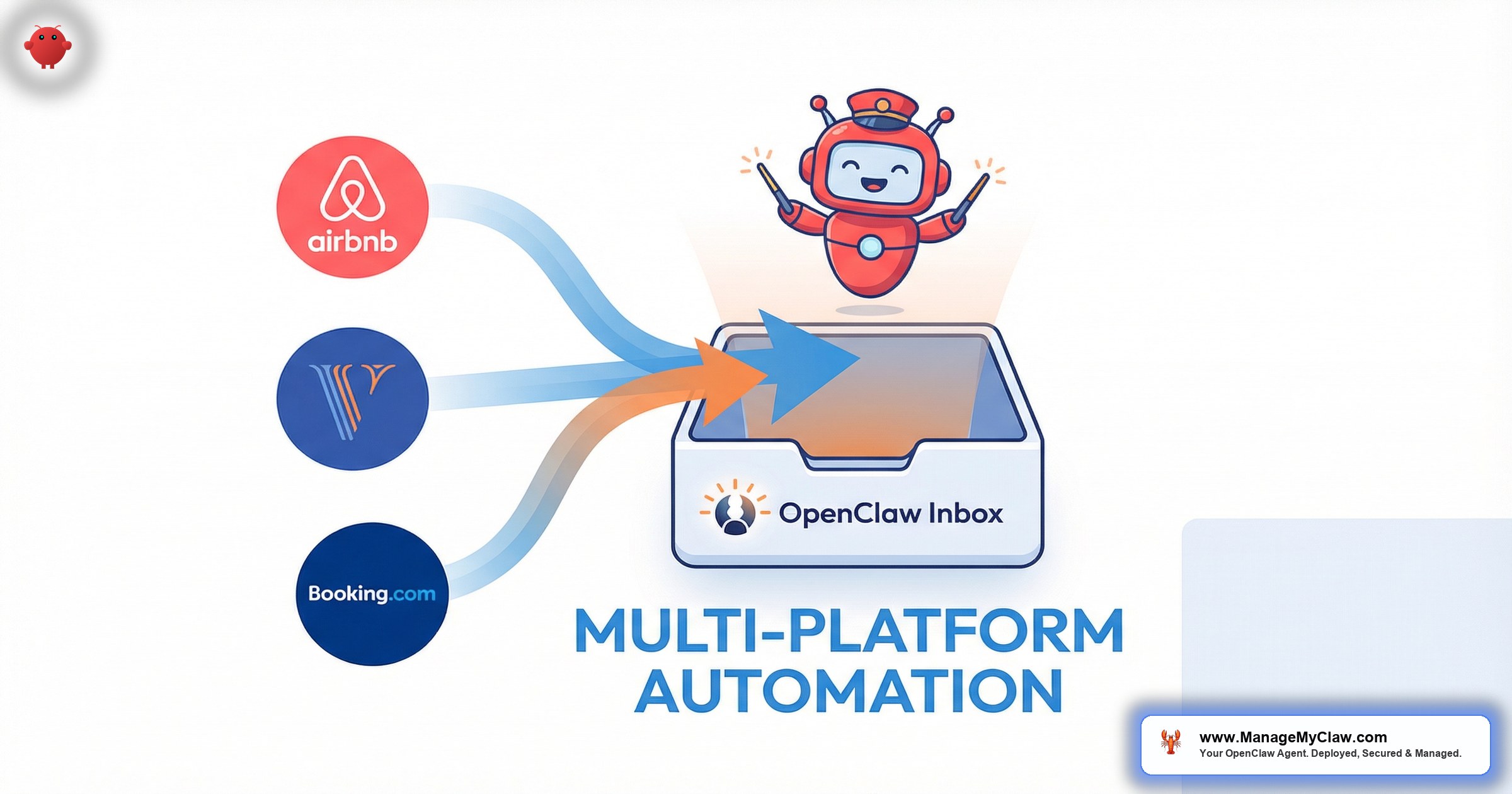
OpenClaw is an open-source AI agent framework that runs on your own server — bare-metal, managed by systemd, authenticated through Gog OAuth. For an AI STR maintenance contractor operation, it triages incoming requests from multiple property managers, categorizes them by urgency and trade (plumbing, electrical, HVAC, general), dispatches the right technician, tracks completion, and sends status updates back to the PM. You fix things. OpenClaw handles the inbox.
You became a contractor because you’re good with your hands. Nobody mentioned that half the job would be answering texts while standing in someone’s crawl space.
Why Maintenance Triage Is the Real Bottleneck
Not every maintenance request is equal. A burst pipe at 2 AM with a guest in the unit is a drop-everything emergency. A squeaky cabinet hinge is a “next time you’re in the area” task. The problem is that both requests arrive the same way — as a text or email from a property manager that says “hey, can you check something at Unit 7?” — and it’s on you to figure out the priority.
Here’s what triage looks like without a system:
| Request | Actual Priority | How It Arrives | Time to Assess |
|---|---|---|---|
| Toilet overflowing (guest in unit) | Emergency — respond within 1 hour | Text at 9 PM | 30 seconds (obvious) |
| “AC isn’t cold enough” | Could be a filter, could be a compressor. Unknown until inspection | Email from PM, forwarded from guest | 5-10 min (need follow-up questions) |
| Lightbulb out in hallway | Routine — next turnover | Cleaning crew mentioned it in group chat | 2 min (but you’re driving and forget) |
| “The WiFi is slow” | Not your problem (ISP issue) | Text from host | 3 min to explain it’s not a maintenance item |
| Dishwasher not draining | Medium — fix before next guest (2 days) | Airbnb message forwarded by PM | 5 min (need to check model, parts availability) |
Each request requires you to: read the message, determine if it’s actually a maintenance issue, assess urgency, check your schedule, respond to the PM with an ETA, drive to the property, fix the problem, report completion, and eventually invoice. The repair itself might take 20 minutes. The communication and coordination around it take 30-45.
When you can’t distinguish emergencies from routine requests quickly, everything gets treated as medium priority. The burst pipe waits 2 hours because it was buried in the same text thread as the squeaky hinge. The PM loses trust. The guest leaves a 1-star review mentioning “maintenance took forever.” You lose the contract — not because you couldn’t fix it, but because you didn’t get there fast enough.
The best maintenance contractors aren’t necessarily the best at fixing things. They’re the best at responding fast to the right things. That’s a triage problem, not a wrench problem.
How OpenClaw Triages and Dispatches Maintenance Requests
OpenClaw monitors your email inbox through Gog OAuth. Property managers forward maintenance requests to your scheduling address (or their PMS sends them automatically). The agent reads each request, categorizes it, assigns a priority, and dispatches the right response. Here’s the full pipeline.
Step 1: Receive and Parse the Request
When a maintenance request email arrives, OpenClaw extracts: the property address, the reported issue, whether a guest is currently in the unit, the next guest’s check-in date, and the PM’s contact info. It doesn’t just keyword-match “plumbing” or “electrical.” It reads the full description to understand context. “Water on the bathroom floor” could be a burst pipe or a guest who didn’t close the shower curtain. OpenClaw asks the right follow-up question if the request is ambiguous.
Step 2: Categorize by Trade and Urgency
The agent classifies every request along 2 dimensions: trade type and urgency level.
| Urgency Level | Response Window | Examples |
|---|---|---|
| Emergency | Under 2 hours | Water leak (active), no heat in winter, gas smell, lockout with guest at door |
| Urgent | Same day | AC failure in summer, hot water out, broken door lock, toilet not flushing |
| Standard | Before next guest | Dishwasher not draining, garbage disposal jammed, blinds broken |
| Routine | Next available visit | Squeaky door, lightbulb replacement, touch-up paint, caulking |
| Not maintenance | Redirect to PM | WiFi issues (ISP), noise complaints (neighbor), “how do I use the oven” (guest education) |
The categorization rules are yours. You define what counts as an emergency vs. urgent vs. routine. OpenClaw applies your rules consistently at 3 AM the same way it does at 3 PM — which is more than you can say about yourself after a 14-hour day.
If you run a team with specialized techs — a plumber, an electrician, and 2 general handymen — OpenClaw routes requests to the right person based on the issue category. Plumbing goes to your plumber. Electrical goes to your electrician. “The drawer is stuck” goes to whoever is closest. No more dispatching your electrician to change a lightbulb because you were in a hurry.
Step 3: Dispatch and Confirm
Once categorized, OpenClaw sends a dispatch notification to the assigned technician with: property address, access code, issue description, urgency level, and any relevant property notes (“this unit has a finicky water heater — pilot light instructions are on the utility closet door”). The tech confirms receipt, and OpenClaw sends an ETA to the property manager: “Your maintenance request for 456 Elm St has been assigned. Technician arriving by 2:30 PM.”
For emergencies, the agent skips the scheduling queue. It contacts the on-call tech directly and escalates to you if nobody responds within 15 minutes. You define the escalation chain. OpenClaw follows it.
The PM doesn’t want to know your scheduling conflicts. They want to know when someone’s showing up. OpenClaw gives them that answer in under 60 seconds.
Step 4: Track Completion and Report Back
When the tech finishes, they reply with “done” and a brief description of what was fixed: “Replaced garbage disposal. Old unit was a Badger 5, installed InSinkErator Evolution.” OpenClaw logs the completion, the repair details, and the time spent. It sends the PM a completion report: “Maintenance complete at 456 Elm St. Garbage disposal replaced. Property ready for next guest.”
If the repair requires a follow-up visit (ordered a part, need a specialist, cosmetic damage needs a separate contractor), OpenClaw logs the open item and reminds you when the part arrives or the specialist is available. Nothing falls through the cracks because nothing depends on your memory.
How Automated Triage Helps You Win Property Management Contracts
Property managers evaluate maintenance vendors on 3 things: response time, communication quality, and invoicing accuracy. If you’re fast, you send clear updates, and your invoices are clean — you keep the contract. If any of those 3 slip, there are 5 other handyman companies in your area ready to take your place.
OpenClaw gives you an edge on all 3:
- Response time — automated triage means the PM gets an ETA within 60 seconds of submitting a request. No waiting for you to check your phone, read the message, think about your schedule, and text back. The answer is instant.
- Communication — every request gets a confirmation, an ETA, a completion report, and a follow-up note if needed. The PM never has to chase you for a status update. Property managers scaling their portfolios need this reliability — see how operators scale from 5 to 50 properties and why vendor communication is non-negotiable at 20+ units.
- Invoicing — OpenClaw logs every completed job with date, property, issue, time spent, and parts used. Monthly invoices are auto-generated from this log. No reconstructing your month from memory. No missed billable work.
“Our maintenance vendor sends us a completion report within 5 minutes of finishing a job. We’ve never had a vendor do that before. They’re our only vendor now.”
— STR property manager, r/realestateinvesting (640 upvotes, February 2026)The cleaning companies servicing these same properties are adopting similar automation — AI for Airbnb cleaning companies covers how the dispatch and notification model works on the turnover side. When both your cleaning and maintenance vendors send automated updates, the property manager’s operational load drops significantly. That makes you both harder to replace.
You don’t win PM contracts in a bidding war. You win them by being the vendor who never makes the PM chase you for an update. That’s a systems advantage, not a pricing advantage.
Parts Tracking and Cost Documentation
Every repair has a parts cost. Faucet cartridge: $14. Garbage disposal: $89. HVAC capacitor: $35. The problem isn’t the cost — it’s documenting it accurately and passing it through to the PM or owner. Most contractors keep a mental note, buy parts at Home Depot, throw the receipt in the truck, and reconstruct costs at invoicing time. Some receipts are lost. Some parts costs are forgotten. You underbill and eat the difference, or you overbill and create trust issues.
OpenClaw tracks parts costs as part of the completion report. When a tech replies “done,” they include parts: “Replaced cartridge, Moen 1225, $18.47.” The agent logs the cost, attaches it to the job, and includes it on the monthly invoice. The PM sees exactly what was done and what it cost. No ambiguity. No “what was that $89 charge for?”
Over time, this data shows you which properties are maintenance-heavy (and might need their retainer adjusted), which types of repairs are most common (so you can stock common parts in your truck), and which properties have recurring issues that suggest a larger underlying problem.
When you can show a PM data — “Unit 12 has had 4 plumbing calls in 6 months, all related to the same drain line” — you’re not just fixing problems. You’re identifying them before they become emergencies. That positions you as a strategic partner, not just a vendor on a call list. PMs pay more for that kind of insight.
The data isn’t just for invoicing. It’s ammunition for retainer conversations. “Your properties averaged 3.2 service calls per month last quarter. A $500/month retainer covers everything under $150 per call and guarantees 2-hour emergency response.” That’s a pitch backed by numbers, not guesses.
Getting Automated Triage Up and Running
OpenClaw runs on a VPS that costs $12-24/month. Deployed on bare-metal with systemd, secured with Gog OAuth for email. You don’t need a dedicated IT person or a computer science background.
Prerequisites
- OpenClaw instance — running on a VPS or Mac Mini, managed by systemd
- Email access via Gog OAuth — Gmail or Google Workspace (where PM requests arrive)
- Property roster — addresses, access codes, and property-specific notes for each unit you service
- Technician roster — specialties, contact info, service zones, on-call schedule
- Triage rules — your definitions of emergency, urgent, standard, and routine (OpenClaw applies them consistently)
- 30-45 minutes of setup time — to configure categories, dispatch rules, and notification templates
| Item | Cost | Frequency |
|---|---|---|
| OpenClaw (open-source) | $0 | — |
| VPS hosting | $12-24 | Monthly |
| API costs (triage + dispatch + reports) | $15-30 | Monthly |
| ManageMyClaw deployment | $499 | One-time |
| Year 1 total | $823-1,147 (vs. $15,000-20,000 for a part-time dispatcher) | |
ManageMyClaw handles the full deployment: server setup, email connection, triage rules configuration, technician routing, and PM notification templates. Your system is up and running within 60 minutes. For hosts and PMs looking to connect their operations to your maintenance workflow, OpenClaw for Airbnb hosts covers the host-side integration. See full pricing here.
Frequently Asked Questions
Do property managers need to change how they send requests?
Minimally. They forward maintenance requests to your scheduling email address (or CC it). If they use a PMS like Guesty or Hostaway, the system can auto-forward maintenance tickets. If they text you today, you give them an email address to use instead — or you forward the texts yourself during the transition. Most PMs prefer the email-based system once they see the automated confirmations and completion reports they receive in return.
What if a request is ambiguous and needs follow-up questions?
OpenClaw sends a follow-up email to the PM: “We received a maintenance request for 789 Pine St regarding ‘water on the bathroom floor.’ Can you confirm: is the water actively flowing, or is this a puddle that was found after the guest left?” The agent asks specific, diagnostic questions based on the issue category. It doesn’t dispatch a tech until it has enough information to assign the right person.
Can I use this if I’m a solo handyman, not a company with technicians?
Yes. If you’re a 1-person operation, the “dispatch” goes to you. The value is in the automated triage (so emergencies jump to the top), the PM notifications (so you don’t spend 20 minutes per day texting status updates), and the invoicing data (so your monthly billing is accurate without reconstructing from memory).
How does OpenClaw handle after-hours emergencies?
You define your on-call schedule. If an emergency comes in at 2 AM, OpenClaw contacts the on-call technician (via email or SMS). If there’s no response within your defined window (default: 15 minutes), it escalates to the next person on your list. If nobody responds, it sends you an alert. The PM gets an automatic acknowledgment: “Emergency request received. On-call technician has been contacted. ETA to follow.”
Does this integrate with the turnover workflow?
Yes. When a cleaning crew flags a maintenance issue during a turnover (“cracked tile in the shower”), OpenClaw can receive that flag and create a maintenance ticket automatically. The full turnover-to-maintenance pipeline is covered in our turnover team automation guide. Cleaning and maintenance work as linked systems — checkout triggers cleaning, cleaning flags maintenance, maintenance completion feeds back into property readiness.