“You ask guests for passport scans, emergency contacts, phone numbers, and travel dates. That data flows through every tool in your stack. Do you know which servers it sits on? In which countries? Under whose data retention policy?”
Data privacy for STR hosts refers to how short-term rental operators store, process, and protect the personal information their guests provide — from names and phone numbers to government ID scans and payment details. OpenClaw is an open-source AI agent framework with 250,000+ GitHub stars that runs entirely on your own bare-metal server via systemd, connecting to communication channels through Gog OAuth. Every guest message, every piece of personal data, every conversation log stays on infrastructure you own and control. No cloud vendor. No shared multi-tenant database. No third-party data retention policies you didn’t write.
This post explains what guest data you’re actually handling (it’s more sensitive than most hosts realize), where that data goes when you use cloud-hosted automation tools, what the regulatory landscape looks like in 2026, and why self-hosted AI agents are the only architecture that gives you genuine data sovereignty. This isn’t about paranoia. It’s about understanding what you’re liable for and making sure you can actually answer the question “where is my guest’s passport scan stored?” without saying “I think it’s on Hospitable’s servers somewhere.”
What Guest Data You’re Actually Handling
Most hosts think of guest data as “a name and some messages.” The reality is significantly broader — and significantly more regulated.
| Data Category | Examples | Sensitivity Level | Regulatory Impact |
|---|---|---|---|
| Identity documents | Passport scans, driver’s license, national ID | Critical | GDPR Art. 9, many local STR laws |
| Contact information | Phone numbers, email addresses, home address | High | GDPR, CCPA, CAN-SPAM |
| Financial data | Payment method details, damage deposit info | Critical | PCI DSS, GDPR |
| Travel information | Arrival/departure dates, flight numbers, car details | Medium | GDPR (travel profiling) |
| Communication logs | Every message sent and received | Medium–High | GDPR, ePrivacy Directive |
| Behavioral data | Check-in/out times, WiFi usage, smart lock logs | Medium | GDPR (profiling), local surveillance laws |
If you operate in the EU (or host EU citizens, which you almost certainly do), GDPR applies to all of this data. You’re the data controller. That means you’re legally responsible for how it’s stored, who has access to it, how long it’s retained, and what happens if it’s breached. Delegating operations to a cloud-hosted tool doesn’t transfer that responsibility — it adds a data processor to the chain while keeping you liable.
Here’s the uncomfortable part: most hosts using Hospitable, Guesty, or Host Tools have never read those platforms’ data processing agreements. They don’t know which AWS region their guest data is stored in. They don’t know the retention policy. They couldn’t answer a GDPR Subject Access Request if one arrived tomorrow.
Where Your Guest Data Goes With Cloud-Hosted Tools
When you use a cloud-hosted automation platform like Hospitable, Guesty, or Host Tools, every guest message passes through their servers. Here’s the typical data flow.
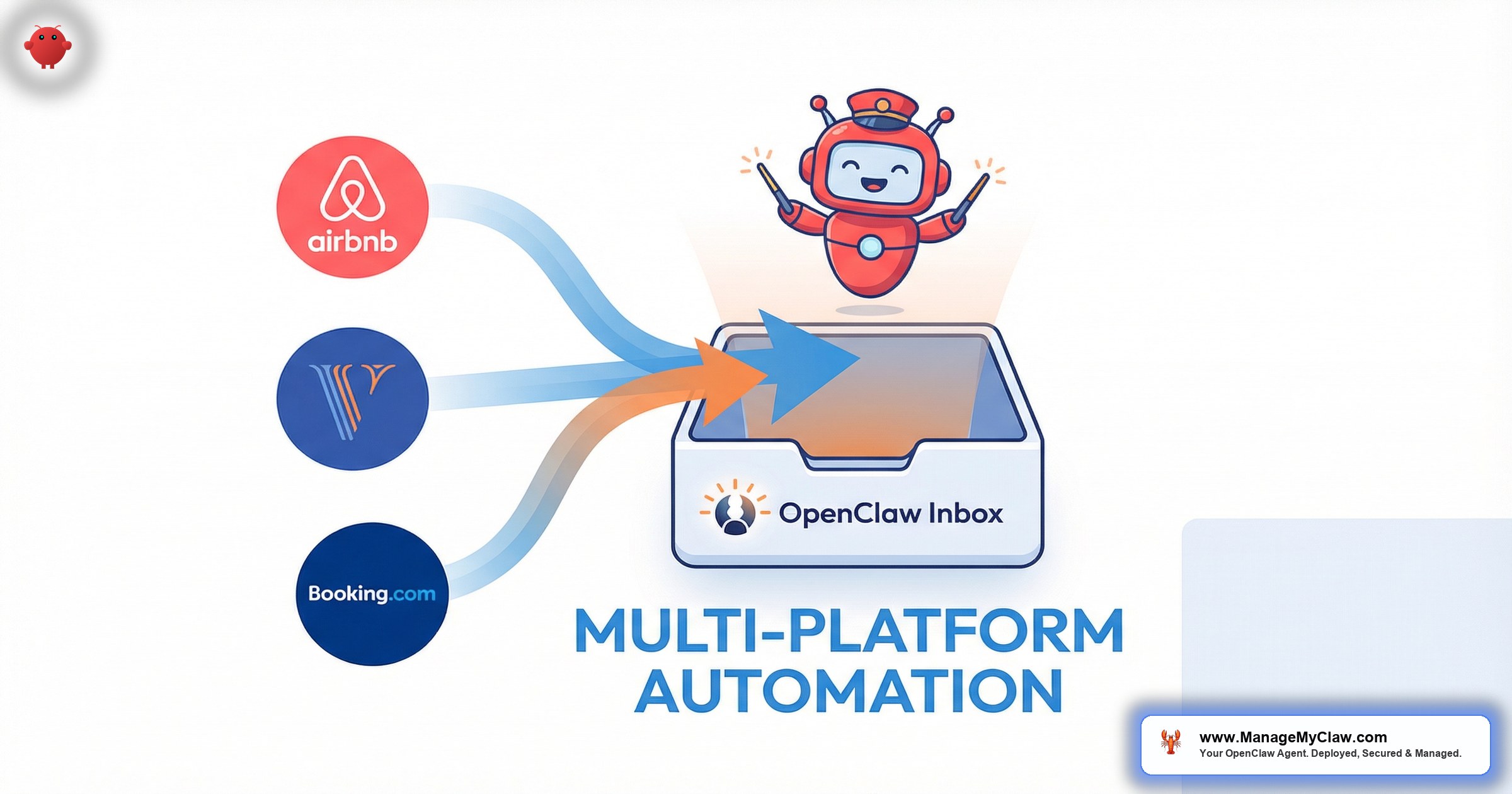
- Guest sends a message on Airbnb, VRBO, or Booking.com
- Platform API delivers the message to the cloud tool’s servers (AWS, GCP, or Azure — you don’t choose which)
- Cloud tool processes the message — applies rules, generates responses, logs the interaction
- Message data is stored on the cloud tool’s multi-tenant database (shared infrastructure with every other customer)
- Response is sent back through the platform API
At step 4, your guest’s personal data sits on servers you don’t control, in a database shared with thousands of other hosts, under a data retention policy the vendor wrote. Most cloud tools retain data for 12–36 months after you cancel your subscription. Some retain it indefinitely for “analytics and improvement purposes.” You agreed to this in the terms of service you didn’t read.
Cloud-hosted STR tools use shared databases. A breach at Hospitable, Guesty, or any SaaS provider exposes guest data from every host on the platform — not just yours. You can’t control their security practices, patch schedules, or employee access policies. You’re trusting them with your guests’ passport scans based on a privacy policy that can change with 30 days’ notice.
How OpenClaw Keeps Guest Data on Your Server
OpenClaw runs on your own bare-metal VPS. Not a shared cloud instance — a dedicated server that you control. The data flow is fundamentally different.
- Guest sends a message through any channel (email, SMS, WhatsApp)
- Gog OAuth integration delivers the message directly to your OpenClaw instance
- OpenClaw processes the message on your server — reads, understands, generates reply
- Message data is stored in your server’s local database (encrypted, single-tenant, you own the keys)
- Response is sent back through the same Gog OAuth channel
The critical difference is at step 4. Your guest data never touches a third-party server. It doesn’t sit in a multi-tenant database. It isn’t subject to someone else’s retention policy. You control encryption, access, retention periods, and deletion — because it’s your server.
The deployment includes security hardening out of the box: firewall rules via UFW, fail2ban for brute-force protection, encrypted connections, and SSH key-only access. The server runs as a systemd service with automatic restarts and log rotation. Your guest data is as secure as you make your server — and we make it very secure during the initial deployment.
Think about it this way: you wouldn’t store your guests’ passport scans in a shared Google Drive folder labeled “STR Guest Info.” But when you use a cloud tool, you’re essentially doing the digital equivalent — putting sensitive data on shared infrastructure and hoping the vendor’s security is better than yours.
| Feature | Cloud-Hosted Tool | OpenClaw (Self-Hosted) |
|---|---|---|
| Data location | Vendor’s cloud (AWS/GCP region they choose) | Your VPS (region you choose) |
| Database type | Multi-tenant (shared with all customers) | Single-tenant (your data only) |
| Encryption keys | Vendor holds keys | You hold keys |
| Retention policy | Vendor’s policy (12–36+ months) | Your policy (delete when you want) |
| Breach liability | Shared with vendor + all their customers | Isolated to your server |
| GDPR data processor | Vendor = data processor (you’re still controller) | No processor — you’re controller and processor |
The Regulatory Landscape for STR Guest Data in 2026
Data privacy regulations affecting STR hosts have intensified significantly since 2024. Here’s what you need to know.
GDPR (EU/EEA)
If you host EU citizens — and you do, unless you’ve somehow managed to exclude all European travelers — GDPR applies. You need a lawful basis for processing guest data (legitimate interest for booking fulfillment, consent for marketing). You need to honor Subject Access Requests within 30 days. You need to notify authorities within 72 hours of a data breach. Fines: up to 4% of annual revenue or 20 million EUR, whichever is higher.
EU Short-Term Rental Regulation (2025)
The EU’s new STR regulation, enacted in late 2025, requires hosts to register and share guest data with local authorities. This creates a new compliance burden: you need to know exactly what data you hold, where it’s stored, and be able to produce it on demand. If your data is scattered across 3 cloud tools and your own email, good luck responding to an audit within the required timeframe.
CCPA/CPRA (California)
California’s privacy laws give guests the right to know what data you’ve collected, request deletion, and opt out of data sharing. If you list properties in California or host California residents, you’re covered. Self-hosted data means you can fulfill deletion requests instantly — no waiting for a vendor’s support team to process your ticket.
Regulations aren’t theoretical risks. They’re operational requirements with deadlines and penalties. The question isn’t whether a guest will ever exercise their data rights — it’s whether you’ll be able to respond when they do. With self-hosted data, the answer is always yes, because you control the data directly.
How to Set Up Privacy-First STR Automation
Switching to a self-hosted AI agent doesn’t require rebuilding your entire operation. Here’s the practical path.
The total cost: $499 one-time ManageMyClaw deployment + approximately $25/month for VPS hosting. Compare that to Hospitable at $40–100/month with no data sovereignty, or hiring a privacy consultant at $200–500/hour to audit your cloud tool stack.
The irony is that self-hosting is both the more private option AND the cheaper option. You’d expect privacy to cost more. In this case, it costs less — because you’re not paying a SaaS vendor’s margin on top of the infrastructure costs you’d incur anyway.
Data Privacy as a Booking Differentiator
Here’s something most hosts haven’t considered: data privacy is a marketing differentiator. Travelers — particularly European, Australian, and privacy-conscious guests — increasingly factor data handling into their booking decisions. A 2025 Skyscanner survey found that 34% of travelers consider host data practices when choosing accommodation, up from 12% in 2022.
You can surface this in your listing description: “All guest communication is handled by AI on our private server. Your personal data is never stored on shared cloud platforms.” For privacy-conscious travelers, that’s a booking trigger. For corporate travelers whose companies have data handling policies, it can be a requirement.
This is especially relevant for hosts in tourist-heavy EU cities where GDPR awareness among guests is high. A Frankfurt business traveler booking through Booking.com is more likely to trust a host who explicitly states their data handling practices than one whose listing says nothing about it.
Frequently Asked Questions
Does OpenClaw send any data to external servers?
OpenClaw sends message text to LLM API endpoints (OpenAI, Anthropic, or local models) for response generation. The message content is processed and discarded by the API — it’s not stored or used for training if you use API access (not consumer products). All other data — conversation logs, guest profiles, knowledge bases — stays on your server.
Can I run OpenClaw with a fully local LLM to avoid any external API calls?
Yes. OpenClaw supports local LLMs through Ollama or vLLM. Response quality depends on the model you run, but for common STR messages (check-in info, parking questions, local recommendations), smaller local models perform well. This gives you 100% air-gapped data processing with zero external API dependencies.
How do I handle a GDPR Subject Access Request with OpenClaw?
Because all data is in your server’s database, you can query it directly. Search by guest name or email, export their data, and send it within the 30-day GDPR deadline. For deletion requests, remove the records from your database. No vendor support ticket required.
What happens to my data if I stop using the managed service?
It’s your server. The data stays there. We set up your OpenClaw instance and maintain it. If you cancel managed care, the server and all its data remain yours. We don’t retain copies of your guest data. See our pricing page for details on managed care plans.
Is self-hosted more secure than cloud-hosted?
It depends on implementation. A poorly configured VPS is less secure than a well-managed cloud platform. That’s why the deployment includes security hardening: UFW firewall, fail2ban, encrypted connections, SSH key auth, automatic security updates. With proper configuration, self-hosted is more secure because the attack surface is smaller (1 server vs a multi-tenant platform with thousands of users).