“HostBuddy automates 40–50% of your guest messages. That sounds good until you realize the other 50–60% still require you to be glued to your phone at midnight. The question isn’t whether AI helps — it’s whether 50% is enough.”
ManageMyClaw is a managed deployment service for OpenClaw, an open-source AI agent framework with 250,000+ GitHub stars that runs on your own bare-metal server via systemd. OpenClaw connects to communication channels through Gog OAuth and autonomously handles guest messages, review responses, cleaning coordination, and operational communication — achieving 70–90% automation rates by reading, understanding, and responding to messages in context. HostBuddy is a cloud-hosted AI messaging platform for Airbnb hosts that uses natural language processing to respond to common guest queries, reaching 40–50% automation with pre-configured knowledge bases.
This is a direct comparison of managemyclaw vs hostbuddy for STR hosts who’ve decided they want AI-powered guest communication but need to choose between these 2 architectures. We’ll cover automation depth, pricing, data ownership, multi-channel capabilities, and the specific scenarios where each platform wins.
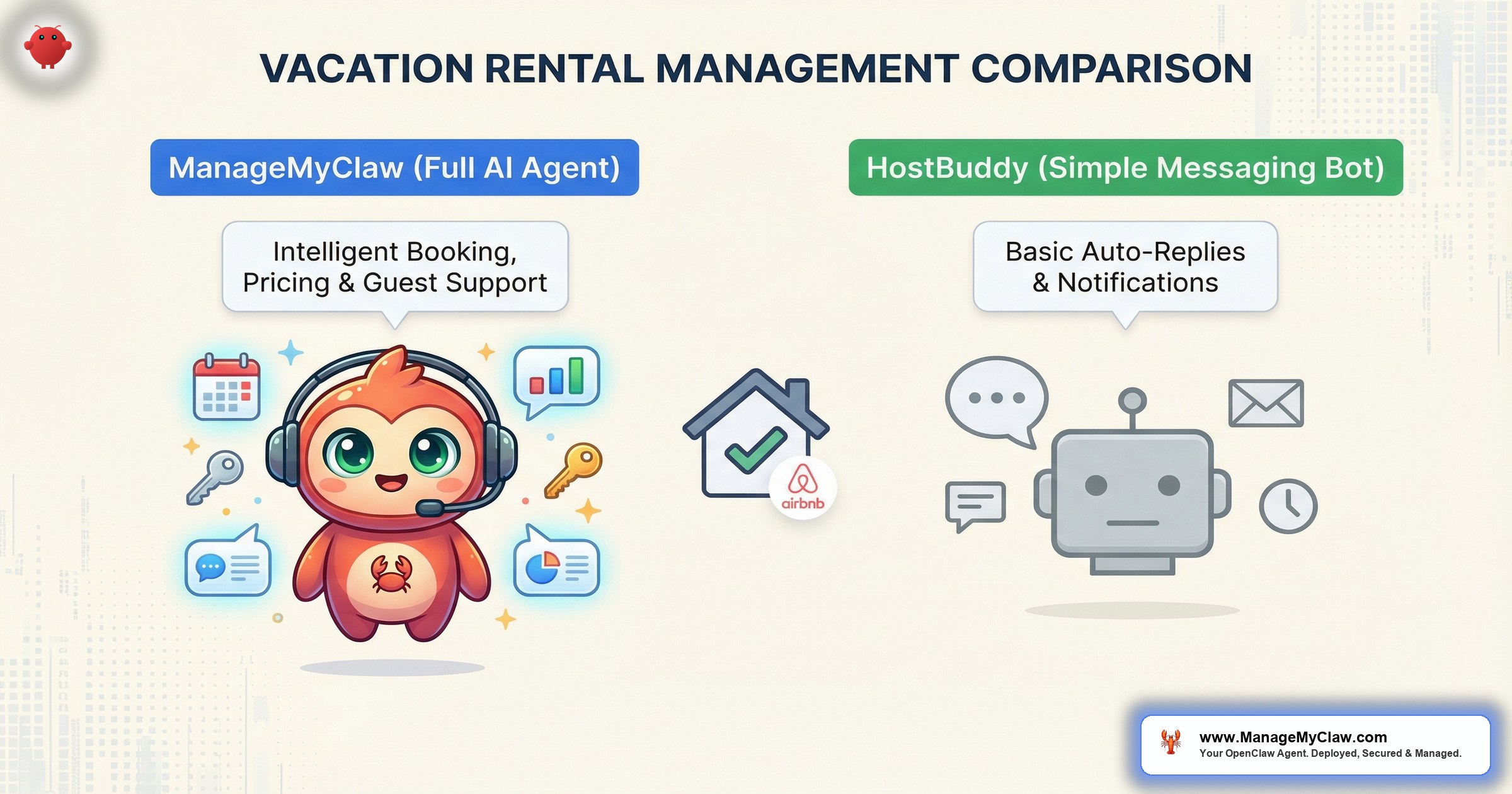
Both tools use AI for guest messaging. The similarity ends there. One is a messaging bot focused on common questions. The other is an autonomous agent that handles the full spectrum of guest communication plus operations. The gap between 50% and 90% automation is the gap between “AI helps me” and “AI runs this for me.”
Messaging Bot vs. Autonomous Agent: What’s the Difference?
HostBuddy works by matching incoming guest messages against a pre-configured knowledge base of common questions and answers. When a guest asks “What’s the WiFi password?” HostBuddy recognizes the intent, matches it to the WiFi answer in your knowledge base, and sends the response. It’s effective for frequently asked questions — check-in times, parking information, WiFi codes, appliance instructions.
Where it breaks down is at the edges. “My flight was delayed and I won’t arrive until 1 AM — is there a late check-in procedure?” “The shower pressure seems low, is that normal?” “Can you recommend a restaurant for my parents’ 40th anniversary that has outdoor seating and a vegetarian menu?” These require comprehension beyond intent matching — they require understanding context, combining information, and generating novel responses.
OpenClaw doesn’t match intents. It reads the message, understands what the guest is asking, checks your property knowledge base for relevant information, and composes a response that directly addresses the specific question. The difference is like autocomplete versus having a conversation.
| Capability | HostBuddy | OpenClaw |
|---|---|---|
| Common FAQ responses | Strong (40–50% of messages) | Strong (covered within 70–90%) |
| Complex multi-part questions | Weak (escalates to host) | Strong (parses and responds to each part) |
| Novel/unexpected questions | Cannot handle (escalates) | Handles with reasoning from knowledge base |
| Multi-language | Limited (English primary, some translation) | 90+ languages, auto-detected, native responses |
| Tone matching | Fixed tone templates | Adapts to guest tone and context |
| Review responses | Not included | Contextual, unique per guest/stay |
| Operational coordination | Not included | Cleaning dispatch, owner updates, vendor messages |
| Escalation intelligence | Escalates anything it doesn’t match | Escalates only when confidence is low |
What the 40% vs. 80% Gap Means in Practice
Let’s make this concrete. If you receive 400 guest messages per month (typical for a 5-listing host), here’s what each automation rate actually looks like in your daily life.
| Metric | HostBuddy (45%) | OpenClaw (80%) | Difference |
|---|---|---|---|
| Messages auto-handled | 180 | 320 | +140 messages/month |
| Messages requiring you | 220 | 80 | -140 messages/month |
| Your time spent (at 3 min/msg) | 11 hrs/month | 4 hrs/month | 7 hrs saved |
| Overnight messages handled | ~54 (common queries only) | ~96 (nearly all) | 42 fewer 2 AM interruptions |
The 140 additional messages OpenClaw handles autonomously are the hard ones — the restaurant recommendations, the “my flight is delayed” messages, the multi-part questions about check-in AND parking AND pet policies in a single text. These are the messages that take 5–8 minutes each because they require context-switching and research. That 7 hours/month of saved time is conservative.
Here’s what no automation rate metric captures: the cognitive load difference. With HostBuddy, you’re still “on call” for 220 messages per month. You can’t fully disconnect because you know half your messages need you. With OpenClaw, 80 messages per month need your attention — and most of those are genuinely unusual situations where your personal judgment adds value.
Cost Comparison: Subscription vs. One-Time
HostBuddy prices at approximately $15–30 per listing per month depending on tier and features. Their Starter plan handles basic messaging, while their Pro plan adds more advanced features and higher message volumes. For a 10-listing host on the Pro plan, expect $200–300/month — $2,400–3,600/year.
OpenClaw via managed deployment is $499 one-time + approximately $25/month for VPS hosting. No per-listing fees. No message volume limits. No tier upgrades.
| Portfolio | HostBuddy Pro (~$25/listing/mo) | ManageMyClaw Year 1 | ManageMyClaw Year 2+ |
|---|---|---|---|
| 3 listings | $900/yr | $799/yr | $300/yr |
| 5 listings | $1,500/yr | $799/yr | $300/yr |
| 10 listings | $3,000/yr | $799/yr | $300/yr |
| 20 listings | $6,000/yr | $799/yr | $300/yr |
At 5+ listings, OpenClaw is cheaper in year 1 with higher automation rates. From year 2 onward, you’re paying $300/year for VPS hosting versus $1,500–6,000/year for HostBuddy. The savings scale linearly with your portfolio size. You’re paying less for more automation. That’s not a common trade-off in software. Usually, “better” costs more. In this case, better costs less because you’re paying for infrastructure, not a vendor’s margin.
Where Your Guest Data Lives
HostBuddy is a cloud-hosted platform. Every guest message passes through their servers, gets processed on their infrastructure, and is stored in their multi-tenant database. Your guest data — names, phone numbers, travel details, message content — sits alongside every other host’s data on shared infrastructure you don’t control.
OpenClaw runs on your own bare-metal VPS. Guest data stays on your server. It’s stored in your database with your encryption keys. You control retention periods, access policies, and deletion schedules. For EU hosts dealing with GDPR, for privacy-conscious travelers, and for your own liability management, this is a fundamental architectural advantage.
This matters more than most hosts think. A data breach at HostBuddy exposes guest data from every host on their platform. A security issue on your OpenClaw VPS is isolated to your data only — and it’s hardened with firewall rules, fail2ban, and encrypted connections deployed during initial setup.
When you cancel a cloud-hosted tool, your guest data doesn’t disappear. Most SaaS platforms retain data for 12–36 months post-cancellation under their data retention policies. With OpenClaw, canceling managed care means nothing changes on your server — you still own it, the data is still there, and you can delete it whenever you want.
Multi-Channel and Multi-Language Capabilities
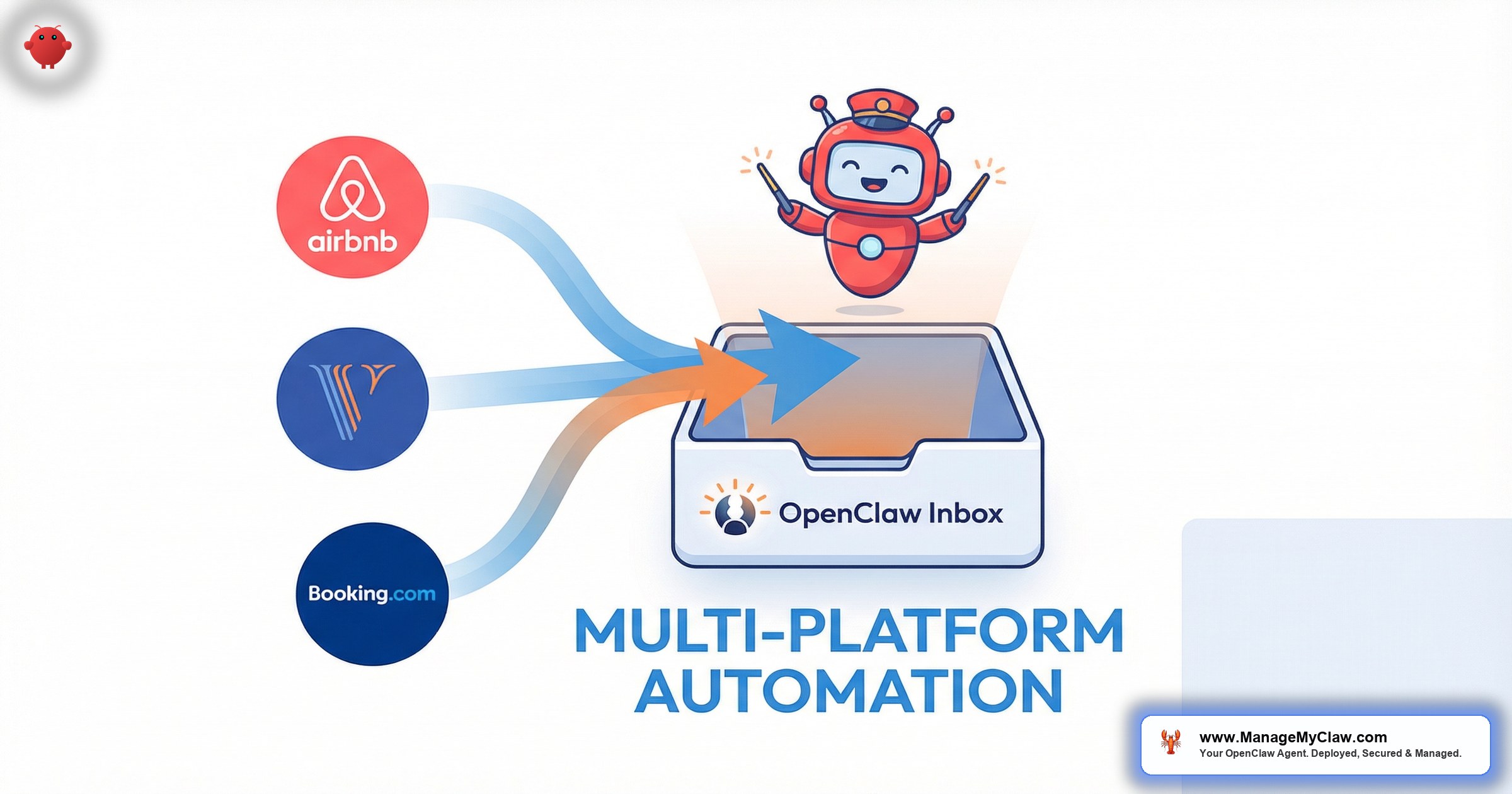
HostBuddy connects primarily through Airbnb’s messaging API. Some plans add VRBO and Booking.com integration. Email, SMS, and WhatsApp are not natively supported — if guests contact you outside the booking platforms, HostBuddy doesn’t see those messages.
OpenClaw connects to email, SMS, WhatsApp, Telegram, and any channel you configure through Gog OAuth. A guest who messages you on WhatsApp gets the same AI-powered response as one who messages through Airbnb. Direct booking guests who contact you via email or phone get covered too. For hosts who use direct booking websites alongside OTAs, this is the difference between partial coverage and full coverage.
Language Support
HostBuddy supports English as its primary language with translation capabilities for some additional languages. The translations are functional but not native-quality — guests can tell they’re getting a translated response rather than a reply from someone who speaks their language.
OpenClaw responds natively in 90+ languages. It doesn’t translate — it composes directly in the guest’s language. A Japanese guest gets a response that reads like it was written by a Japanese speaker, not a response translated from English. For hosts in tourist destinations where guests speak 8–15 different languages, this is a significant quality difference. Your German guest in Lisbon gets a reply in fluent German. Your Brazilian guest in Tokyo gets a reply in natural Portuguese. Neither of them knows they’re talking to software — because the language quality doesn’t give it away.
What OpenClaw Does That HostBuddy Doesn’t
HostBuddy is a messaging tool. OpenClaw is an operations agent that includes messaging. The scope difference is significant.
- Review responses — OpenClaw writes unique, contextual review responses for each guest. Not templates. Responses that reference the guest’s name, stay dates, and any notable interactions. HostBuddy doesn’t handle reviews.
- Cleaning coordination — When a guest checks out, OpenClaw can dispatch your cleaning team via SMS, email, or WhatsApp with property details and turnover instructions. HostBuddy doesn’t coordinate operations.
- Owner communication — If you manage properties for owners, OpenClaw can generate and send periodic performance updates. HostBuddy focuses exclusively on guest-facing messaging.
- Vendor coordination — Maintenance requests, supply orders, contractor scheduling — OpenClaw handles operational communication across your entire business, not just guest messages.
- Escalation with context — When OpenClaw escalates to you, it includes the full conversation context, its assessment of the situation, and a suggested response. You’re not starting from scratch — you’re approving or editing a pre-analyzed situation.
HostBuddy answers your guests’ questions. OpenClaw runs your guest communication, review management, cleaning coordination, and operational messaging. The difference between a messaging tool and an operations agent is the difference between a calculator and an accountant.
Which One Should You Pick?
Pick HostBuddy if:
- You manage 1–3 listings with predictable guest questions
- 40–50% automation is enough for your current volume
- You only need Airbnb messaging coverage (no email/SMS/WhatsApp)
- You prefer a cloud-hosted tool with no server management
- Guest communication is your only automation need (no reviews, cleaning, operations)
Pick OpenClaw (via ManageMyClaw) if:
- You want 70–90% automation — handling complex questions, not just FAQs
- You manage 5+ listings and want flat-fee pricing that scales
- You host international guests needing native multi-language responses
- You need automation beyond messaging — reviews, cleaning, operations
- You want guest data on your own server, not a shared cloud
- You use multiple channels (email, SMS, WhatsApp) beyond just Airbnb messaging
“The gap between 50% and 90% automation doesn’t mean ‘40% more messages handled.’ It means the difference between a tool that assists you and a system that replaces the need for your constant availability.”
— OpenClaw deployment analysis, March 2026Frequently Asked Questions
Is HostBuddy’s 40–50% automation rate accurate?
HostBuddy reports automation rates varying by property and knowledge base completeness. 40–50% is the typical range based on user reports and HostBuddy’s own published case studies. Properties with very predictable guest communication (same questions repeatedly) may see higher rates. Properties with diverse, international guests or complex situations will see lower rates.
Can I try both before deciding?
HostBuddy offers a free trial period. ManageMyClaw’s $499 deployment is a one-time investment, not a trial. However, you can run both simultaneously — HostBuddy on Airbnb messaging, OpenClaw on email/SMS/WhatsApp — to compare quality before fully committing. Once you’ve seen OpenClaw handle the messages HostBuddy can’t, the decision usually becomes clear.
Does HostBuddy connect to Airbnb more directly than OpenClaw?
Yes. HostBuddy connects through Airbnb’s messaging API, which means it reads and responds within the Airbnb messaging interface. OpenClaw connects to communication channels (email, SMS, WhatsApp) through Gog OAuth — Airbnb messages need to be routed to email for OpenClaw to handle them. This is an indirect connection that works well for messaging but isn’t native to the Airbnb app.
What about HostBuddy’s upselling features?
HostBuddy offers automated upsell messaging for early check-in, late checkout, and add-on services. OpenClaw can do the same through its knowledge base — configure early check-in pricing, late checkout fees, and any other upsell, and OpenClaw will offer them when relevant to the guest’s message. The difference is that OpenClaw offers upsells contextually (when the guest’s message creates an opportunity), not on a schedule.
How fast does each tool respond?
HostBuddy typically responds within 1–3 minutes for messages it can handle. OpenClaw averages under 90 seconds. Both are fast enough to satisfy platform ranking algorithms. For guest perception, both feel nearly instant compared to a human’s multi-hour response time. See our guide on response time and ranking impact.