“Your lead submits an inquiry at 2:14 PM. You respond at 4:47 PM. By then, the odds of making contact have dropped 100x — and the buyer is already talking to someone else.”
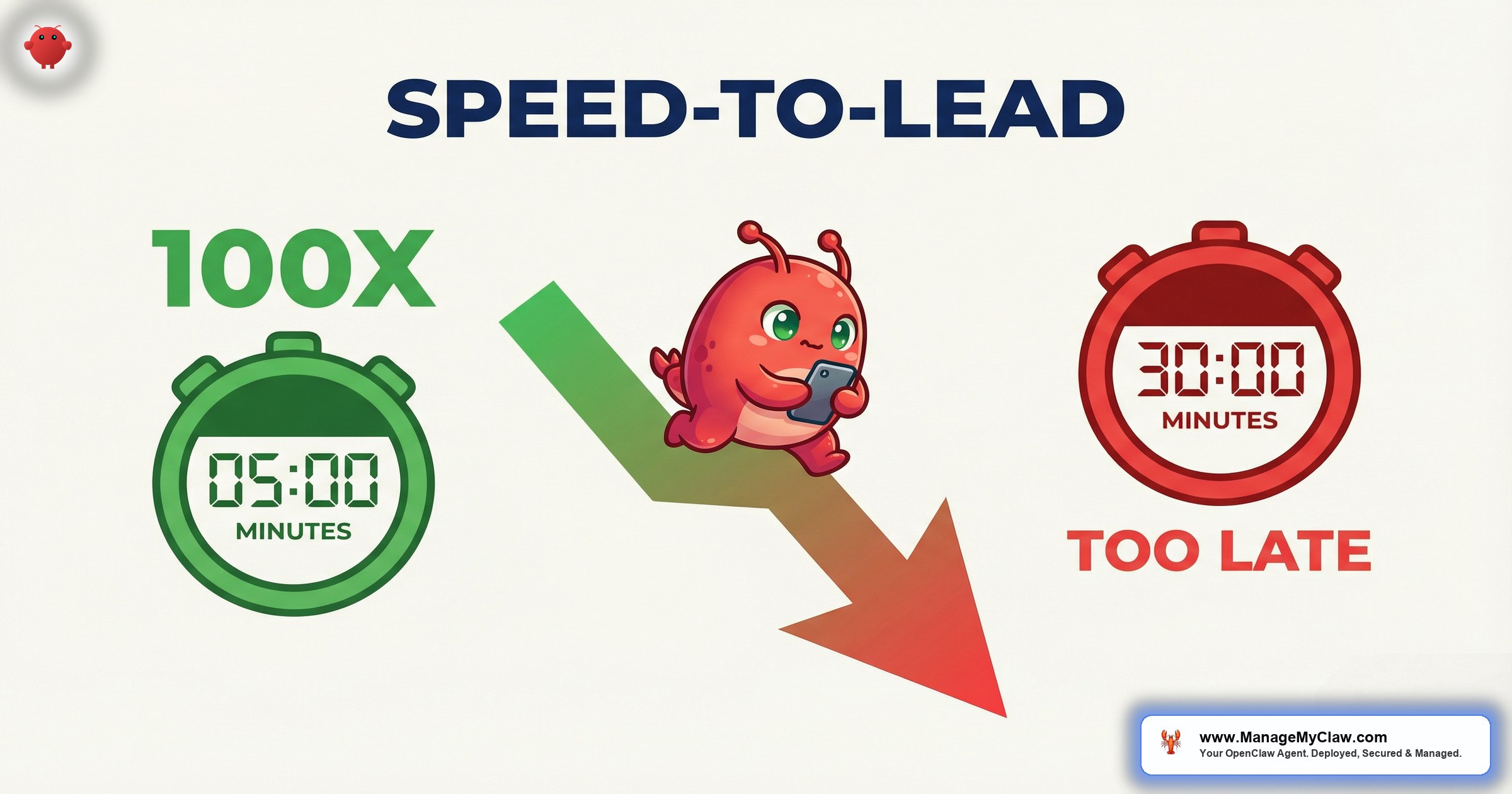
Speed to lead in real estate isn’t a buzzword. It’s the single most measurable predictor of whether a lead converts into an appointment, a showing, and eventually a closing. The data comes from MIT’s study with InsideSales.com — the largest analysis of lead response timing ever conducted — and it shows that contacting a lead within 5 minutes is 100 times more effective than waiting 30 minutes. Not 2x. Not 10x. A hundred times.
OpenClaw is an open-source AI agent framework that runs on bare-metal infrastructure under systemd — your server, your data, no vendor lock-in. For real estate agents, it functions as a 24/7 lead response layer: parsing inquiries from Zillow, Realtor.com, your website, and email, then drafting and sending personalized responses before you’ve finished your showing.
Here’s the part that stings. You already know speed matters. Every agent does. The problem isn’t awareness — it’s that you’re physically showing a $750K listing when the $1.2M buyer submits their inquiry. You can’t respond in 5 minutes if you’re standing in someone else’s kitchen.
This post breaks down the verified research behind speed to lead real estate conversion, quantifies what slow response costs in lost commission, and shows how agents use OpenClaw to eliminate the gap between when a lead arrives and when it gets a response.
The Math Behind Response Time: What MIT Actually Found
The MIT / InsideSales.com study analyzed over 100,000 call attempts across multiple industries and measured 2 things: the probability of making contact with a lead and the probability of qualifying that lead. Both metrics collapsed with time.
The numbers aren’t subtle:
- Contact odds drop 100x at 30 minutes vs 5 minutes. If you reach 90 out of 100 leads at the 5-minute mark, you’re reaching fewer than 1 at the 30-minute mark.
- Qualifying odds drop 21x at 30 minutes vs 5 minutes. Even when you do make contact after 30 minutes, the lead is 21 times less likely to convert into a qualified prospect.
- 8x conversion rate when contact happens in the first 5 minutes vs 5–24 hours (InsideSales 2021 follow-up study).
Think of it like fresh bread. At 5 minutes out of the oven, everyone wants a slice. At 30 minutes, it’s still fine. At 2.5 hours, it’s room-temperature and sitting next to 6 other loaves someone else dropped off.
And then there’s the number that should keep every agent up at night: 78% of buyers work with the first agent who responds. Not the best agent. Not the most experienced agent. Not the agent with the highest Google reviews. The first one who picked up the phone or replied to the email.
The MIT data was cross-industry, but real estate amplifies the effect. A buyer inquiring about a property has high intent — they’ve already searched listings, compared prices, and narrowed their criteria. That intent degrades faster than in most industries because there are dozens of agents competing for the same lead on every portal. Speed isn’t just about conversion. It’s about being the only agent the buyer ever talks to.
What 2.5 Hours Actually Costs You in Lost GCI
Shift AI’s case study on real estate lead response quantified what most agents try not to think about: the average agent response time is 2.5 hours. And more than 40% of leads never get a follow-up within 24 hours at all.
Let’s do the commission math on what that delay costs a mid-production agent.
| Metric | Slow Response (2.5 hrs) | Fast Response (under 5 min) |
|---|---|---|
| Monthly portal leads | 40 | 40 |
| Contact rate | ~12% (after decay) | ~60% |
| Leads contacted | 5 | 24 |
| Appointment rate (of contacted) | 25% | 25% |
| Appointments/month | 1.25 | 6 |
| Close rate (of appointments) | 20% | 20% |
| Closings/year | 3 | 14.4 |
| GCI at $8K avg commission | $24,000 | $115,200 |
The difference is $91,200 per year in gross commission income. And that’s conservative — it assumes the same appointment-to-close rate regardless of speed. In reality, faster response also correlates with higher close rates because you’re catching buyers at peak motivation.
Shift AI pegged the number at $1M+ per year in missed GCI for a team of 8–10 agents at typical response speeds. For a solo agent, recovering 3–4 additional closings per year adds $24,000–$32,000 to your income. That’s not a marketing investment. That’s money already in your pipeline that you’re losing to the clock.
It’s like running a restaurant where 40% of the customers who walk in leave before anyone takes their order. The food is great. The ambiance is great. Nobody’s working the host stand.
You’re Not Lazy. You’re at a Showing.
The 2.5-hour average isn’t a discipline problem. It’s structural. You’re out of the office when you’re doing your highest-value work: showings, listing appointments, inspections, closing tables. Here’s a typical Tuesday for an agent handling 6–8 deals:
- 9:00 AM — Listing presentation (you can’t check your phone mid-pitch)
- 10:30 AM — Showing 3 properties with a buyer (90 minutes in the car and walking through homes)
- 12:00 PM — Lunch and catching up on 47 emails, 12 texts, 3 portal leads
- 1:30 PM — Inspection at a property under contract (2 hours)
- 3:30 PM — Drive to the office, finally open the CRM
- 4:00 PM — Respond to the lead that came in at 10:15 AM — 5 hours and 45 minutes ago
That buyer from 10:15 AM? They submitted inquiries on 3 portals. 2 agents responded within 8 minutes. By 10:30 AM, the buyer had a call scheduled. By 4:00 PM, they’d already done a virtual showing. 78% of buyers work with the first agent who responds. You lost this lead because you were doing your job while the lead timer was ticking.
Speed to lead real estate data shows the damage isn’t just per-lead — it compounds. Every lost lead is also a lost referral source. An agent who converts 14 portal leads into closings per year generates 3–5 referrals from those clients. An agent who converts 3 generates maybe 1. Over 3 years, the gap in your referral network becomes a gap that no amount of ad spend can close.
How OpenClaw Responds to Leads While You’re at Showings
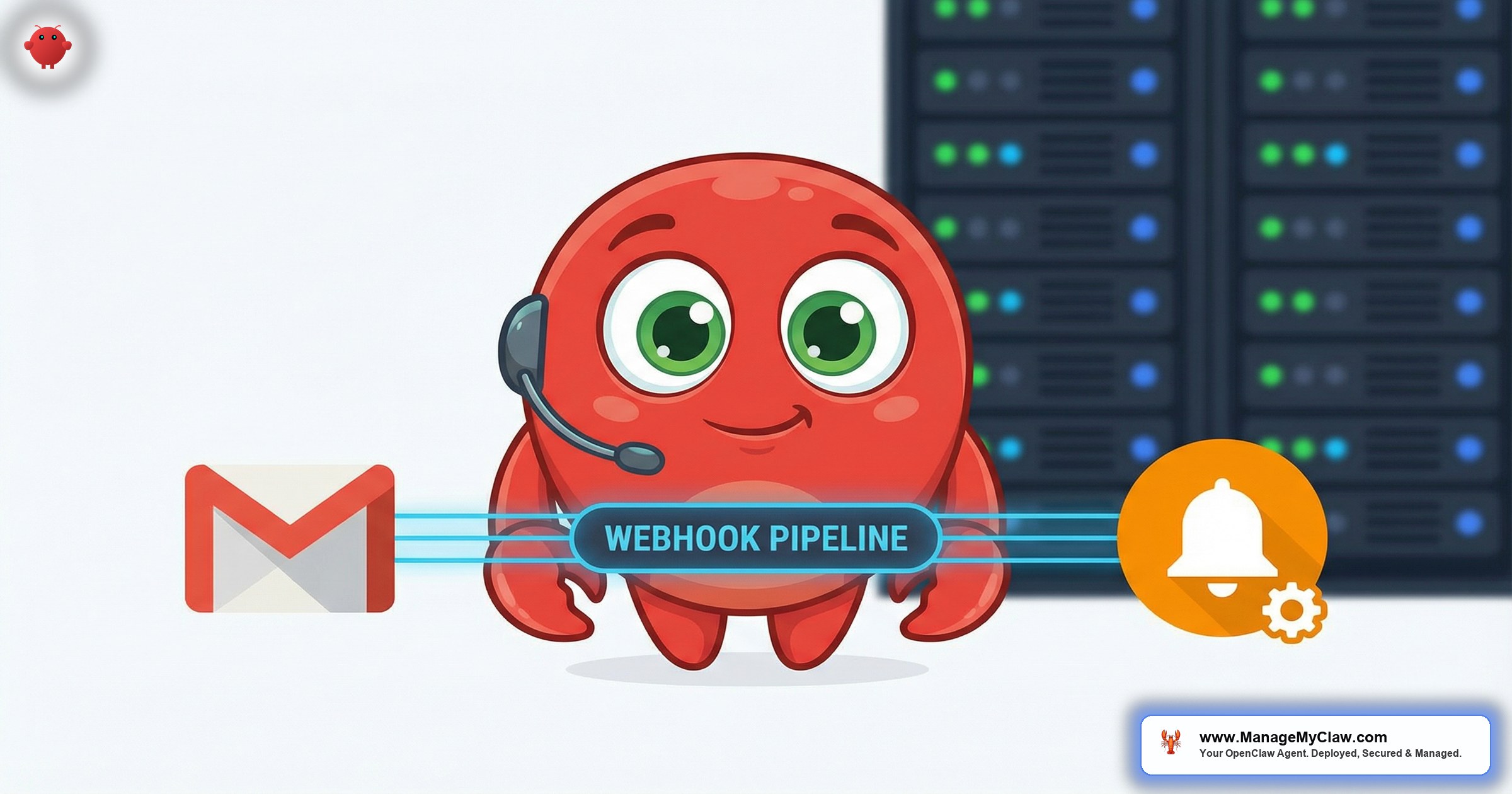
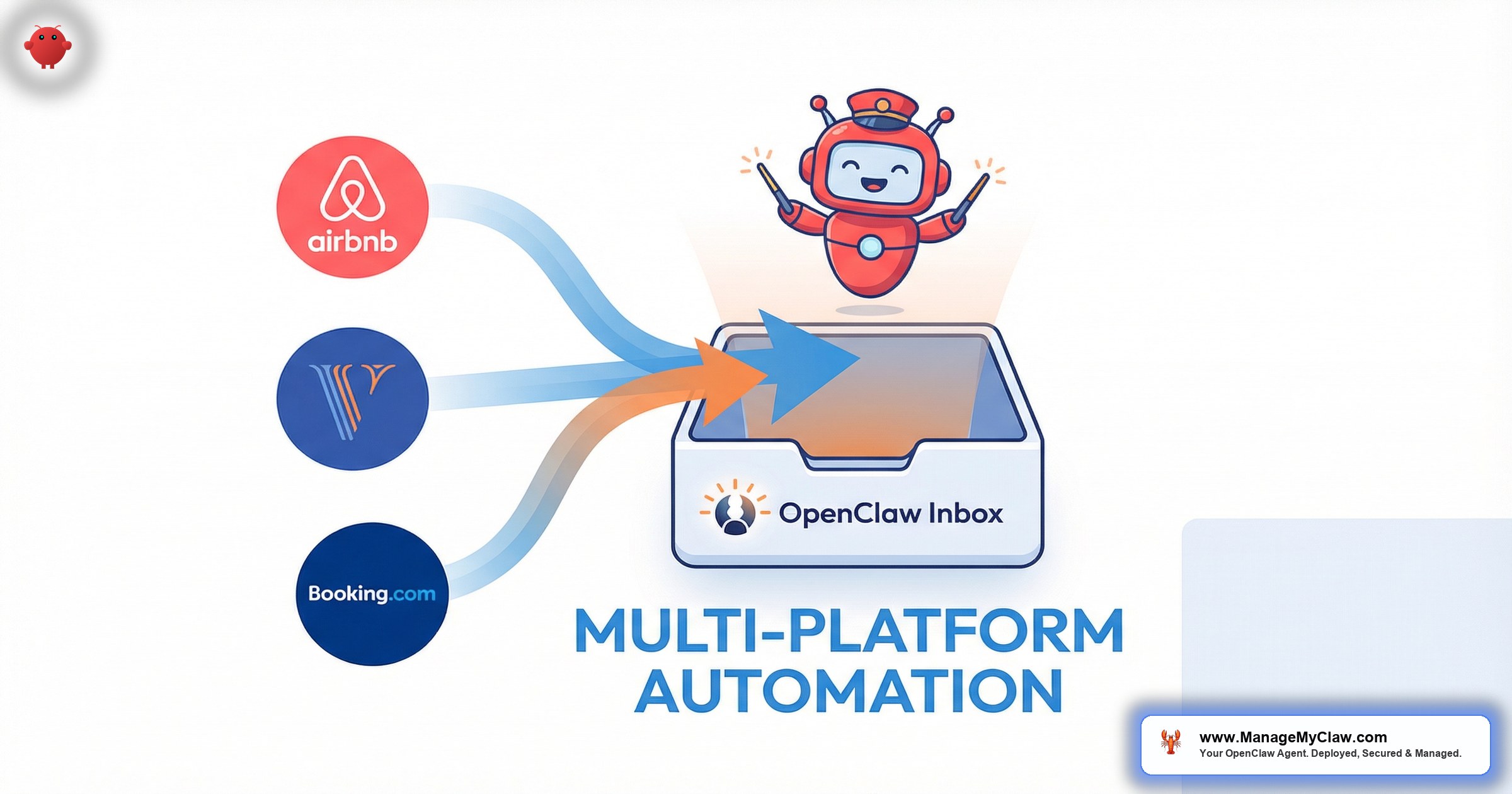
OpenClaw doesn’t replace you in the conversation. It buys you time. When a lead hits your pipeline — Zillow, Realtor.com, your website, email — the agent reads the inquiry, identifies the property, and sends a personalized response within seconds. Not a generic autoresponder. A response that references the specific listing and sets up the next step.
- Lead arrives (webhook from portal or email via Gog OAuth). OpenClaw parses the sender, property address, and any criteria mentioned.
- Instant acknowledgment (under 30 seconds). Personalized response referencing the listing, confirming availability, and asking a qualifying question: budget, timeline, pre-approval status.
- Qualification loop. If the buyer replies, OpenClaw continues — answering property questions from MLS data, confirming showing times from your calendar, collecting what you’d gather in a 10-minute phone call.
- Handoff. Once qualified, you get a summary: buyer name, budget, timeline, property interest, pre-approval status. Full context, no cold call.
It’s not about the AI being a better salesperson than you. It’s about the AI being available at 10:15 AM when you’re walking through a living room explaining hardwood floor refinishing options to another buyer.
The NAR 2025 Member Profile shows that 68% of agents have already adopted AI tools. RPR’s February 2026 data pushes that to 82%. The adoption curve isn’t coming — it’s here. The agents who haven’t configured automated lead response aren’t competing against agents with better marketing. They’re competing against agents whose leads never go unattended.
Response Method Comparison
| Method | Avg Response Time | Personalized? | Available 24/7? | Cost/Month |
|---|---|---|---|---|
| Manual (agent checks phone) | 2.5 hours | Yes | No | $0 |
| Generic autoresponder | Instant | No | Yes | $0–$50 |
| ISA (Inside Sales Agent) | 5–15 min | Yes | Business hours only | $2,500–$4,000 |
| Proprietary AI platform | Under 1 min | Semi | Yes | $300–$800 |
| OpenClaw (self-hosted) | Under 30 sec | Yes | Yes | $42–$84 |
The generic autoresponder is fast but hurts you — buyers know a template when they see one, and it doesn’t advance the conversation. An ISA is personalized but costs $30K–$48K per year and only works business hours. OpenClaw hits the intersection: personalized, instant, 24/7, at a fraction of the ISA cost. (For a deeper breakdown of how this compares to proprietary platforms in the real estate space, see ManageMyClaw vs WorkReadyAI.)
Faster Response Creates a Flywheel You Can’t Buy with Ads
The ROI of speed to lead real estate optimization isn’t just the direct conversion lift. It’s the compound effect that builds over 12–24 months.
- Faster response → more appointments. 24 contacts per month instead of 5. Same lead volume, same ad spend, 4.8x more conversations.
- More appointments → more closings. At a 20% close rate, that’s 14 closings per year instead of 3.
- More closings → more referrals. Every closed client generates 0.3–0.5 referrals over the next 2 years. 14 closings produce 4–7 referrals. 3 closings produce 1–2.
- More referrals → lower acquisition cost. Referral leads convert at 3–5x the rate of portal leads and cost nothing to acquire.
It’s the difference between rolling a snowball down a hill and carrying it. Both get you to the bottom. One of them is 20 feet wide when it arrives.
Year 1: +11 closings = +$88K GCI. Year 2: those clients generate 4–5 referrals = +$32K–$40K at zero acquisition cost. Year 3: the referral network compounds again. Same market. Same portals. Same ad spend. Different infrastructure.
The Leads Are Already There. The Clock Is Already Running.
You don’t have a lead generation problem. The portals are sending you buyers. The math from MIT, InsideSales, and Shift AI all converge on the same point: the bottleneck isn’t at the top of your funnel. It’s in the 2.5 hours between when a lead arrives and when you respond.
82% of agents are now using AI tools (RPR, February 2026). The ones with automated lead response aren’t working harder. They’re capturing the leads you’re losing while you’re at showings. The investment to fix this — $42–$84/month self-hosted, or a one-time managed deployment to have it up and running tonight — is nowhere near the $91K+ in annual GCI you’re leaving on the table.
78% of buyers work with the first agent who responds. If that agent isn’t you — every single time — the marketing spend, the reviews, and the experience don’t matter. Somebody faster already has the appointment.
Frequently Asked Questions
Does automated response actually work, or do buyers know it’s AI?
The key is personalization. OpenClaw references the specific property, asks a qualifying question, and continues the conversation based on replies. Most buyers don’t care whether the initial response was human or AI — they care that someone acknowledged them and made it easy to take the next step. The handoff to you happens with full context.
How does OpenClaw get my leads from Zillow and Realtor.com?
Portal leads typically arrive via email notification. OpenClaw connects to your email through Gog OAuth — encrypted middleware that never exposes your raw credentials. When a lead email arrives, the agent parses the inquiry and triggers the response sequence. For CRMs with webhook support (Follow Up Boss, kvCORE), triggers can bypass email entirely for even faster response.
What if the AI says something wrong about a property?
OpenClaw pulls property data from your connected sources — MLS data, CRM records, listing information. It doesn’t fabricate details. The initial response confirms basic listing data and asks qualifying questions rather than making claims. You can run draft-review mode for the first 2–4 weeks, then enable auto-send for categories you trust.
I already have a CRM with auto-reply. Why do I need this?
CRM auto-replies are template-based — the same message regardless of property or inquiry. They don’t continue the conversation or collect qualifying data. OpenClaw reads the inquiry, crafts a property-specific response, qualifies the buyer through conversation, and hands you a ready-to-call lead with budget, timeline, and intent already collected.
What does this cost compared to hiring an ISA?
An ISA costs $2,500–$4,000/month, works business hours only, and handles 50–80 leads per day. OpenClaw runs 24/7 at $42–$84/month, handles unlimited concurrent leads, and scales without additional cost. For a managed deployment, setup starts at $499 one-time with the agent up and running the same day.
How fast can I get this set up?
Self-deployment on bare-metal with systemd takes 10–15 hours if you’re comfortable with server configuration, Gog OAuth, and API integrations. A ManageMyClaw managed deployment has your agent up and running in under 60 minutes from onboarding form submission — VPS provisioned, security hardened, email connected, and lead response workflows configured. No phone call required.
See how ManageMyClaw works — from initial setup to your first automated response.